A collision with a large commercial truck can be devastating. When a truck driver or their company is responsible for a crash, they should be held accountable. Proving this responsibility often comes down to evidence, and one of the most powerful pieces of evidence is stored in a small electronic device. Understanding the role of Electronic Logging Device (ELD) data in Washington truck crashes is crucial, as this digital proof can reveal the truth that trucking and insurance companies may not want you to see.
This information is often the key to demonstrating negligence—a legal term for the failure to use reasonable care, resulting in harm to another person. It can provide a clear, minute-by-minute account of a driver’s actions leading up to a collision, cutting through the confusion and conflicting stories that often arise.
If you were injured in a commercial truck crash, a skilled Seattle truck accident lawyer can secure critical ELD evidence and fight for your compensation—contact us today for a free consultation.
Key Takeaways about ELD Data in Washington Truck Crashes
- Electronic Logging Devices (ELDs) automatically record a commercial truck driver’s driving hours, vehicle speed, and location, providing unbiased data.
- This data is critical for proving violations of federal Hours of Service (HOS) rules, which are designed to prevent accidents caused by driver fatigue.
- Trucking companies and their insurers may be hesitant to share ELD data because it can provide clear evidence of liability in a crash.
- It is vital to act quickly after an accident to send a legal notice, called a spoliation letter, to ensure this electronic evidence is preserved.
- Analysis of ELD records can help reconstruct the events of a crash and counter any inaccurate claims made by the truck driver or their employer.
What Exactly Is an Electronic Logging Device (ELD)?
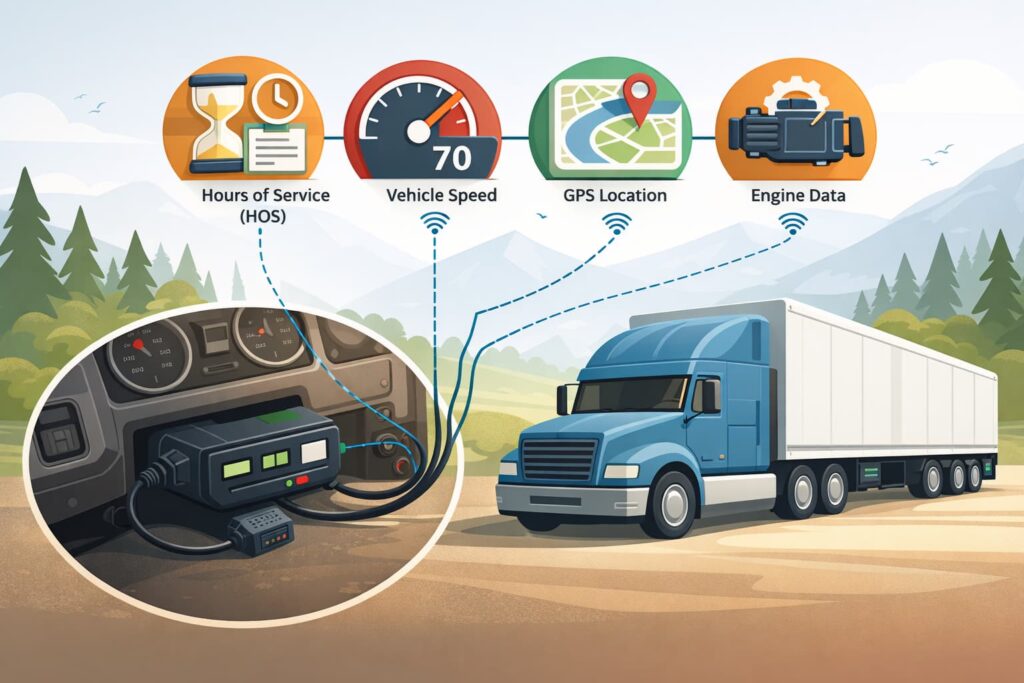
Think of an Electronic Logging Device, or ELD, as a “black box” for a commercial truck. It’s a small piece of technology that connects directly to the truck’s engine. The Federal Motor Carrier Safety Administration (FMCSA) mandates that most commercial trucks use these devices. The purpose of the ELD rule is to create a safer work environment for drivers and make our roads in Washington and across the country safer by tracking and enforcing important safety rules.
Unlike old-fashioned paper logbooks that could be easily falsified, an ELD automatically and accurately records a massive amount of data. This information provides an objective look into the truck’s operation and the driver’s conduct.
An ELD captures essential details such as:
- Hours of Service (HOS): It tracks precisely when the driver is on-duty, off-duty, and actively driving.
- Vehicle Speed: The device records the truck’s speed at all times, which can show if the driver was speeding before the crash.
- GPS Location: It provides a detailed location history, allowing for a precise reconstruction of the truck’s route.
- Engine Data: This includes when the engine is turned on or off, how many miles have been driven, and engine hours.
This collection of data creates a digital footprint that is incredibly difficult to argue with, providing a clear and unbiased record of events.
The Federal “Hours of Service” Rules: Why They Matter in Washington
One of the biggest dangers on our roads, from the I-90 corridor to rural state routes, is a tired truck driver. Driver fatigue is a factor in a significant number of serious truck accidents. To combat this, the FMCSA has established strict regulations known as the Hours of Service (HOS) rules. These rules set limits on how long a commercial truck driver can work and drive before they are required to take a break.
The ELD is the primary tool for enforcing these rules. It automatically logs a driver’s time, making it clear when a violation occurs. An insurance company might want to claim their driver was well-rested and alert, but the ELD data doesn’t lie.
Here are some of the key HOS limits that ELD data tracks:
- 11-Hour Driving Limit: A driver can drive a maximum of 11 hours after 10 consecutive hours off duty.
- 14-Hour Limit: A driver may not drive beyond the 14th consecutive hour after coming on duty, following 10 consecutive hours off duty.
- 30-Minute Driving Break: Drivers must take a 30-minute break when they have driven for 8 cumulative hours without at least a 30-minute interruption.
- 60/70 Hour Limit: A driver cannot be on duty for more than 60 hours in 7 consecutive days or 70 hours in 8 consecutive days.
When ELD data shows a driver exceeded these limits before a crash, it becomes powerful evidence that fatigue was likely a contributing factor, strengthening the case for negligence.
How Electronic Logging Device (ELD) Data Can Build Your Washington Truck Crash Case
After a serious truck accident, the insurance company for the trucking firm may try to settle quickly for a low amount or argue that their driver was not at fault. The ELD data is your tool to establish the facts and hold the responsible parties accountable. A skilled legal team can analyze this data to build a strong foundation for your claim.
Proving Driver Fatigue and HOS Violations
This is the most direct application of ELD data. If the records show the driver was on the road for 12 straight hours before crashing on the wet roads of Snoqualmie Pass, it creates a strong presumption of negligence. It proves the driver and the trucking company broke federal safety laws designed specifically to prevent these kinds of incidents. This moves the focus from a “he said, she said” argument to one based on hard, undeniable facts.
Reconstructing the Moments Before the Crash
ELD data goes beyond just tracking hours. It provides a second-by-second timeline that can be used to reconstruct the accident.
- Speeding: Did the driver exceed the speed limit? Was their speed unsafe for the rainy conditions common around Puget Sound? The ELD will show their exact speed leading up to the point of impact.
- Sudden Braking or Swerving: While the ELD itself might not show brake application (other devices do), the GPS and speed data can show erratic movements or a failure to slow down when approaching traffic.
- Location Inconsistencies: Was the truck where it was supposed to be? GPS data can reveal if the driver took an unauthorized detour or was in an area where large trucks are restricted.
This detailed information helps paint a complete picture for a judge or jury, showing exactly how the driver’s actions contributed to the collision.
Contradicting the Official Story
Often, a truck driver’s initial report of an accident may omit key details or present a version of events that minimizes their fault. They might claim they were well-rested and driving carefully. The ELD data serves as an impartial witness that can directly contradict these claims.
If a driver states they had just started their shift, but the ELD shows they had been driving for 10.5 hours, their credibility is immediately called into question. This can be a turning point in a personal injury case.
Why Insurance Companies May Resist Handing Over ELD Data
If ELD data is so useful, why isn’t it always easy to get? The answer is simple: the data often contains incredibly damaging information for the trucking company and its insurer. It can unequivocally prove fault, which means the insurance company would be responsible for paying fair compensation for medical bills, lost wages, and other damages. Because of this, they may use tactics to delay or avoid producing this critical evidence.
Some common roadblocks include:
- Delay Tactics: The insurer or trucking company might ignore initial requests or take an unreasonable amount of time to respond, hoping you will give up or accept a low settlement offer.
- Claims of Lost Data: They may claim that due to a technical glitch or an error, the data from the time of the accident is corrupted or unavailable.
- Providing Incomplete Records: They might turn over a summary or a partial report instead of the full, raw data file, leaving out the most critical information about the moments before the crash.
Overcoming these challenges often requires swift legal action to formally demand the preservation and production of all relevant electronic data.
The Critical Window: Preserving ELD Evidence
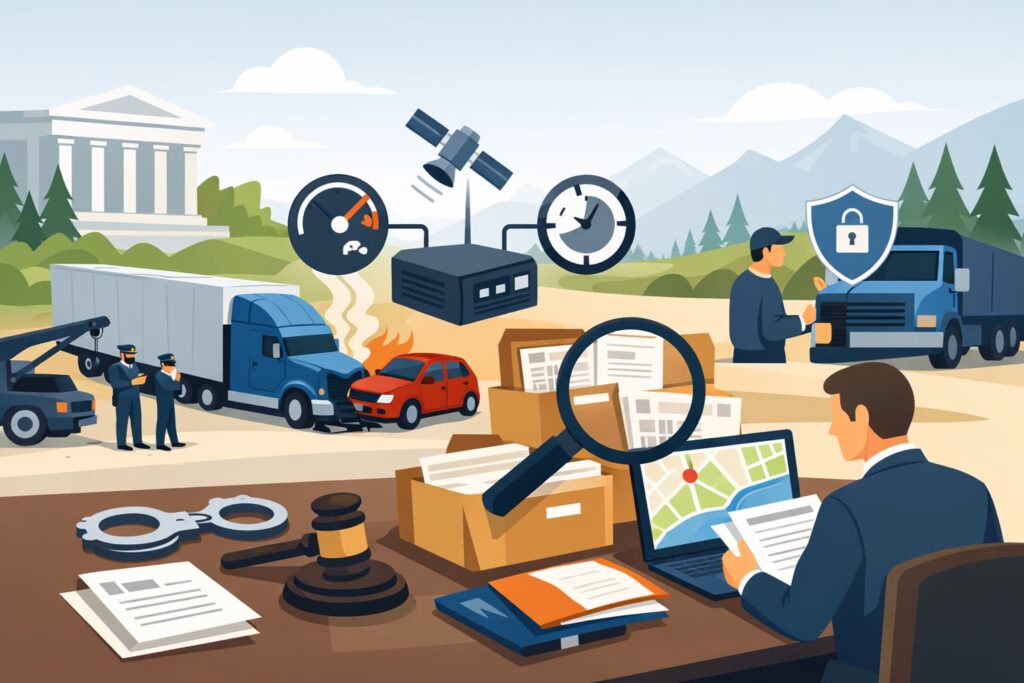
Time is of the essence after a truck crash. Federal regulations only require trucking companies to retain HOS records and supporting documents for six months. After that, they can legally destroy them. If you wait too long to act, the most important piece of evidence in your case could be gone forever.
This is why one of the first steps a Seattle personal injury attorney will take is to send a “spoliation letter.” This is a formal legal notice sent to the trucking company and its insurance provider, instructing them not to destroy any evidence related to the crash. This includes the ELD data, driver logs, maintenance records, driver qualification files, and post-crash drug and alcohol test results. Sending this letter creates a legal duty for them to preserve the evidence. If they destroy it after receiving the notice, they could face serious penalties from the court.
Beyond the ELD: Other “Black Box” Data in Commercial Trucks
While the ELD is a powerful tool, it’s not the only “black box” on a modern commercial truck. Many trucks are also equipped with an Event Data Recorder (EDR). An EDR is more focused on the crash event itself.
Think of it this way:
- ELD: Records the driver’s entire shift, focusing on hours, speed, and location over a long period.
- EDR: Records the truck’s operational data in the final seconds before, during, and after a crash.
An EDR can capture information like steering wheel angle, brake application, throttle position, and seatbelt use. When combined, ELD and EDR data can provide a comprehensive and nearly irrefutable account of how and why an accident occurred.
ELD Data in Washington Truck Crashes FAQs
Here are answers to some common questions about the role of electronic data in truck accident claims.
Can a trucking company legally delete or alter ELD data after a crash?
No. Intentionally altering, concealing, or destroying ELD data, especially after being notified of a potential legal claim, is illegal and known as spoliation of evidence. Courts can issue severe sanctions against a company that does this, which may include instructing the jury to assume the destroyed evidence was unfavorable to the trucking company.
What if the truck in my accident was older and didn’t have an ELD?
While most commercial trucks are required to have ELDs, there are some exceptions, particularly for trucks manufactured before the model year 2000. In these cases, the driver may have been using paper logbooks. An attorney can still demand those logs, along with other evidence like fuel receipts and dispatch records, to reconstruct the driver’s activities and check for HOS violations.
How does Washington state law interact with federal ELD regulations?
Washington State has adopted the Federal Motor Carrier Safety Regulations as its own. This means that all federal rules regarding ELDs and Hours of Service are fully enforceable on state highways and interstates within Washington. A violation of a federal HOS rule is also a violation of Washington state law.
Does ELD data show if a driver was on their cell phone?
An ELD itself does not record cell phone usage. However, the data can provide clues. For example, if the GPS data shows the truck drifting or its speed is erratic right before the crash, it could suggest driver distraction. This data, combined with a legal request for the driver’s cell phone records, can be used to prove distracted driving.
How long does it take to get ELD data after a formal request?
The timeline can vary. If a trucking company cooperates after receiving a preservation letter, the data may be produced within a few weeks. However, if the company or its insurer resists, it may be necessary to file a lawsuit and use the discovery process—the formal process of exchanging information between parties—to obtain a court order compelling them to turn over the data.
Let Us Handle the Fight for Evidence
The moments, days, and weeks following a serious truck accident can be difficult. As you focus on your physical and emotional recovery, the last thing you need is a battle with a large insurance corporation over critical evidence like ELD data. The legal team at Boohoff Law, P.A. understands what’s at stake and is prepared to act quickly to preserve the proof needed for your case.
We will get you through this. Our attorneys have decades of combined experience holding negligent trucking companies accountable. We will send the necessary legal notices to protect the evidence, work with forensic specialists to analyze the complex data, and build a case designed to secure the full and fair compensation you are entitled to.
Your consultation is always free, and you will never pay us a fee unless we win your case. Contact us today at (877) 999-9999 or through our online form to learn more about your rights and options. We are here to help.

Free Consultation
We Are Here For You 24/7
Reviews

– Elissa M.
“Really pleased with Boohoff Law! Received immediate responses when I had any questions. Treated amazingly by all staff … made this process a true breeze!”
– Caitlyn M.
– Brandy K.
Related Posts
Who Is Liable for a Trailer Detachment Accident in Washington?
Who’s Liable in a Lumber Truck Accident Near Olympia, WA?
What to Do When Your Total Loss Offer Is Too Low in Olympia, WA
Recovery is personal.
We’re here for you.
We’re close by. And if you can’t make it to us, we’ll meet you where you need us, at home or in the hospital.













© 2025 Boohoff Law, P.A. — Auto Accident Lawyers.
The information on this website is for general information purposes only. Nothing on this site should be taken as legal advice for any individual case or situation. This information is not intended to create, and receipt or viewing does not constitute, an attorney-client relationship.
Disclaimer: The results and testimonials presented on this website are based on the unique facts and circumstances of each case. Past results do not guarantee or predict similar outcomes in future cases. Every legal matter is different, and you should not rely on prior case results as an expectation of future performance.
