The stretch of Interstate 5 that winds past Joint Base Lewis-McChord and through the Nisqually Valley toward Olympia is more than just a critical artery for Washington commerce; it’s a daily reality for thousands of commuters and a known hotspot for devastating large truck accidents. The combination of heavy commercial traffic, daily commuters, and challenging road designs creates a high-risk environment.
I-5 Mounts Road truck accident claims are far more complicated than a standard car crash claim. They involve powerful corporate interests, complex federal regulations, and significant potential for life-altering injuries. Pursuing fair compensation requires a detailed understanding of the trucking industry and the specific laws that govern it.
After a serious crash on I-5 near Mounts Road, an experienced Seattle truck accident lawyer can take on trucking companies and protect your rights—contact us today for a free consultation.
Key Takeaways about I-5 Mounts Road Truck Accident Claims
- The I-5 corridor near Mounts Road and Olympia is a high-risk area for accidents involving commercial trucks due to high traffic volume, road configuration, and proximity to major logistics hubs.
- Truck accident claims are substantially different from car accident claims because they often involve multiple potentially responsible parties, such as the driver, the trucking company, and maintenance contractors.
- Federal regulations from the Federal Motor Carrier Safety Administration (FMCSA) play a significant role in establishing the standard of care for truck drivers and their employers.
- Crucial evidence in these claims can include electronic logging devices (ELDs or “black boxes”), driver qualification files, and vehicle inspection reports.
- Under Washington’s laws, injured individuals may seek compensation for medical expenses, lost income, property damage, and the personal impact of their injuries.
- The state’s comparative fault system can influence the total compensation an injured person receives if they are found to be partially responsible for the crash.
Why Is the I-5 Corridor Near Mounts Road So Prone to Truck Accidents?
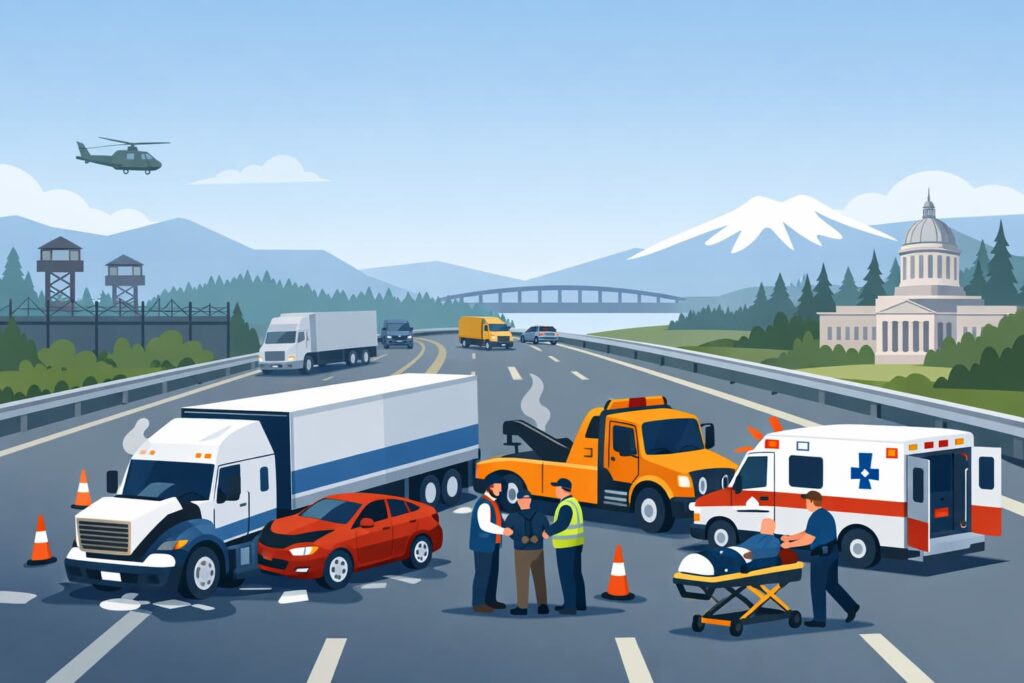
Anyone who regularly drives from Tacoma south toward the state capitol in Olympia knows the feeling of tension that can build on I-5, especially around the Mounts Road exit and the Nisqually River Bridge. This particular segment of the interstate has a reputation for a reason. Several factors converge here to create a uniquely hazardous environment for all drivers, particularly when sharing the road with 80,000-pound commercial vehicles.
First, this area handles an immense volume of traffic. It’s a primary route connecting the major ports of Seattle and Tacoma with points south, meaning it is constantly filled with semi-trucks, delivery vans, and other commercial vehicles. This commercial flow mixes with a high number of daily commuters and military personnel from Joint Base Lewis-McChord (JBLM), creating dense, often fast-moving traffic patterns that leave little room for error.
Second, the road’s design presents its own challenges. The curves, grades, and merging lanes around the Nisqually Delta and the approach to Olympia require constant driver attention. When a truck driver is fatigued or distracted for even a moment, these design elements can quickly turn a minor mistake into a multi-vehicle pileup. Congestion is a near-daily occurrence, leading to abrupt stops and starts that are particularly dangerous for heavy trucks with much longer stopping distances than passenger cars.
These conditions are a recipe for serious collisions, making I-5 Mounts Road truck accidents a frequent and unfortunate reality.
Understanding What Makes I-5 Mounts Road Truck Accident Claims So Complex
A collision with a commercial truck isn’t just a bigger version of a car accident; the legal process for seeking accountability is fundamentally different. While a car crash claim typically involves you, the other driver, and your respective insurance companies, a truck accident claim opens up a much wider field of potentially liable parties and a deeper well of evidence to investigate.
More Than Just the Driver: Identifying Liable Parties
In the world of commercial trucking, the driver behind the wheel is often just one piece of a larger corporate puzzle. A thorough investigation may reveal that several different entities share responsibility for the crash.
- The Trucking Company (Motor Carrier): The carrier is responsible for hiring, training, and supervising its drivers. They can be held liable for negligent hiring (like hiring a driver with a poor safety record) or for pushing drivers to violate safety rules to meet deadlines.
- The Cargo Owner or Loader: If the truck’s cargo was improperly loaded, balanced, or secured, it can shift during transit, causing the driver to lose control. The company that loaded the freight may be held partially or fully responsible.
- The Truck or Parts Manufacturer: If the accident was caused by a mechanical failure, such as brake failure or a tire blowout, the manufacturer of the truck or the specific faulty component could be liable under product liability laws.
- Maintenance and Repair Facilities: Trucking companies often outsource their vehicle maintenance. If a third-party mechanic performed a faulty repair or failed to identify a critical safety issue, that business could also be held accountable.
Identifying all responsible parties is a critical step, as it can provide multiple avenues for securing the compensation needed to cover the full extent of your injuries and losses.
Federal vs. State Regulations: A Different Set of Rules
The trucking industry is governed by a complex web of federal and state laws designed to keep our roads safe. The Federal Motor Carrier Safety Administration (FMCSA) sets nationwide standards for everything from how long a driver can be on the road to the type of insurance a carrier must have.
These regulations are incredibly important in a truck accident claim. For example, the FMCSA’s Hours-of-Service rules dictate strict limits on driving time to prevent driver fatigue. If an investigation shows the driver violated these rules, it can be powerful evidence of negligence.
Other regulations cover vehicle inspections, driver qualifications, and drug and alcohol testing. A violation of any of these safety standards can be a key factor in proving that a trucking company’s carelessness contributed to the collision.
Common Causes of Commercial Truck Crashes in Washington
While every accident is unique, investigators often find that they stem from a handful of recurring issues. Understanding these common causes helps in building a strong claim by focusing the investigation on the most likely points of failure.
- Driver Fatigue: As mentioned, federal rules exist to prevent drowsy driving, yet it remains a leading cause of truck crashes. Economic pressure can lead drivers and their companies to push the limits, with devastating consequences.
- Distracted Driving: Using a cell phone, adjusting a GPS, or even eating while driving can pull a driver’s attention from the road. For someone operating a vehicle that weighs tens of thousands of pounds, a few seconds of inattention can cover the length of a football field.
- Improper Cargo Loading: An unbalanced or overloaded trailer can make a truck difficult to control, especially during turns, sudden stops, or in high winds along the I-5 corridor.
- Poor Vehicle Maintenance: Worn-out brakes, bald tires, and malfunctioning lights are all preventable issues. Trucking companies have a duty to keep their fleets in safe, working order through regular inspections and repairs.
- Speeding or Reckless Driving: To meet tight delivery schedules, some drivers may exceed the speed limit or engage in aggressive behaviors like tailgating or unsafe lane changes. On a congested highway like I-5, this behavior is exceptionally dangerous.
These failures represent breaches of the duty of care that truck drivers and their employers owe to everyone else on the road.
What Kind of Compensation Can You Pursue in a Truck Accident Claim?

The goal of a personal injury claim is to provide the financial resources necessary to make you whole again, at least as much as money can. This compensation, legally referred to as “damages,” is designed to cover both the tangible and intangible losses you have suffered. In Washington, damages are typically categorized in two ways.
Economic Damages are the direct, calculable financial losses resulting from the accident. They include:
- All medical bills, from the initial emergency response to future physical therapy or long-term care
- Lost wages from time you were unable to work during your recovery
- Loss of future earning capacity if your injuries prevent you from returning to your previous job
- The cost of repairing or replacing your vehicle and any other damaged property
Non-Economic Damages are meant to compensate you for the profound personal and emotional impact of the crash. These losses don’t have a clear price tag but are just as real. They may include:
- Pain and suffering
- Emotional distress and mental anguish
- Loss of enjoyment of life or inability to participate in hobbies
- Disfigurement or permanent scarring
It is important to note that Washington follows a “pure comparative fault” rule. Under this rule, you can still recover damages even if you are found to be partially at fault for the accident. However, your total compensation award will be reduced by your percentage of fault. For instance, if you were found to be 10% at fault, your final award would be reduced by 10%.
Steps to Protect Your Rights
The days and weeks following a serious collision are often confusing and difficult. While you focus on your physical and emotional health, there are a few simple things you can do to protect your ability to pursue a fair claim later on. This is not about being at the scene, but about managing the process once you’ve received initial medical care.
- Create a File for Everything: Keep all accident-related documents in one place. This includes medical bills, repair estimates, letters from insurance companies, and receipts for any out-of-pocket expenses like prescriptions or transportation to doctors’ appointments.
- Document Your Recovery Journey: Keep a simple journal to track your pain levels, medical appointments, and how your injuries are affecting your daily life. This can be valuable for demonstrating the extent of your non-economic damages.
- Stay Off Social Media: It is best to avoid posting any information, photos, or opinions about the accident or your recovery online. Insurance companies often search social media for any evidence they can use to argue that your injuries are not as severe as you claim.
- Be Careful with Insurance Adjusters: The trucking company’s insurance adjuster may contact you very soon after the crash. They may seem friendly, but their job is to minimize the amount their company has to pay. You are not obligated to give them a recorded statement before speaking with a legal representative.
Taking these steps can help preserve important information and prevent you from accidentally saying something that could harm your claim down the road.
I-5 Mounts Road Truck Accident Claim FAQs
Here are some answers to common questions people have after being involved in a commercial truck crash in Washington.
What is the statute of limitations for a truck accident claim in Washington?
In Washington state, the statute of limitations for most personal injury claims, including those from truck accidents, is three years from the date of the incident. This means you generally have three years to either settle your claim or file a lawsuit. If you miss this deadline, you may lose your right to seek compensation forever.
How is a truck’s “black box” data used in a claim?
A truck’s electronic logging device (ELD) or event data recorder (EDR), often called a “black box,” records critical information about the truck’s operation, such as its speed, braking activity, and steering inputs in the moments leading up to a crash. This objective data can be essential in proving what really happened and can often contradict a driver’s version of events.
What if the truck driver was an independent contractor?
Trucking companies sometimes try to avoid liability by classifying their drivers as independent contractors. However, this defense is not always successful. If the company exercises significant control over the driver’s work—such as setting their routes, requiring company logos, or controlling their schedule—they may still be held legally responsible for the driver’s actions.
Will my truck accident claim have to go to court?
Many truck accident claims are settled out of court through negotiations with the insurance companies. However, if the insurance company refuses to offer a fair settlement that covers the full extent of your damages, filing a lawsuit may be necessary. A seasoned legal team prepares every case as if it will go to trial to be in the strongest possible position during negotiations.
Do I need a lawyer if the trucking company’s insurance offers a settlement?
It is highly advisable to consult with an attorney before accepting any settlement offer. Initial offers from insurance companies are often far lower than what you may truly be entitled to and may not account for future medical needs or lost earning potential. An experienced personal injury lawyer can evaluate the true value of your claim and handle all communications with the insurer on your behalf.
A Compassionate Advocate Can Make a Difference
Dealing with the consequences of a serious truck accident is a heavy burden. As you focus on your physical and emotional recovery, you should not have to fight a legal battle against a powerful trucking company and its insurance carrier by yourself. Having a dedicated legal team on your side can level the playing field, allowing you to focus on what matters most: getting better.
At Boohoff Law, P.A., we understand the challenges you are facing. We are committed to providing compassionate and determined legal representation for those injured in Washington and Florida. Our team has the experience to investigate complex I-5 Mounts Road truck accident claims and hold negligent parties accountable. We will help you understand all of your options and work relentlessly to secure the financial outcome you deserve.
We invite you to contact us for a free, no-obligation consultation to discuss your case with an experienced Seattle personal injury lawyer. We work on a contingency fee basis, which means you will never pay any fees unless we win your case. Call us 24/7 at (877) 999-9999 or reach out to us through our online form.

Free Consultation
We Are Here For You 24/7
Reviews

– Elissa M.
“Really pleased with Boohoff Law! Received immediate responses when I had any questions. Treated amazingly by all staff … made this process a true breeze!”
– Caitlyn M.
– Brandy K.
Related Posts
Who Is Liable for a Trailer Detachment Accident in Washington?
Who’s Liable in a Lumber Truck Accident Near Olympia, WA?
What to Do When Your Total Loss Offer Is Too Low in Olympia, WA
Recovery is personal.
We’re here for you.
We’re close by. And if you can’t make it to us, we’ll meet you where you need us, at home or in the hospital.







© 2025 Boohoff Law, P.A. — Auto Accident Lawyers.
The information on this website is for general information purposes only. Nothing on this site should be taken as legal advice for any individual case or situation. This information is not intended to create, and receipt or viewing does not constitute, an attorney-client relationship.
Disclaimer: The results and testimonials presented on this website are based on the unique facts and circumstances of each case. Past results do not guarantee or predict similar outcomes in future cases. Every legal matter is different, and you should not rely on prior case results as an expectation of future performance.
