No Fees
Unless We Win
Millions Recovered!

Washington Truck Accident Lawyers
Nearly everything Washington ships moves over the same five roads. I-5 north to south, I-90 over Snoqualmie Pass, US 2 over Stevens Pass, I-82 through the Yakima Valley, and US 395 up the east side of the state. Where you were hit on that map already tells us a lot.
It tells us what kind of truck was probably involved, which company likely dispatched it, and which rulebook it had to follow. You need a Washington truck accident lawyer who reads the corridor first, then the carrier, then the federal rules that bound it.
Here is the part nobody warns you about. A large carrier’s rapid response investigator can be at the scene photographing skid marks and collecting witness names while you are still in an emergency room.
Available 24/7
Our specialists are here to listen and help for free, no strings attached.
877-999-9999
for a free consultation
Five Corridors Carry Almost All of Washington’s Freight

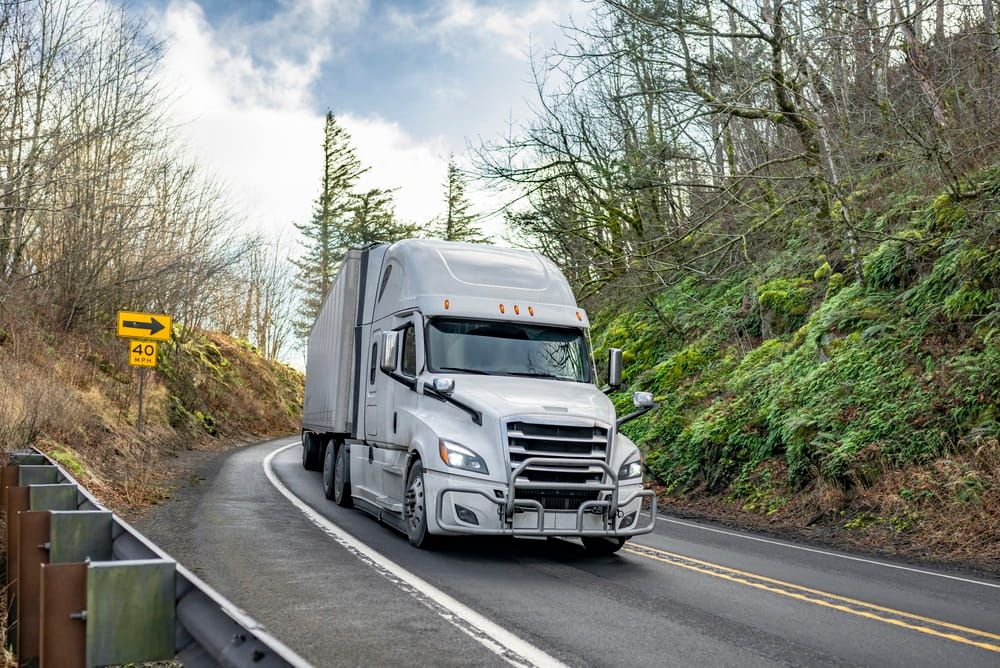
Most commercial truck crashes in Washington happen on five roads: I-5, I-90, US 2, I-82 and US 395. Each carries a different mix of freight and produces a different kind of case. Identifying which one you were on is the fastest way to narrow down who owned that truck and which rules bound it.
I-5 is the north to south spine, from the Canadian border to Oregon, feeding the Northwest Seaport Alliance terminals in Seattle and Tacoma. Port drayage rigs, long-haul freight and local delivery trucks share those lanes at very different speeds.
I-90 is the primary east to west route over Snoqualmie Pass, and US 2 the largely two-lane alternate over Stevens Pass. East of the mountains, I-82 carries Yakima Valley and Tri-Cities agricultural freight, and US 395 is the north to south freight route up the eastern side of the state.
Washington’s Freight Corridors and What Runs on Them
| Corridor | What moves through it | The recurring hazard | Counties it crosses |
|---|---|---|---|
| I-5 | Port drayage, long-haul interstate freight, regional delivery, the Canada to Oregon through-route | Heavy trucks and commuters in the same lanes, chronic congestion, rain and low winter light | Whatcom, Skagit, Snohomish, King, Pierce, Thurston, Lewis, Cowlitz, Clark |
| I-90 and Snoqualmie Pass | Main east to west freight, about 28,000 vehicles a day over the 3,022 ft summit | Snow, ice, avalanche control closures, long grades that punish brakes on loaded rigs | King, Kittitas, Grant, Adams, Lincoln, Spokane |
| US 2 and Stevens Pass | The alternate east to west route, about 4,500 vehicles a day over the 4,061 ft summit | Two-lane sections, passing conflicts, winter closures and avalanche control | Snohomish, Chelan, Douglas, Grant, Lincoln, Spokane |
| I-82 | Agricultural and food-processing freight toward I-90 and Oregon | Seasonal harvest surges, and truck traffic spilling onto rural two-lane feeder roads | Kittitas, Yakima, Benton |
| US 395 | 7.2 million tons of freight a year, about $13.5 billion in commerce | Long rural stretches, freight mixed with local traffic, winter fog and ice in the Columbia Basin | Spokane, Stevens, Ferry to the north; Adams, Franklin, Benton to the south |
The Corridor Predicts the Carrier
A truck on I-5 near the Tacoma tideflats is probably running short port trips for a drayage company. A truck on I-82 in September is probably hauling produce for a regional agricultural carrier. Different businesses, different insurance, different records. The corridor also settles whether the carrier was in interstate commerce, which decides if federal rules apply, and which county your case gets filed in.
That is why our first question is not how you are feeling. It is where you were, which direction, at what time of day.
What Federal Rules Apply to the Truck That Hit Me?

Federal safety rules apply if the vehicle was a commercial motor vehicle, or CMV, used in interstate commerce. Under 49 CFR 390.5, that generally means a gross vehicle weight rating of 10,001 pounds or more. Gross vehicle weight rating, or GVWR, is the manufacturer’s maximum loaded weight for that vehicle, not what it happened to weigh that day.
Those rules come from the Federal Motor Carrier Safety Administration, or FMCSA. They govern how long a driver can be at the wheel, how the carrier documents it, and how much liability insurance it must carry.
One clarifying note, because it comes up constantly: plenty of small delivery vans fall under the 10,001 pound line and are not commercial motor vehicles at all. Larger box trucks and tractor-trailers are, and the registration tells us which.
You Can Look the Carrier Up Yourself, Today
FMCSA publishes a free lookup tool called SAFER Company Snapshot. With the company name or the USDOT number, the U.S. Department of Transportation number painted on the door, you can pull that carrier’s registration, fleet size, and crash and inspection history in about a minute.
Do it before you talk to anyone from the company. It tells you immediately whether you are dealing with a two-truck operation or a national fleet with a legal department. Bring us what you find.
How Many Hours Is a Truck Driver Allowed to Drive?

A property-carrying driver must take 10 consecutive hours off duty before driving, may then drive no more than 11 hours, and cannot drive at all after the 14th consecutive hour on duty. A 30-minute break is required after 8 cumulative hours of driving. These are the federal hours of service rules, usually shortened to HOS.
There are weekly ceilings too, 60 hours in 7 days or 70 in 8, depending on how the carrier operates. All of it sits in 49 CFR 395.3.
Fatigue cases are not won by argument. They are won by paperwork, and the paperwork already exists.
How Much Insurance Does a Commercial Truck Have to Carry?
$750,000 is the federal floor for a for-hire interstate carrier hauling general, non-hazardous freight in a vehicle rated at 10,001 pounds or more. That comes from 49 CFR 387.9, and many carriers hold considerably more. An ordinary Washington driver, by contrast, has to carry only 25/50/10.
That shorthand means $25,000 per person for bodily injury, $50,000 per crash and $10,000 for property damage, under RCW 46.29.090. RCW stands for the Revised Code of Washington, the state’s statute book.
On a serious injury, that gap is the difference between a policy that runs out during your hospital stay and one that can cover a surgery, a year of therapy and lost income.
Who Can Be Held Responsible Besides the Driver?
Usually more than one company. A Washington truck case can reach past the driver to the motor carrier, the broker, the shipper, the business that loaded the trailer, the maintenance contractor and the separate company that owns the trailer.
Trucking is layered on purpose. A tractor may be owned by one company, leased to a second, dispatched by a third and pulling a trailer belonging to a fourth, which is why one claim against one driver rarely captures the whole picture. Here is where responsibility can land.
- The motor carrier, for hiring, training and supervision, and for the schedule pressure it put on the driver.
- The broker, depending on what it knew about that carrier’s safety record when it handed over the load.
- The shipper and the loader, when cargo was overloaded, unbalanced or badly secured.
- The maintenance contractor, when brakes, tires or required inspections were not done.
- The trailer’s owner, when the defect sat on a unit the driver did not own and could not have fixed.
Not every case reaches all of them. Which ones apply is discovery work, and it is why a truck case is not simply a bigger car accident case.
Why the Company Pays for What Its Driver Does
When an employee causes a crash while doing their job, the employer is legally responsible. Lawyers call this respondeat superior, Latin for “let the master answer”: the company that put that driver on that route answers for the driver’s negligence.
Which is exactly why a carrier’s first move is often to call the driver an independent contractor. Whether the label holds turns on control: who set the route, the delivery window, the equipment and the rules. That is a question of fact, decided on records rather than on how a company describes itself to you on the phone.
Every day you wait, the carrier’s file gets thicker and yours stays empty. Put a lawyer on it now at +1 (877) 999-9999.
What the Truck’s Electronic Logging Device Already Knows

Most commercial trucks record their own driving. An electronic logging device, or ELD, is a unit wired into the engine that automatically logs when the truck was moving, for how long, and when the driver went on and off duty. It is the best available check on a fatigue defense, because it does not remember things differently a month later.
It is not the only recorder. Trucks also generate telematics showing location over time, engine data showing speed, throttle and hard braking, and in many fleets, footage from cameras aimed at the road and at the driver. Around those devices sits a paper trail: dispatch messages, the bill of lading, the driver’s qualification file, testing records, and maintenance history for tractor and trailer.
None of it is yours. All of it sits on servers controlled by the company you are about to make a claim against.
How Do I Keep the Trucking Company From Erasing the Evidence?
You send a spoliation letter, in the first week. It is a formal written demand that the carrier preserve specific items: ELD data, engine data, camera footage, dispatch records, driver logs and the maintenance file. Once it is delivered, destroying those records carries consequences inside the case.
Retention windows are short and the company sets them, which is why the first week after a truck crash matters more than the first month.
The other side is not waiting. The rapid response teams large carriers keep under contract are there to document the scene before it is cleared, reach witnesses while memories are fresh, and take a recorded statement from you before you have spoken to a lawyer.
That is not a scandal. It is a lawful system, and nobody built the equivalent for you.
How Do Mountain Passes and Winter Change a Truck Case?

They change the physics and the argument, not the law. A loaded tractor-trailer descending Snoqualmie Pass in freezing rain needs far more stopping distance than the same truck on dry valley pavement, and professional drivers are trained for exactly that. Washington’s pure comparative fault rule means conditions can shift how fault is divided, but they never erase the carrier’s share of it.
Snoqualmie and Stevens stay open through winter only because WSDOT, the Washington State Department of Transportation, runs active avalanche control on them. Keeping freight moving over the Cascades in January takes constant intervention, and every carrier that runs those passes knows it before it dispatches a load.
When WSDOT posts traction or chain requirements, trucks are expected to comply and use the designated chain-up areas. Whether a driver did is documented rather than a matter of opinion, which makes it one more record worth demanding in the first week.
Which Passes Close for the Winter, and When
Three close for the season entirely. State route 410, or SR 410, crosses Chinook Pass and SR 123 crosses Cayuse Pass, both typically open from late May until late October or early November. SR 20, the North Cascades Highway, typically opens between mid and late April and closes in November or early December.
Those dates move with the snowpack. In 2026, SR 20 had its latest seasonal reopening on record, with WSDOT targeting June 25. Treat any pass date as typical rather than fixed.
Freight mostly avoids SR 20, which is why a closure on I-90 or US 2 reshuffles truck traffic statewide within hours. If your crash happened during one of those closures, the carrier’s dispatch records will show it.
Does Bad Weather Mean Nobody Is at Fault?
No. Washington uses pure comparative negligence: fault is divided by percentage, and your share reduces what you recover but never bars it. RCW 4.22.005 says contributory fault “diminishes proportionately the amount awarded … but does not bar recovery.”
No percentage ends the claim here. Even someone assigned most of the fault recovers a reduced amount, which is not true in many other states and is the first thing out-of-state adjusters get wrong.
Conditions are a fact about the road, not a defense on their own. A professional driver in a heavy vehicle is expected to account for the road ahead, and the records usually show whether they did: speed, braking, hours already driven, and what dispatch was saying about the delivery window.
Filing a Truck Accident Case in Washington

You generally have three years from the date of the crash to file a personal injury lawsuit in Washington. The deadline comes from RCW 4.16.080(2), the statute of limitations, sometimes shortened to SOL. Miss it and the claim is gone, however strong it was.
Three years sounds generous. For a truck case it is not, because the evidence that decides these cases sits on company servers with retention schedules measured in weeks.
Which County Your Case Belongs In
A Washington truck case is normally filed in the superior court for the county where the crash happened, not where you live and not where the carrier is based. On a long corridor that distinction is real. A crash on I-5 in Pierce County goes to Pierce County Superior Court in Tacoma, while a crash on I-90 east of the summit could belong in Kittitas, Grant, Adams, Lincoln or Spokane County, where the superior court sits at 1116 W Broadway Ave.
King County has two full-service facilities, and which one hears your case depends on where you were hit: the King County Courthouse in Seattle for north and east King County, the Maleng Regional Justice Center in Kent for the south end.
Washington Does Not Cap Noneconomic Damages
There is no statutory limit on pain and suffering damages in a Washington injury case. The State Supreme Court struck the old cap down in Sofie v. Fibreboard Corp. in 1989 as a violation of the constitutional right to a jury trial, and the legislature repealed the cap statute, RCW 4.56.250, in 2023.
That matters most in the injuries trucks actually cause: spinal and brain injuries, crush injuries, amputations, and the long recoveries that cost people their work and their independence.
Find the Truck Accident Lawyers for Your Part of Washington

Boohoff Law has six Washington offices, and each city has its own truck accident page covering local courts, corridors and claim details. Start with the city closest to where the crash happened, not where you live. Venue follows the crash.
Our Seattle office at 920 5th Ave, Suite 1530 covers King County and the industrial freight corridors through SODO and Georgetown, so if you were hit in King County, our Seattle truck accident lawyer page is your starting point.
Tacoma (950 Pacific Ave #650) covers Pierce County and Port of Tacoma drayage. Everett (2902 Colby Ave, Suite 103) takes Snohomish County and the US 2 approach to Stevens Pass. Olympia (203 4th Ave E, Suite 207) covers Thurston County and I-5 south. East of the Cascades, Spokane (905 W Riverside Ave., Ste 503) handles I-90 beyond the summit and US 395, and Kennewick (5204 Okanogan Pl., Ste 110) covers I-82, the Tri-Cities river crossings and the agricultural freight season.
If a passenger car hit you rather than a commercial truck, our Washington car accident lawyer page is the better place to begin.
Questions People Ask Before Hiring a Washington Truck Accident Lawyer
These are the questions we field most often on a first call. If yours is not here, ask us directly. There is no charge and no obligation afterward.
Usually yes. A claim runs against the liability coverage that was in force on the date of the crash, and that coverage does not disappear because the company later stopped hauling, sold its trucks or changed its name.
What a shutdown changes is speed. Records scatter, drivers move on, and the people who can explain a dispatch log get hard to find. If you know the company closed, say so on the first call so the preservation demands and the coverage search start that week.
Usually your own health insurance, plus personal injury protection, or PIP, if you carry it. Washington is an at-fault state, not a no-fault state, so the trucking company’s insurer typically pays nothing until the claim resolves.
PIP is optional here. Insurers must offer it under RCW 48.22.085, but the named insured may reject it in writing, and many do without realizing it. Where it applies, the statutory minimums are $10,000 in medical and hospital benefits, $2,000 for funeral expenses, $10,000 in income continuation capped at $200 a week, and $5,000 in loss of services capped at $200 a week.
Yes, in most cases. A crash on a Washington road is generally litigated in the Washington county where it happened, even when the carrier is headquartered elsewhere. Being registered in Texas or Idaho does not move your case there.
What an out-of-state carrier changes is pace. Claims get routed to a national adjuster, decisions take longer, and records sit in another time zone. One more reason not to let months pass before someone requests them.
A citation helps, but it is not required. Fault in a civil injury claim is decided on all the evidence, and a traffic ticket is one piece of it. Serious truck cases are frequently built on records the officer at the scene never saw.
Citations also arrive late, often days or weeks afterward, once a collision investigator finishes. The absence of a ticket on day one says very little about what your case is worth.
No. Nothing requires you to hand the other side’s insurer a blanket authorization for your medical history, and a broad one lets an adjuster pull years of unrelated records looking for something else to blame your injuries on.
Your records will still be produced, in a targeted way limited to the treatment that matters in your case. Send us anything the carrier or its insurer asks you to sign, including property damage paperwork, before you put your name on it. Some of those forms release more than the vehicle.
Start your Washington truck accident claim

The most useful thing you can do right now is preserve the record before it ages out. Tell us the road, the date, your direction of travel, and anything you remember about the truck: a company name, a plate, a USDOT number. We will handle the reconstruction.
Boohoff Law represents injured people across Washington, from the Canadian border to the Columbia, in English and Spanish. No Fees. Unless We Win. Nobody should have to argue alone against a company with a head start and a legal department.
Call +1 (877) 999-9999 and we will get a preservation demand out before the carrier’s retention window closes.
Recovery is personal.

We’re here for you.
We’re close by. And if you can’t make it to us, we’ll meet you where you need us, at home or in the hospital.










© 2025 Boohoff Law, P.A. — Auto Accident Lawyers.
The information on this website is for general information purposes only. Nothing on this site should be taken as legal advice for any individual case or situation. This information is not intended to create, and receipt or viewing does not constitute, an attorney-client relationship.
Disclaimer: The results and testimonials presented on this website are based on the unique facts and circumstances of each case. Past results do not guarantee or predict similar outcomes in future cases. Every legal matter is different, and you should not rely on prior case results as an expectation of future performance.
