When the skies open up over Olympia, the familiar Pacific Northwest rain can quickly turn a routine drive into a hazardous situation. One of the most common dangers on wet roads is hydroplaning, where a vehicle’s tires lose contact with the road surface and skim across a layer of water.
If you’ve been injured in a crash involving a hydroplaning car, you might wonder who is responsible. The answer is not always straightforward; while the driver who lost control is often found at fault, this is not a guaranteed outcome. Determining responsibility in hydroplaning car accidents in Olympia depends on the specific actions of each driver and the surrounding circumstances.
Injured in a wet-road crash? An experienced Olympia car accident lawyer can help—contact us today for a free consultation.
Key Takeaways about Hydroplaning Car Accidents in Olympia
- Determining fault in a hydroplaning accident involves evaluating whether a driver acted reasonably given the wet weather conditions.
- A driver who hydroplanes can be found negligent for actions like speeding, driving on worn tires, or being distracted.
- Washington State’s comparative fault rule allows for responsibility to be shared among multiple parties, which can affect compensation.
- In some cases, parties other than the drivers, such as a government entity for poor road maintenance or a manufacturer for defective tires, could hold some responsibility.
- Gathering evidence like photos, witness statements, and vehicle maintenance records is important after a wet-weather crash.
- An experienced attorney can investigate the incident to help establish the factors that contributed to the accident.
What Exactly Is Hydroplaning?
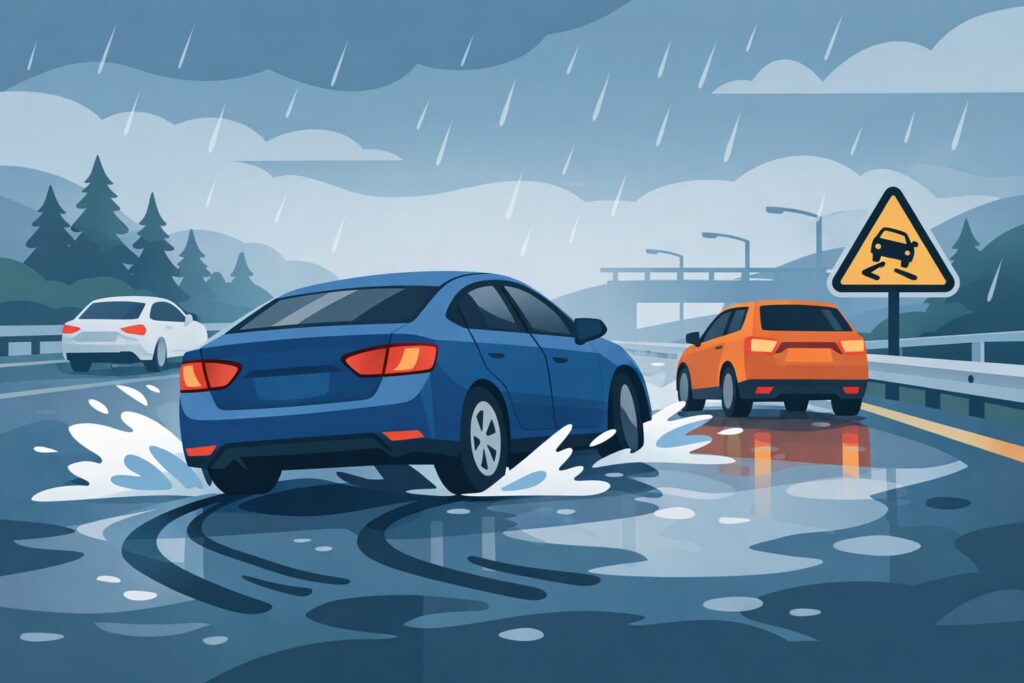
Hydroplaning, sometimes called aquaplaning, happens when a layer of water builds up between a vehicle’s tires and the road surface. This leads to a loss of traction, making it impossible for the driver to steer or brake effectively. Imagine your car suddenly becoming a boat, skimming uncontrollably across the water. It only takes a thin layer of water and a certain speed for this to occur.
Several factors can contribute to a hydroplaning incident on roads like I-5 or local streets such as Capitol Way:
- Vehicle Speed: The faster you go, the less time the water has to be channeled away by your tire treads.
- Tire Condition: Worn-out tires with shallow tread depth can’t grip the road properly or disperse water effectively.
- Water Depth: Deeper standing water, common during heavy Olympia downpours, increases the risk significantly.
When a car hydroplanes, the driver essentially becomes a passenger until the vehicle slows down enough for the tires to regain contact with the pavement. This loss of control is what often leads to serious accidents.
Determining Fault in Washington State Car Accidents
To understand who is at fault in a hydroplaning crash, it’s important to know how Washington State handles accident responsibility. Our state uses a system called pure comparative fault, also known as comparative negligence.
In plain English, this means that responsibility for an accident can be divided among everyone involved. In Washington, a court will determine the percentage of fault for each person. For example, if you are found to be 10% at fault for an accident, any compensation you receive would be reduced by that 10%. This system recognizes that a crash is often the result of multiple factors and choices, not just one single mistake.
The Duty of Care in Rainy Conditions
Every driver on the road has a legal obligation, or a duty of care, to operate their vehicle in a reasonably safe manner. This isn’t a static rule; it changes with the conditions. Driving safely on a sunny, dry day is very different from driving during a storm.
In wet weather, this duty of care includes:
- Slowing down to a speed that is safe for the conditions, which may be well below the posted speed limit.
- Increasing the following distance between your vehicle and the one ahead.
- Ensuring your vehicle is in good working order, with properly inflated tires that have adequate tread.
- Remaining attentive and avoiding distractions that take your focus off the road.
A driver who fails to adjust their behavior to account for the rain may be found to have breached their duty of care. This breach is a key component of negligence.
How Negligence Is Proven in Hydroplaning Car Accidents in Olympia
Negligence is a legal term for failing to act with reasonable care, resulting in harm to another person. To prove that another driver was negligent in a hydroplaning accident, you and your legal team must generally establish four key elements:
- Duty: The other driver had a legal duty to operate their vehicle safely and adjust for the weather.
- Breach: The driver violated that duty by acting carelessly (e.g., speeding on a wet road).
- Causation: The driver’s careless actions directly caused the hydroplaning incident and your injuries.
- Damages: You suffered measurable losses as a result, such as medical bills, lost income, or pain and suffering.
Proving these elements requires a thorough investigation into the moments leading up to the crash to show that the incident was preventable.
Is the Driver Who Hydroplaned Automatically at Fault?
This is the central question for many people injured in these types of crashes. The simple answer is no—a driver who hydroplanes is not automatically considered at fault. The weather itself isn’t a person and can’t be held liable. However, a driver’s reaction to the weather, or lack thereof, is what matters.
Fault is determined by whether the driver was acting negligently when they lost control. If the driver was doing everything right—driving at a safe speed, with good tires, and paying full attention—but still hit an unavoidable patch of standing water near Capitol Lake, it might be harder to prove they were at fault. More often than not, however, hydroplaning is linked to a driver’s preventable choices.
When the Hydroplaning Driver May Be at Fault
A driver who loses control on a wet road is often found negligent because hydroplaning can usually be prevented by driving cautiously. An investigation may show that the driver was at fault if they were:
- Driving Too Fast for Conditions: This is the most common reason for hydroplaning. A driver who fails to reduce speed on wet pavement can be held responsible.
- Driving on Unsafe Tires: If the driver’s tires were bald, underinflated, or otherwise poorly maintained, they knowingly increased their risk of losing control.
- Engaged in Distracted Driving: A driver who was texting, eating, or otherwise not paying attention may not have noticed standing water or dangerous conditions ahead.
- Making Sudden Maneuvers: Abruptly turning, braking, or accelerating on a wet surface can easily trigger a hydroplane.
In these situations, the driver’s actions directly contributed to the loss of control, making them responsible for the resulting harm.
When Another Party Could Be Responsible
While the driver is often the focus, they aren’t the only party that could bear some responsibility for hydroplaning car accidents in Olympia. Sometimes, the dangerous condition itself was caused by someone else’s negligence.
Other potentially liable parties include:
- A Government Agency: Cities, counties, or the state are responsible for designing and maintaining safe roads. If a road has improper drainage, large potholes that collect water, or a history of similar accidents that the agency failed to address, that government body could be partially or fully at fault.
- A Tire Manufacturer: If the hydroplaning was caused by a defective tire that failed to perform as designed, the manufacturer could be held liable through a product liability claim.
- A Vehicle or Tire Service Center: If a mechanic or tire shop performed faulty work, such as installing the wrong tires or failing to properly inflate them, their negligence could have contributed to the crash.
Identifying all potentially responsible parties is a critical step in ensuring you can pursue the full compensation you deserve for your injuries.
Common Causes of Hydroplaning Accidents in Olympia
Living in the Puget Sound region means we are no strangers to rain. This constant moisture on our roadways creates conditions ripe for hydroplaning. According to the U.S. Department of Transportation, rain is a major factor in roadway safety, with over 357,000 people injured in weather-related crashes annually on average.
Here are some of the most frequent causes of these dangerous incidents:
- Excessive Speed: The number one factor. The Washington State Driver Guide explicitly warns that as speed increases, so does the risk of hydroplaning.
- Tire Issues: Tires that are worn, underinflated, or not suited for wet conditions cannot channel water away effectively.
- Road Conditions: Poorly maintained roads with inadequate drainage, ruts, or “polished” surfaces from heavy traffic can allow water to pool.
- Vehicle Weight: Lighter vehicles are more susceptible to hydroplaning than heavier ones.
Understanding these causes highlights the importance of defensive driving and proper vehicle maintenance, especially in a rainy climate like Olympia’s.
Steps to Take After a Wet-Weather Crash
Once you have received initial medical attention, the process of protecting your rights begins. The actions you take in the days and weeks following the crash can have a significant impact on your ability to recover fair compensation.
Consider taking these important steps:
- Document Everything: Write down everything you remember about the accident while it’s still fresh in your mind. Note the time, weather conditions, road conditions, and what you saw and heard.
- Keep All Paperwork: Organize all documents related to the accident, including the police report, medical records, bills, and any correspondence from insurance companies.
- Follow Medical Advice: Attend all doctors’ appointments and follow your prescribed treatment plan. This not only helps your physical recovery but also creates an official record of your injuries.
- Be Cautious with Insurance Companies: Be aware that an insurance adjuster for the other driver is not on your side. Their goal is to minimize the amount the company has to pay. Avoid giving a recorded statement or accepting a quick settlement offer before understanding the full extent of your damages.
Taking these proactive measures can help build a strong foundation for your personal injury claim.
How an Attorney Can Help with Your Hydroplaning Accident Claim
Trying to handle an injury claim on your own, especially after a serious crash, can be a difficult process. An Olympia personal injury attorney can manage the legal details so you can focus on your health and recovery. They can serve as your advocate, working to hold the responsible party accountable and secure the resources you need.
Investigating the Hydroplaning Car Accident
A key role of an attorney is to conduct an independent investigation into the crash. Proving that another driver’s negligence caused the hydroplaning requires more than just pointing to the wet road.
An investigation may involve:
- Collecting Evidence: Gathering the police report, witness statements, photos of the scene, and vehicle damage assessments.
- Consulting with Experts: Working with accident reconstruction specialists to analyze skid marks, vehicle positions, and other physical evidence to determine what happened.
- Subpoenaing Records: Obtaining the other driver’s cell phone records to check for distracted driving or maintenance records for their vehicle to check the condition of their tires.
- Analyzing Weather Data: Compiling official weather reports for the time of the accident to establish the conditions.
This detailed investigation is essential for building a persuasive case that demonstrates how the other party’s carelessness led to your injuries.
Calculating the Full Value of Your Claim
Insurance companies often try to settle claims for the lowest possible amount. An experienced attorney can help you calculate the true, long-term cost of your injuries to ensure you don’t accept an offer that leaves you with future expenses.
Damages in a personal injury claim can include:
- Economic Damages: These are tangible financial losses, such as current and future medical bills, lost wages from time off work, and diminished earning capacity if you cannot return to your previous job.
- Non-Economic Damages: These are intangible losses related to your quality of life, such as pain and suffering, emotional distress, and loss of enjoyment of life.
An attorney will carefully document all of your losses to present a comprehensive demand to the insurance company and will be prepared to argue for that full value in negotiations or in court if necessary.
Hydroplaning Car Accident FAQs
We understand you may have many questions after being involved in a wet-weather crash. Here are answers to some common concerns.
What should I do if the other driver blames the weather for the accident?
Blaming the rain is a common defense, but it is rarely a sufficient one. Drivers have a legal responsibility to adjust their driving for foreseeable conditions like rain. An investigation can help determine if the driver was speeding or acting carelessly, which would make them negligent despite the weather.
How can I prove the other driver’s tires were bald?
Evidence is key. Photos taken at the accident scene can be very valuable. Additionally, your attorney can request an inspection of the other vehicle or obtain its maintenance records as part of the legal discovery process to document the condition of the tires.
Can I file a claim against the city of Olympia for poor road conditions?
Filing a claim against a government entity is possible but involves a complex process with specific rules and shorter deadlines. If you believe a poorly maintained road caused your hydroplaning accident, it is crucial to contact an attorney promptly to explore your options and ensure all necessary legal notices are filed correctly.
How long do I have to file a personal injury lawsuit in Washington?
In Washington, the statute of limitations for most personal injury claims is three years from the date of the injury. If you do not file a lawsuit within this timeframe, you may lose your right to seek compensation.
Contact a Car Accident Lawyer at Boohoff Law, P.A. Today
If you were injured in a hydroplaning car accident, you don’t have to face the recovery process by yourself. The legal team at Boohoff Law, P.A. is here to help you understand your rights and options. We are committed to providing compassionate and determined advocacy for injury clients in Seattle, Olympia, and across Washington, as well as in Florida. As you focus on healing, we will focus on your case, taking on the insurance companies to pursue the outcome you deserve.
We offer a free, no-obligation consultation to discuss your case. And remember, we work on a contingency fee basis, which means you will never pay us any fees unless we win your case. Millions have been recovered for our clients. Contact us 24/7 at (877) 999-9999 or use our online form for your free consultation and find out what your case may be worth.

Free Consultation
We Are Here For You 24/7
Reviews

– Elissa M.
“Really pleased with Boohoff Law! Received immediate responses when I had any questions. Treated amazingly by all staff … made this process a true breeze!”
– Caitlyn M.
– Brandy K.
Related Posts
Who Is Liable for a Trailer Detachment Accident in Washington?
Who’s Liable in a Lumber Truck Accident Near Olympia, WA?
What to Do When Your Total Loss Offer Is Too Low in Olympia, WA
Recovery is personal.
We’re here for you.
We’re close by. And if you can’t make it to us, we’ll meet you where you need us, at home or in the hospital.













© 2025 Boohoff Law, P.A. — Auto Accident Lawyers.
The information on this website is for general information purposes only. Nothing on this site should be taken as legal advice for any individual case or situation. This information is not intended to create, and receipt or viewing does not constitute, an attorney-client relationship.
Disclaimer: The results and testimonials presented on this website are based on the unique facts and circumstances of each case. Past results do not guarantee or predict similar outcomes in future cases. Every legal matter is different, and you should not rely on prior case results as an expectation of future performance.
