No Fees
Unless We Win
Millions Recovered!

Washington Bus Accident Lawyers
Washington does not have a bus company. It has dozens of legally separate operators: city transit departments, countywide transit authorities, a regional transit agency, school districts, private charter and tour companies, and state supported intercity lines.
That distinction is not trivia. The type of operator involved in your crash decides what you have to file, who you file it with, and whether you can sue right away or have to wait. A Washington bus accident lawyer at Boohoff Law can tell you which of the two procedures applies to your case, usually on the first call.
There are two tracks, and nearly everything that happens next depends on which one you are on. If you are still working out what kind of claim you have, our Washington personal injury lawyers page is the wider start.
Available 24/7
Our specialists are here to listen and help for free, no strings attached.
877-999-9999
for a free consultation
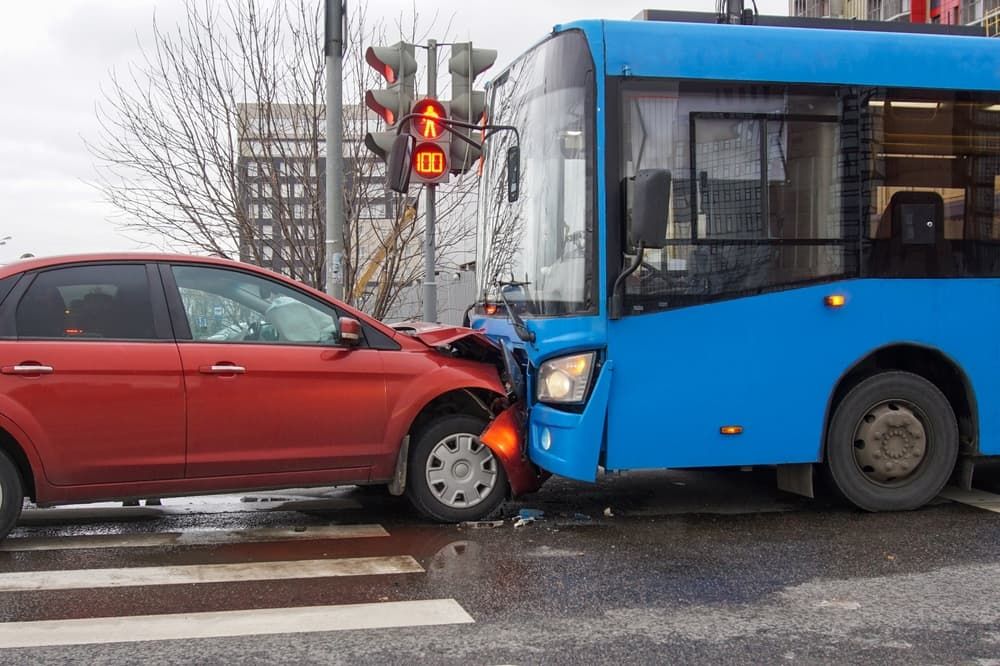
Is a Bus Accident Claim Different From a Regular Car Accident Claim?
Yes, in two specific ways. A bus operator is held to the highest degree of care rather than the ordinary care a regular driver owes. And if a government entity operates the bus, you cannot file a lawsuit until you have first presented a written claim and then waited 60 calendar days.
A common carrier is a business that transports the public, for a fare or as a public service, and Washington holds it to more than ordinary care. That comes from Walker v. King County Metro, 126 Wn. App. 904, 908 (2005).
The higher standard does not hand you the case. Carriers are not insurers and are not strictly liable, so being hurt on a bus is not by itself proof anyone did anything wrong. It changes the measuring stick, not the burden of proof.
The second difference is procedural, and it is the one that catches people. Suing a government entity requires a step that suing a private driver does not, and missing it gets the case dismissed no matter how strong the facts are. If another car caused the crash and the bus was simply where you were sitting, the process looks more like our Washington car accident lawyer page, and you may run both at once.
The Two Claim Tracks, Public Operator or Private Carrier

Every bus injury claim in Washington runs on one of two tracks. If a government entity operates the bus, you must present a written claim and wait 60 days before you can sue. If a private company operates it, there is no claim form and no waiting period at all.
Most buses on Washington roads are public, and the operators look nothing alike. King County Metro, Sound Transit, Spokane Transit Authority and its City Line bus rapid transit corridor, Intercity Transit in Olympia, Lacey, Tumwater and Yelm, and Ben Franklin Transit in the Tri-Cities are all local government entities. Bus rapid transit, or BRT, means larger vehicles running frequently on a fixed corridor with limited stops.
Fare has nothing to do with it. Intercity Transit currently charges no fare at all, and a rider hurt on one of its buses is on the public track exactly like a rider who paid.
State agencies are the smaller group, and they follow a different chapter of the law and a different address. The Washington State Department of Transportation, the Washington State Patrol and Washington State Ferries are state agencies, which matters when the claim is partly about how a state route was built or maintained.
Telling a Public Operator From a Private One
Look at the name on the vehicle and the registered owner listed on the collision report. Public operators carry an agency name and a route number. Private carriers carry a company name and usually a trip or charter name instead.
If you kept a ticket or a booking confirmation, that is the fastest answer. If you were driving, walking or riding a bike when the bus hit you, the collision report settles it.
| Public Operator | Private Carrier | |
|---|---|---|
| Examples | King County Metro, Spokane Transit Authority, Intercity Transit, Ben Franklin Transit, Sound Transit, public school districts, and state agencies such as WSDOT and Washington State Ferries | Greyhound, FlixBus, Northwestern Trailways, charter and tour companies, employee and hotel shuttles, and the private operators that run the Travel Washington routes |
| Governing law | RCW 4.92.100 and 4.92.110 for state agencies. RCW 4.96.020 for cities, counties, transit agencies and school districts | No special claim statute. Ordinary negligence and insurance rules |
| Must you file a claim form first | Yes. State agency claims go to the Office of Risk Management at the Department of Enterprise Services on a mandatory standard form. Local entity claims go to that entity’s own appointed agent | No. There is no government claim form and no agent to serve |
| Waiting period before suit | 60 calendar days after the claim is presented. The filing deadline is paused during those 60 days | None. Suit may be filed as soon as the case is ready |
| Standard of care | Highest degree of care as a common carrier | Highest degree of care as a common carrier. Same standard |
| Deadline to file suit | 3 years, RCW 4.16.080(2), plus the 60 day pause | 3 years, RCW 4.16.080(2) |
Two rows in that table are identical. The standard of care and the three year deadline follow the carrier, not the ownership. What changes is the paperwork in front of the lawsuit.
What Is the 60 Day Rule, and Does It Apply to My Claim?

The 60 day rule is a waiting period, not a deadline. Once a written claim has been presented to a Washington government entity, 60 calendar days have to pass before a lawsuit can be filed against it. It applies to every public operator, from a transit agency to a school district, and to no private carrier.
The statute of limitations, meaning the legal deadline to file suit and sometimes shortened to SOL, is paused during those 60 days. The step costs you no time.
People put off the claim because they assume a waiting period eats into their deadline. It works the other way around.
There is a grace period on the back end too. File within five court days after the period closes and the suit still counts as timely. Court days are days the court is open, not calendar days.
Washington Has No 90 Day Claim Trap
Washington does not have a short notice deadline. There is no 90 day rule and no 180 day rule for claims against government entities here. If you moved from a state that has one, the deadline you are bracing for does not exist.
The claim has to be presented within the three year window, and presenting it tolls the clock 60 days. That is the whole timing rule.
Who Receives the Claim, DES or a Local Agent?

A claim against a state agency goes to the Office of Risk Management at the Department of Enterprise Services, known as DES, on a mandatory standard tort claim form. A claim against a local entity goes to that entity’s own appointed agent instead. A claim delivered to the wrong office is not a claim: nothing tolls and nothing starts.
The state agency requirement is set by RCW 4.92.100 and RCW 4.92.110, and the state publishes the form and its claim filing instructions directly.
Local Entities Each Appoint Their Own Agent
For local entities there is no single statewide office. RCW 4.96.020 requires every local government entity to appoint its own agent, and your claim goes to that agent. RCW is the Revised Code of Washington, the state’s statute book.
A transit authority, a city, a county and a school district are four separate entities with four separate agents, even when they run buses on the same block. Appointments change, so we verify the current one before anything is mailed. Some cases sit on both tracks at once: if the crash also turned on how a state route was designed, a local claim and a state claim go out in parallel, to two offices.
One call settles the track question. Give us the operator, the route or trip and the date at +1 (877) 999-9999, and we will tell you which statute governs your claim, which office has to receive it, and what your real deadline is.
What If It Was a School Bus?

Your defendant is the school district. Districts are local government entities, which puts a school bus injury squarely on the public track: written claim to the district’s appointed agent under RCW 4.96.020, 60 day wait, then suit. Neither the state nor OSPI is the party you claim against.
These buses carry an inspection history most vehicles never generate. Under RCW 46.32.010, the Commercial Vehicle Division of the Washington State Patrol, the state police agency, puts 100 percent of public school buses through a summer inspection and another 25 percent through an unannounced winter round. OSPI, the Office of Superintendent of Public Instruction, administers student transportation statewide.
None of that record is searchable. Inspection results, maintenance history, driver training files and route records all exist, and every one has to be requested rather than looked up. When a second driver caused the crash, two claims run in parallel under two sets of rules: the district on the public track, that driver on the private one.
Charter Buses, Tour Buses and Intercity Lines

If a private company operated the bus, there is no government claim form and no 60 day waiting period. You can file suit as soon as the case is ready. The highest degree of care still applies, because that standard attaches to the job of carrying the public, not to who owns the vehicle.
Private carriers cover a wide range: Greyhound, FlixBus, Northwestern Trailways, casino and wedding charters, airport and employer shuttles, tour buses, and field trip charters a district hired rather than ran itself. Amtrak Cascades and Washington State Ferries also carry intercity travel, and the ferries are a state agency, which puts them back on the public track.
One correction, because outdated listings still circulate: BoltBus has ceased operations.
Travel Washington’s Five Intercity Routes
Travel Washington is a WSDOT supported intercity bus program built as a federal Section 5311 public-private partnership. Its five routes reach parts of the state no transit agency serves.
- Apple Line (Northwest Trailways): Omak, Ellensburg, Wenatchee.
- Dungeness Line (MTR Western): Port Angeles, Port Townsend, Seattle, Sea-Tac.
- Gold Line (Belair Charters / Central Washington Airporter): Kettle Falls, Deer Park, Spokane, Spokane International Airport.
- Grape Line (Belair Charters / Central Washington Airporter): Walla Walla, Pasco.
- Wheat Line (Belair Charters / Central Washington Airporter): Pasco, Mesa, Connell, Othello, Moses Lake, Ritzville, Sprague, Cheney, Spokane.
The Wheat Line began service on May 1, 2026, the newest intercity bus route in the state.
Because these routes are state supported but privately operated, the track question is worth asking rather than assuming. Which procedure applies depends on which entity you are claiming against.
Long runs carry their own risk profile. Intercity and charter buses cross I-90 at Snoqualmie Pass and US 2 at Stevens Pass, the two crossings held open all winter with avalanche control while SR 20 and SR 410 close for the season. A carrier that sends a coach over a pass in January has made decisions about tires, chains, driver hours and whether to run at all, and those decisions leave records worth demanding.
Checking a Private Carrier’s Federal Safety Record

Interstate bus companies fall under federal oversight, and much of that record is public. Anyone can pull a carrier’s safety profile from the FMCSA SAFER Company Snapshot, a free database run by the Federal Motor Carrier Safety Administration. It is the first thing we check when a private carrier is involved.
The oversight applies because a full size motorcoach is a commercial motor vehicle, or CMV, under 49 CFR 390.5: a vehicle rated at 10,001 pounds or more by gross vehicle weight rating (GVWR, the manufacturer’s maximum loaded weight) and used across state lines.
Drivers of those vehicles follow federal hours of service rules, shortened to HOS, at 49 CFR 395.3: 10 consecutive hours off duty before driving, an 11 hour driving cap, and no driving after the 14th consecutive hour on duty. A carrier that let a driver run past those limits created a record, and it is discoverable.
What a Washington Bus Injury Claim Is Worth

Three things set the value of a Washington bus injury claim: how badly you were hurt, how completely that injury is documented, and how much working life it takes from you. The size of the operator does not raise or lower it. What state law adds are two limits most people expect to find and will not find here.
Limit one would be a percentage bar on partial fault. Washington does not have one. RCW 4.22.005 subtracts your assigned share of fault from the award and stops there; contributory fault, in the statute’s words, “does not bar recovery.”
Limit two would be a ceiling on noneconomic damages, the legal term for pain, lost function and what an injury takes that never shows up on an invoice. One existed until the state Supreme Court held it unconstitutional in Sofie v. Fibreboard Corp., 112 Wn.2d 636 (1989), and lawmakers took the statute off the books in 2023.
Suit has to be filed within three years under RCW 4.16.080(2), and presenting a government claim adds the 60 day pause on top of that window.
The Loss Clients Undercount
Earning capacity is the piece clients undersell most often. A spine or shoulder injury that ends shift work at a warehouse, a hospital or a food processing plant is a career loss, not a few missed weeks, and it has to be documented that way from the start.
Boohoff Law has recovered $9 million for a client injured in a head-on collision. Prior results do not guarantee a similar outcome, and every case is decided on its own facts.
Where a Washington Bus Lawsuit Gets Filed

A Washington bus case is normally filed in the superior court of the county where the crash happened, not where you live and not where the operator is headquartered. That holds whether the defendant is a transit agency, a school district or a charter company. The one county that needs a second look is King, which runs two full service superior court facilities.
North and east King County cases go to the King County Courthouse in Seattle, while south King County cases go to the Maleng Regional Justice Center in Kent.
Elsewhere it is simpler. Spokane County Superior Court sits at 1116 W Broadway Ave and Thurston County Superior Court at 2000 Lakeridge Drive SW in Olympia. For a Kennewick case the practical venue is the Benton County Justice Center on W Okanogan Place, though the county seat courthouse is in Prosser.
Bus Accident Pages for Washington Cities
Boohoff Law has offices in Seattle, Everett, Tacoma, Olympia, Spokane and Kennewick. The procedure on this page is statewide. What changes city to city is which agency runs the bus, which agent takes the claim, and which court hears it.
If your crash happened in King County, our Seattle bus accident lawyer page covers the local agencies and the court split in more detail. We publish city level bus pages for our other Washington markets too.
Questions Washington Bus Accident Clients Ask Before They Hire Us
These come up on statewide calls, when the crash, the operator, the court and the client are not all in the same city.
No. Washington attorneys are licensed statewide, so a firm can represent you in any county regardless of where its office sits. What matters is whether the firm knows the operator, the claim procedure and the court that will hear it.
Boohoff Law has offices in six Washington cities and takes claims in counties where we have none. Most of the early work is records and written claims, none of which requires you to drive anywhere.
No. The claim gets presented, reviewed and either paid or denied on the same record either way. What changes is who builds that record, and how complete it is when the agency’s risk manager first reads it.
Unrepresented claimants usually submit medical bills. A prepared claim submits the treatment history, the wage loss, the operator and maintenance records obtained from the agency, and a valuation the agency has to answer. None of that is hostile. It is simply the difference between a file the agency can price and a file it can set aside.
It is usually fixable, and worth checking today. A claim delivered to an entity that is not the defendant does not count as presented, so it did not start the 60 day period and did not pause your deadline. The fix is to present a proper claim to the correct agent right away.
The risk is time, not permanence. Bring us whatever you sent and the date you sent it.
Yes. Where you live does not control the claim. A crash that happened in Washington is governed by Washington law and is normally filed in the county where it occurred, whether you were a resident, a student or a tourist. That usually cuts in your favor, because Washington’s pure comparative fault rule and its lack of a damages cap are more generous than what many states apply.
Often, yes, especially on government claims. These cases get declined for procedural reasons more than for weak facts, usually because the claim step looked like a dead end to someone who does not handle it regularly.
Send us the declination letter and any correspondence with the operator. If the case cannot be brought, you will hear that in the first conversation, not at the end of a long one.
Two Tracks, One Phone Call

Public or private is the fork that decides everything else about your claim, and it is not a question you should have to settle alone. Either way the first moves are identical: pin down the operator, confirm which statute governs, and get the real deadline on a calendar.
Was it a city bus, a school bus, a chartered coach, or a vehicle with a company name painted on the side? Whatever the answer, one conversation is enough to tell you which procedure applies and what has to happen first.
Boohoff Law handles bus and transit injury claims in every Washington county. Call +1 (877) 999-9999 for a free review, at any hour, in English or Spanish. No Fees. Unless We Win.
Recovery is personal.

We’re here for you.
We’re close by. And if you can’t make it to us, we’ll meet you where you need us, at home or in the hospital.










© 2025 Boohoff Law, P.A. — Auto Accident Lawyers.
The information on this website is for general information purposes only. Nothing on this site should be taken as legal advice for any individual case or situation. This information is not intended to create, and receipt or viewing does not constitute, an attorney-client relationship.
Disclaimer: The results and testimonials presented on this website are based on the unique facts and circumstances of each case. Past results do not guarantee or predict similar outcomes in future cases. Every legal matter is different, and you should not rely on prior case results as an expectation of future performance.
