No Fees
Unless We Win
Millions Recovered!

Washington Motorcycle Accident Lawyers
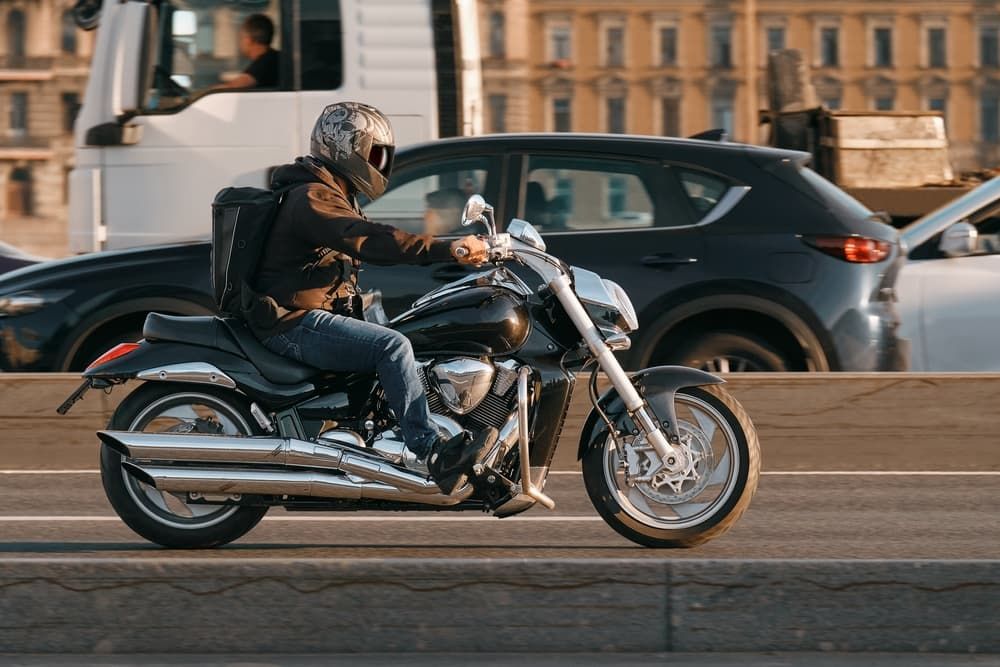
The first move in almost every motorcycle claim is an attempt to make the rider the story. Your speed, your gear, your lane position, how many years you have been riding.
Anything except the driver who turned left across your lane.
A Washington motorcycle accident lawyer at Boohoff Law works the other direction. Our Washington personal injury lawyers handle motorcycle injury claims across the state, from Seattle and Everett through Tacoma and Olympia and east to Spokane and Kennewick. The work starts by moving the question back where it belongs: who caused this crash, and what does the evidence show.
You are going to hear a lot of confident statements over the next few weeks. Some are Washington law. Several are not. This page sets the two side by side, because the gap between them is where most motorcycle claims are won or lost.
Available 24/7
Our specialists are here to listen and help for free, no strings attached.
877-999-9999
for a free consultation
Why Does the Insurance Company Blame the Rider First?
Because it is cheap and it usually works. Shifting a percentage of fault onto the rider lowers what an insurer pays without requiring it to prove anything to a judge. In Washington that tactic has a hard ceiling, because state law does not allow partial fault to erase a claim.
Washington’s statutes are collected in the Revised Code of Washington, or RCW. Every citation below links to the statute itself, so you can read the language instead of an adjuster’s summary of it.
Here is what riders are told, and what the law says next to it.
| The Claim You Will Hear | What Washington Law Actually Says | Why It Matters to Your Case |
|---|---|---|
| “You were partly at fault, so there is nothing here for you.” | RCW 4.22.005: fault on your part “diminishes proportionately the amount awarded … but does not bar recovery.” Washington sets no percentage cutoff. | Your claim survives even at a high fault share. The fight is about the percentage, not about whether you have a case. |
| “You weren’t wearing the right helmet.” | RCW 46.37.530(1)(c) requires a helmet for motorcycle operators and passengers of every age, certified by USDOT to 49 CFR 571.218. It is an equipment rule, not a bar to sue. | A helmet issue becomes a fault percentage to argue over. It says nothing about who caused the collision. |
| “You were lane splitting.” | RCW 46.61.608(3) does prohibit riding between lanes or between adjacent rows of vehicles. An allegation is still only an allegation until it is supported. | Drivers who never saw the motorcycle often describe it this way by default. Physical evidence frequently says otherwise. |
| “Motorcycles are inherently dangerous. You accepted that risk.” | Washington does not lower a driver’s duty of care because the person they hit was on a motorcycle. Riding legally is not consent to be struck. | A generalization about motorcycles is not a defense to one driver’s specific failure to look. |
| “You have no endorsement and no training.” | Licensing and training are separate questions from causation. What decides fault is what each person did in the seconds before impact. | Expect it to come up. Under RCW 4.22.005 it can move a percentage. It cannot close the file. |
Notice the pattern. Every statement in that first column is about you. Not one is about whether the other driver checked twice before turning across a lane.
That substitution starts early, usually in a friendly phone call inside the first week. The adjuster is pleasant, asks how you are healing, and works through a list of questions designed to produce a percentage. None of it feels like an interrogation, which is the point.
Can I Still Recover If I Was Partly at Fault for the Crash?
Yes. Washington is a pure comparative fault state, which means a share of the blame reduces your recovery by that percentage and does nothing more. There is no cutoff where partial fault ends your claim, even if your share turns out to be larger than the other driver’s.
The statute is RCW 4.22.005, and the operative language is short. Fault on your part “diminishes proportionately the amount awarded … but does not bar recovery.”
Numbers make it real. Say a case is valued at $600,000 across medical bills, lost income, future care and pain.
- Found 20 percent at fault, you recover $480,000.
- Found 40 percent at fault, you recover $360,000.
- Found 60 percent at fault, more of the blame than the driver who hit you, you still recover $240,000.
That last line is impossible in much of the country. In a state with a 51 percent bar, a rider carrying most of the blame walks away with nothing. Washington has no such line. If you take one fact from this page, take that one.
It should also change how you read an adjuster’s fault number. A 35 percent assignment is an opening position in a negotiation, not a ruling. Percentages get argued, supported with evidence, and if the case does not settle, decided by a jury rather than by the company writing the check.
What moves a percentage is proof: scene photographs, the resting position of both vehicles, crush and scrape patterns, skid and gouge marks, signal timing, sightline measurements and independent witnesses. All of it pushes against a number assigned in an office, and most of it has a short life, which is why the timing of your first call matters more than the strength of your outrage.
What Does Washington Law Actually Say About Helmets and Lane Splitting?

Washington requires a helmet for every motorcycle operator and passenger, and it prohibits riding between lanes of traffic. Neither rule decides who caused your crash. Both are conduct rules an insurer will try to convert into a fault percentage, and in a pure comparative fault state a percentage reduces a claim instead of ending it.
What Washington’s Universal Helmet Law Does to Your Claim
Not wearing a helmet does not end an injury claim in Washington. The state does require a helmet for motorcycle operators and passengers of every age, under RCW 46.37.530, subsection (1)(c), and the helmet has to be certified by the United States Department of Transportation, the USDOT, to the federal standard at 49 CFR 571.218. A helmet question can change what your claim is worth. It does not decide whether you have one.
There is no age exemption in Washington. Riders who moved from a state that lets adults ride bare-headed often assume the old rule followed them across the line. It did not.
The statute does carry narrow carve-outs of its own for certain fully enclosed vehicles that meet its listed criteria, and none of them describes an ordinary motorcycle. The same statute, at subsection (1)(d), also bars carrying a child under five as a passenger on a motorcycle.
Certification is where the arguments start. A novelty shell never certified to the federal standard is not a helmet under the statute, and an insurer that learns the make and model will look it up. The Washington State Patrol publishes a motorcycle equipment guide covering the rules that apply to your bike and your gear.
If the Insurer Raises a Helmet Question
It becomes an argument about percentage, not about whether you have a case. An insurer raising a helmet issue is trying to move fault onto you, and fault under RCW 4.22.005 reduces a recovery proportionally rather than eliminating it.
Expect that argument to be aimed at head and neck injuries, and expect it to require medical support rather than assumption. An insurer does not get to announce that a helmet would have prevented a particular injury. It has to show it, against a treating physician who may say something different.
If there is a helmet problem in your case, it will be contested and it will cost you something in the negotiation. That is still not a reason to skip the call. A helmet argument changes the shape of a claim rather than the fact of one.
Is Lane Splitting Legal in Washington?
No. Riding between lanes of traffic, or between adjacent lines or rows of vehicles, is prohibited by RCW 46.61.608, subsection (3). Filtering forward between stopped cars at a red light is not carved out of that rule. Nothing about it has changed.
Riders who learned to filter somewhere else tend to assume the habit travels with them. In Washington it does not, and an insurer knows that the moment it sees an out-of-state license or a relocation in your history.
You may also run into House Bill 1367 in a forum thread, quoted as though the state has opened the door. It has not. HB 1367 deals with riding on the shoulder, a different question from filtering between lanes, and as of August 2026 it is still sitting in the House Transportation Committee. No part of it is in effect.
Two practical points if lane splitting gets alleged against you.
First, an allegation is not a finding. Drivers who did not register a motorcycle until the moment of impact often describe it as having come from between lanes, because that is the only story that fits what they noticed. Lane markings, damage angles, debris fields and independent witnesses regularly tell a different one.
Second, even where a violation is established, Washington’s comparative fault rule still governs. It is a percentage argument, not a bar, and an adjuster who implies otherwise is describing a different state’s law.
Before you answer one more question about your gear, your speed or your years on a bike, put someone on your side of the file. Call +1 (877) 999-9999 and let us take those questions instead of you.
The Season, the Roads and the File an Adjuster Is Already Building

Washington motorcycle crashes cluster in summer and on a short list of two-lane mountain routes. Half of the state’s motorcyclist deaths happen in June, July and August, according to the Washington Traffic Safety Commission, or WTSC, the state agency that tracks traffic fatalities. It is also the season when the most rider files get opened, and when the evidence in them disappears fastest.
Route rankings circulate online and are almost always mis-sourced. The best known list puts the North Cascades Highway (SR 20) first, then Chinook Pass (SR 410), the Leavenworth Run, the Klickitat Loop and Mt. Baker Road. It comes from a Davis Law Group analysis of about 4,000 motorcycle crashes from 2016 to 2018, not from a state study. SR 20 earns it: tight, sightline-limited curves between Marblemount and Winthrop, where WSDOT, the Washington State Department of Transportation, has added curve warning signage.
Enforcement follows the same map. The WTSC and the Washington State Patrol run coordinated I-90 Corridor Patrols from Snoqualmie Pass east to Spokane, with agencies in Kittitas, Grant, Adams, Lincoln and Spokane counties targeting speed, loss of control in curves and improper passing. If a citation came out of one of those patrols, expect the insurer to point at it. A citation is evidence, not a determination of fault, and it can be answered.
What an Adjuster Goes Looking for in Your Record
Training history and endorsement status, before almost anything else. Among Washington motorcyclist fatalities in 2024, 71 percent involved riders with no training on record and 40 percent involved riders with no valid motorcycle endorsement. Those figures describe a statewide fatality data set. They are not a description of you.
They matter for one reason: an insurer will check both before it puts a number on your file, and it will use whatever it finds. Knowing that in advance is the difference between being caught flat and having the answer ready with documentation attached.
If you completed a training course, tell us early and we will put the certificate in the file. If you did not, tell us that too, because we would rather learn it from you than read it in a demand response. Neither answer decides who caused the crash.
What a Washington Motorcycle Injury Claim Is Actually Worth
Washington places no cap on noneconomic damages, so pain, permanent loss of function and the effect on your daily life are not limited by any statutory ceiling. The State Supreme Court struck the old cap down as unconstitutional in Sofie v. Fibreboard Corp. in 1989, and the legislature repealed the leftover statute in 2023. What limits most motorcycle recoveries is not the law. It is how much insurance exists.
Washington’s minimum liability requirement is 25/50/10 under RCW 46.29.090: $25,000 per injured person, $50,000 per crash, and $10,000 for property damage. On an orthopedic motorcycle case, $25,000 can be gone before you are discharged. Air transport off a pass, one surgery and the hardware to hold a femur together will do it, and rehabilitation has not started yet.
Why Your Own Coverage Often Decides the Outcome
Underinsured motorist coverage, or UIM, is the part of your own auto policy that pays when the at-fault driver does not carry enough insurance to cover what they did. On motorcycle claims it is frequently the largest single source of money in the case. Washington insurers must offer UIM and uninsured motorist coverage, and you can only decline it in writing, under RCW 48.22.030.
Pull your declarations page and look for it. If you rejected UIM years ago to hold the premium down, that decision is now working against you. If you kept it, it may be the difference between a $25,000 policy and an actual recovery.
You generally have three years from the date of the crash to file a lawsuit in Washington. That deadline, the statute of limitations or SOL, is set by RCW 4.16.080, subsection (2). The case is normally filed in the superior court for the county where the crash happened, which after a summer ride can mean a rural county hours from home.
Boohoff Law has recovered $2.001 million for a client injured in a motorcycle crash. Prior results do not guarantee a similar outcome, and every case turns on its own facts, injuries and available coverage.
Motorcycle Accident Lawyers in Your Part of Washington
The rules on this page apply everywhere in the state. What changes from one market to the next is who responds to the scene, how fast the evidence disappears, and which county’s superior court hears the case.
Boohoff Law has Washington offices in Seattle (920 5th Ave, Suite 1530), Everett (2902 Colby Ave, Suite 103), Tacoma (950 Pacific Ave #650), Olympia (203 4th Ave E, Suite 207), Spokane (905 W Riverside Ave., Ste 503) and Kennewick (5204 Okanogan Pl., Ste 110). We take motorcycle cases from every county, including crashes on rides that started at home and ended somewhere else entirely.
If your crash happened in King County, start with our Seattle motorcycle accident lawyer page. If another vehicle was involved and you are still working out which claim you are making, the Washington car accident lawyer page covers the coverage questions that apply to every crash on a Washington road.
Washington Motorcycle Accident FAQ
These are the questions riders raise on the first call that are not answered above. Each is worth having an answer to before an adjuster asks you the same thing in reverse.
Yes. “I never saw the motorcycle” is closer to an admission than a defense. A driver is expected to look before turning, changing lanes or pulling out, and failing to see a vehicle that was plainly there does not excuse a collision. Expect the insurer to reframe it as a visibility problem caused by your headlight, your lane position or your clothing, and expect that to be answered with sightline evidence, lighting records and witnesses.
Not before you talk to a lawyer. Your motorcycle is physical evidence, and once it is repaired, sold for salvage or crushed, the damage pattern showing impact angle and speed is gone permanently. Storage fees and salvage deadlines create real pressure to agree quickly. An inspection can be arranged that both sides attend, so nothing is examined, moved or measured without your side present.
Yes. A passenger has an independent injury claim against whoever caused the crash, and that can include more than one driver. Washington’s helmet requirement applies to passengers exactly as it applies to operators, so expect the same helmet question pointed at them. Where coverage is thin, a single per-crash limit has to stretch across everyone injured, which is one more reason to identify every available policy early.
No. A report helps, but no claim depends on one. Insurers treat the report as a starting point, and an officer’s opinion about fault binds no one. If no report exists, or the one that exists gets the story wrong, the case is built from photographs, medical records, vehicle damage, roadway evidence and witnesses instead.
Talk to us before you answer the adjuster’s next question

You do not have to accept the first version of events an insurance company hands you, and you should not have to defend the fact that you ride before anyone examines what the driver did. That argument belongs to your lawyer.
Boohoff Law takes Washington motorcycle cases on contingency, so our fee comes out of a recovery and nothing comes out of your pocket while the case runs. Consultations are free, someone answers at any hour, and we work in English and Spanish.
Call +1 (877) 999-9999. Tell us what you have already been accused of, and we will tell you how much of it is actually law.
Recovery is personal.

We’re here for you.
We’re close by. And if you can’t make it to us, we’ll meet you where you need us, at home or in the hospital.









© 2025 Boohoff Law, P.A. — Auto Accident Lawyers.
The information on this website is for general information purposes only. Nothing on this site should be taken as legal advice for any individual case or situation. This information is not intended to create, and receipt or viewing does not constitute, an attorney-client relationship.
Disclaimer: The results and testimonials presented on this website are based on the unique facts and circumstances of each case. Past results do not guarantee or predict similar outcomes in future cases. Every legal matter is different, and you should not rely on prior case results as an expectation of future performance.
