No Fees
Unless We Win
Millions Recovered!
Spokane Motorcycle Accident Lawyer

Spokane Motorcycle Accident Lawyer

Washington requires every motorcycle rider to wear a helmet. That single fact separates Spokane motorcycle accident claims from those in most other states, and it changes how fault, injury severity, and insurance liability work in ways that favor seriously injured riders.
If you need a Spokane motorcycle accident lawyer after a crash, the legal framework here is different from what you may have heard about other states. Boohoff Law represents injured motorcyclists across the Spokane area. Call us for a free consultation: (877) 999-9999
Spokane Motorcycle Accident Guide
- How Are Motorcycle Accident Claims Different in Washington Than in Other States?
- What Causes Most Motorcycle Accidents in Spokane?
- How Does Washington’s Helmet Law Affect a Motorcycle Accident Claim?
- What Makes Motorcycle Accident Injuries So Costly in Spokane Cases?
- Who Pays for a Motorcycle Accident in Washington?
- What Evidence Matters Most in a Spokane Motorcycle Accident Case?
- How Boohoff Law Handles Spokane Motorcycle Accident Cases
- Frequently Asked Questions: Spokane Motorcycle Accident Claims
- Talk to a Spokane Motorcycle Accident Lawyer at Boohoff Law
How Are Motorcycle Accident Claims Different in Washington Than in Other States?
Washington is an at-fault state, requires all riders to wear helmets, and follows pure comparative negligence, three rules that together create a stronger legal position for seriously injured riders than exists in most other states.
In an at-fault state, the driver who caused the crash owes you for the full cost of your injuries, medical bills, lost income, pain and suffering, without the coverage caps that no-fault systems impose elsewhere. There is no threshold to cross before pursuing a claim against the at-fault driver.
Washington’s motorcycle helmet law requires all riders to wear an approved helmet regardless of age. This eliminates one of the most common insurance defense arguments used against motorcycle riders in states with optional helmet laws, that the rider’s own choice contributed to their head injuries.
And under Washington’s pure comparative negligence rule, even if an insurer assigns you partial fault, you still recover. Your recovery is reduced by your percentage of fault, but there is no cutoff. A rider found 40% at fault still recovers 60% of their damages, unlike states that bar recovery above 50%.
If you were injured in a Spokane motorcycle crash, call us: (877) 999-9999

Find out what your case is worth.
Your insurance company may not be telling you everything. Know what you’re entitled to with a free consultation. Rest assured that we will never charge any fees unless we win.

What Causes Most Motorcycle Accidents in Spokane?
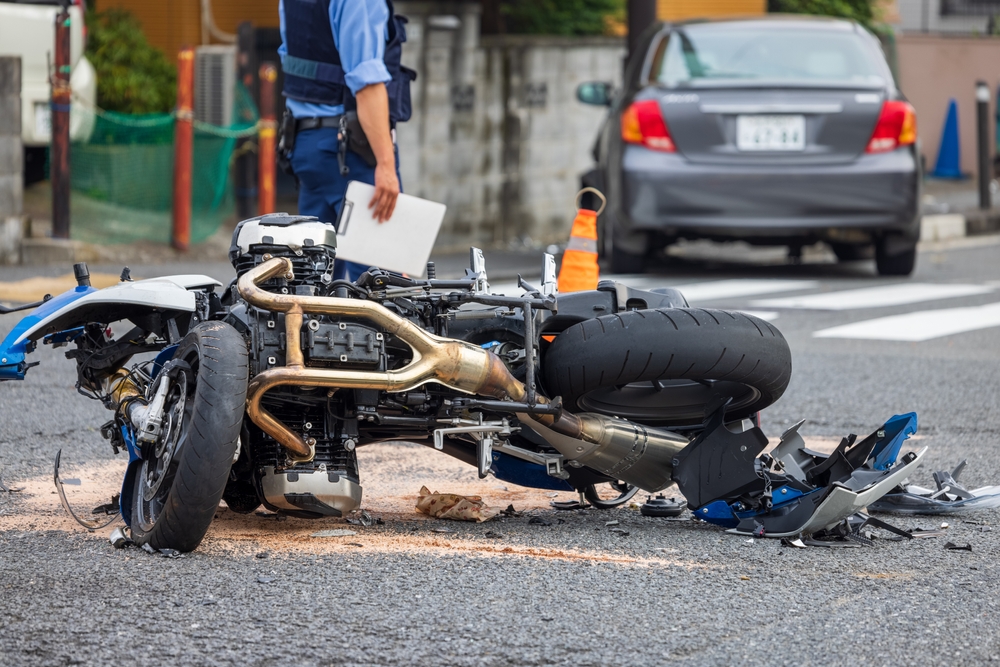
Vehicle-versus-motorcycle crashes in Spokane concentrate on three corridors: downtown intersections, Highway 2, and SR-195. According to the Washington State Patrol, crashes in Eastern Washington are distributed across both urban and rural roads, with each environment producing a distinct crash pattern.
What Makes Downtown Spokane Intersections Dangerous for Riders?
Downtown Spokane’s mix of one-way streets, angled intersections, and high pedestrian-vehicle conflict points creates a demanding environment for motorcyclists. Drivers making left turns across approaching motorcycle traffic, the most common serious motorcycle crash type nationally, are a persistent hazard at signalized intersections throughout central Spokane.
Faded lane markings and poorly designed intersection geometry in parts of the city contribute to conditions where drivers misjudge the speed and position of approaching motorcycles.
How Does Highway 2 Create Unique Risks for Spokane Motorcyclists?
Highway 2’s two-lane sections, limited sight distances on curves, and crosswind exposure create conditions where crashes occur at speeds that produce catastrophic injuries. Its mix of local and through traffic on rural corridors east and west of Spokane creates constant conflict between vehicles traveling at different speeds. Riders using Highway 2 for recreational or commuter purposes face a different risk profile than those on urban streets.
What Crash Risks Does the SR-195 Corridor Present?
Drivers entering or crossing SR-195 from side roads frequently fail to yield to oncoming motorcycle traffic, making intersection crashes the dominant crash type on this corridor. SR-195 runs south from Spokane toward Pullman and carries a mix of commuter, student, and agricultural traffic. The highway’s multiple passing zones, speed transitions, and rural road crossings are common crash sites for motorcycles.
Were you injured on any of these corridors? Call Boohoff Law: (877) 999-9999
Spokane Office Location
Address: 905 W Riverside Ave., Ste 503
Spokane, WA 99201
How Does Washington’s Helmet Law Affect a Motorcycle Accident Claim?

Washington’s mandatory helmet law affects motorcycle claims in two ways depending on whether the rider was wearing a helmet at the time of the crash. The outcome is significantly different in each scenario.
What Happens If You Were Wearing a Helmet When the Crash Occurred?
Compliance with Washington’s helmet law strengthens your claim. A rider who was wearing the required equipment removes one of the most common arguments insurers use to assign comparative fault, that the rider’s own choices contributed to injury severity. In a state where helmet use is mandatory, wearing a helmet is simply following the law. It does not create an argument for the other side.
What If You Were Not Wearing a Helmet at the Time of the Crash?
Not wearing a helmet gives the at-fault driver’s insurer grounds to argue your head injuries were made worse by your own decision, a comparative fault argument that can reduce head-injury-related damages. Riding without a helmet in Washington violates RCW 46.37.530. However, this argument does not eliminate your claim entirely, and it does not affect damages for injuries unrelated to head trauma.
An attorney evaluates how this issue applies to the specific injuries in your case.
Questions about how the helmet issue affects your claim? Call us: (877) 999-9999
What Makes Motorcycle Accident Injuries So Costly in Spokane Cases?
A motorcycle crash and a car crash at the same speed produce dramatically different injury profiles. Motorcyclists have no structural protection, no steel frame, no airbags, no crumple zone absorbing energy before it reaches the rider. The injuries that result are not just physically severe. They are legally significant because of what they cost over time.
What Types of Injuries Drive the Value of a Motorcycle Claim?
Traumatic brain injuries, even with helmets, remain the most serious category of motorcycle crash injury. Spinal cord damage, ranging from herniated discs to complete paralysis, is documented at high rates in motorcycle crashes.
Long bone fractures, pelvic injuries, and road rash requiring skin grafts and multiple surgeries are common outcomes of crashes at highway speed. Each of these injury types generates not just immediate medical costs but long-term care needs, rehabilitation expenses, and potential permanent limitations on work capacity.
How Do Permanent Injuries Affect the Value of a Spokane Motorcycle Claim?
Washington law allows injured motorcyclists to pursue non-economic damages without a cap in most personal injury cases. Permanent disability, chronic pain, disfigurement from scarring, and the loss of the ability to ride, work, or engage in activities the rider valued before the crash, these are all legally compensable losses. In serious cases, non-economic damages can represent the largest component of total compensation.
What Does Future Medical Cost Projection Mean for a Motorcycle Claim?
When injuries are permanent or require ongoing care, an attorney works with medical and economic specialists to project the full cost of future treatment. This projection, covering surgeries, therapy, adaptive equipment, and long-term care, is submitted as part of the damages demand. Insurance companies routinely underestimate future costs in early offers. Building a documented, supported projection of future medical needs is one of the most important steps in a serious motorcycle injury case.
Ready to understand what your motorcycle claim may be worth? Call Boohoff Law: (877) 999-9999
Who Pays for a Motorcycle Accident in Washington?

Washington’s at-fault system means the driver who caused the crash is financially responsible for the resulting damages through their liability insurance. But the insurance landscape for motorcycle crashes in Washington has specific features that affect how claims are paid.
What Insurance Coverage Does Washington Require for Motorcycles?
Washington requires motorcycle owners to carry liability insurance but does not require uninsured motorist coverage, known as UM, or underinsured motorist coverage, known as UIM. These optional coverages protect you when the at-fault driver carries no insurance or insufficient insurance to cover your damages.
Given that serious motorcycle crashes frequently produce damages that exceed the minimum liability limits most Washington drivers carry, UM and UIM coverage on your own motorcycle policy are among the most important financial protections a rider can have.
What If the At-Fault Driver’s Insurance Is Not Enough?
Washington’s minimum auto liability requirements, $25,000 per person in bodily injury, are routinely insufficient for serious motorcycle injuries. When the at-fault driver’s coverage is exhausted, your own UIM coverage pays the difference up to your policy limits.
An attorney identifies every available source of compensation, including coverage from the at-fault driver’s policy, your own motorcycle policy, and any household auto policies that may extend coverage.
Can a Motorcycle Rider Pursue a Claim Against the Government for Road Conditions?
In limited circumstances, yes. When a defective road condition, a pothole, missing lane marking, inadequate signage, or dangerous intersection design, contributes to a motorcycle crash, the government agency responsible for maintaining that road may bear partial liability. The Washington State Department of Transportation maintains state highways, while city and county roads are the responsibility of local agencies.
Claims against these entities require a formal notice of claim, a written document submitted to the government agency within a specific deadline, often 60 to 180 days, that formally notifies them of your intent to seek compensation, before any lawsuit can be filed.
Questions about who is responsible for your Spokane motorcycle crash? Call us: (877) 999-9999
What Evidence Matters Most in a Spokane Motorcycle Accident Case?

Building a strong case in Spokane requires preserving specific evidence before it is lost or overwritten. Our legal team focuses on five critical categories of proof:
1. Official Reports and Visual Proof
- Police Reports: Establishes the official record of citations, location, and preliminary fault.
- Crash Scene Photos: Captures skid marks, debris patterns, intersection geometry, and road conditions specific to Spokane’s seasonal weather.
- Video Footage: We secure time-sensitive data from traffic cameras, dashcams, and nearby business security systems before it is deleted.
2. Technical and Forensic Data
- Event Data Recorders (EDR): Onboard “black boxes” in newer vehicles capture speed, braking, and steering inputs in the seconds before impact.
- Motorcycle Mechanics: Analysis of damage patterns and tire conditions helps reconstruct the physics of the crash.
3. Witness and Expert Testimony
- Eye-Witness Statements: Crucial for countering “biker bias” and proving the at-fault driver’s negligence.
- Accident Reconstruction: Expert analysis of the evidence to build a bulletproof narrative of the event.
The Clock is Ticking: Evidence Preservation
Evidence in Spokane motorcycle accidents has a short lifespan. Without a formal Letter of Preservation, digital footage is typically overwritten within days, and physical evidence disappears. An attorney who begins the investigation immediately ensures that the facts are protected, not lost.
Don’t wait on evidence. Call Boohoff Law now: (877) 999-9999
How Boohoff Law Handles Spokane Motorcycle Accident Cases

Motorcycle accident cases require attorneys who understand how insurers approach these claims and how to counter them. At Boohoff Law, we investigate motorcycle crashes independently, preserve evidence before it disappears, and build liability cases that account for every aspect of the at-fault driver’s failure.
We handle the full claims process, from the initial investigation through settlement negotiations and, when necessary, litigation. Our Spokane car accident attorneys and personal injury team bring the same resources to motorcycle cases that we bring to every serious injury claim across Washington.
Our Seattle motorcycle accident lawyers and broader Washington team have recovered millions for injured clients across the state. We work on contingency, no upfront costs, no fees unless we recover compensation for you.
Contact us online or call (877) 999-9999 to speak with a Spokane motorcycle accident lawyer today.
Frequently Asked Questions: Spokane Motorcycle Accident Claims
Does a rider need a motorcycle endorsement in Washington, and does it affect a claim?
Yes. Washington requires motorcyclists to obtain a motorcycle endorsement, a separate credential added to a standard driver’s license through the Washington Department of Licensing, before legally operating a motorcycle on public roads.
Riding without an endorsement violates state law, and an insurance company may use that violation to argue comparative fault. An attorney evaluates the extent to which that argument affects a specific claim and challenges it with evidence where appropriate.
Can a family member file a claim if a Spokane motorcyclist was killed?
Yes. Washington’s wrongful death statute allows surviving family members to pursue a claim when negligence causes a fatal motorcycle crash. Washington’s wrongful death law is broader than many states in identifying who may file: spouses, children, and in some circumstances parents and siblings of the deceased may have the legal right, known as standing, meaning the recognized authority under the law, to pursue their own losses, including loss of financial support, companionship, and the grief caused by the death.
These claims run alongside any claim the deceased’s estate may bring for injuries suffered before death.
What if I was partly at fault for my Spokane motorcycle crash?
You can still recover compensation. Washington’s pure comparative negligence rule allows recovery regardless of fault percentage. Your recovery is reduced proportionally, 30% fault means 30% less in compensation.
Unlike many other states that bar recovery at 50% or higher fault, Washington has no such cutoff. Insurance companies frequently overstate a rider’s fault to reduce what they pay. An attorney challenges those assignments with crash evidence and applicable legal standards.
What if I wasn’t insured at the time of the crash?
Riding without the required insurance in Washington is a traffic violation, and an insurer may use it in a comparative fault argument. However, it does not automatically bar your personal injury claim against the at-fault driver.
Your ability to recover from the at-fault driver’s liability coverage is separate from your own insurance status. An attorney evaluates how your insurance situation affects your specific claim and identifies every available path to recovery.
How long do I have to file a motorcycle accident lawsuit in Spokane?
Washington’s statute of limitations for personal injury claims is three years from the date of the crash under RCW 4.16.080. For wrongful death claims, the three-year period runs from the date of death. If a government entity is involved, a city, county, or WSDOT (Washington Department of Transportation), the notice of claim deadline is significantly shorter, often 60 to 180 days. Camera footage disappears within days. Contacting an attorney as soon as possible after the crash protects both the evidence and the legal options.
Talk to a Spokane Motorcycle Accident Lawyer at Boohoff Law

Motorcycle crashes produce serious injuries and complicated claims. The at-fault driver’s insurance company will investigate, evaluate, and respond in ways designed to minimize what they pay. You need representation that starts just as quickly.
Boohoff Law represents injured motorcyclists across Spokane and Eastern Washington. We know this area, these roads, and these claims. The consultation is free. You pay nothing unless we recover.
Call (877) 999-9999 or contact us online to speak with a Spokane motorcycle accident lawyer today.


Free Consultation
We Are Here For You 24/7
Recovery is personal.

We’re here for you.
We’re close by. And if you can’t make it to us, we’ll meet you where you need us, at home or in the hospital.








© 2025 Boohoff Law, P.A. — Auto Accident Lawyers.
The information on this website is for general information purposes only. Nothing on this site should be taken as legal advice for any individual case or situation. This information is not intended to create, and receipt or viewing does not constitute, an attorney-client relationship.
Disclaimer: The results and testimonials presented on this website are based on the unique facts and circumstances of each case. Past results do not guarantee or predict similar outcomes in future cases. Every legal matter is different, and you should not rely on prior case results as an expectation of future performance.
