What Counts as Distracted Driving Under Washington Law?
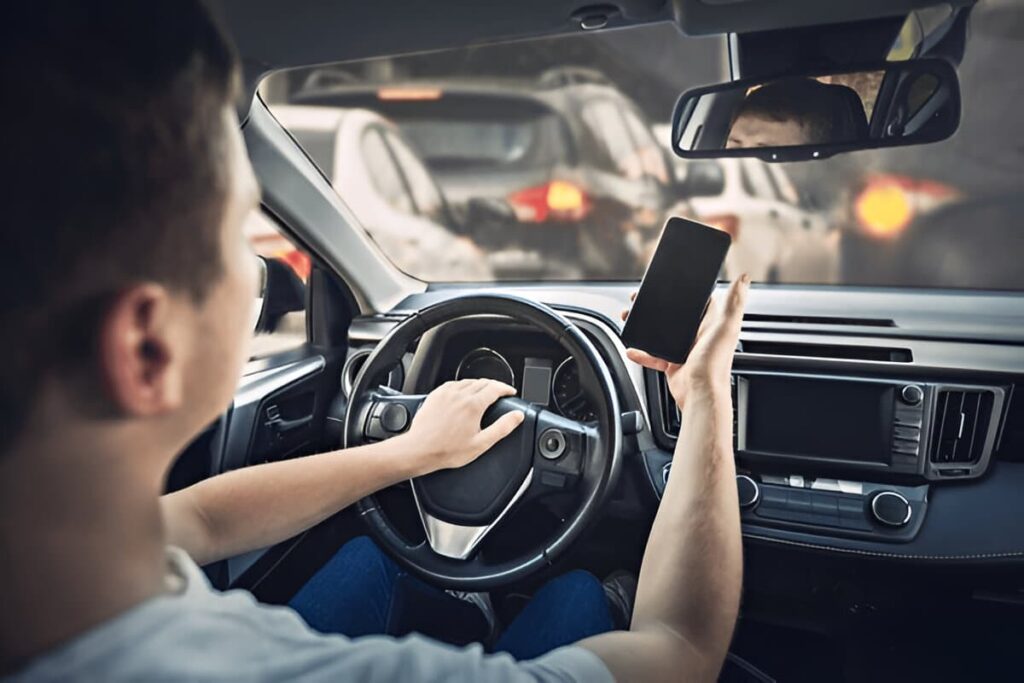
Washington treats two things as distracted driving: holding or typing on a phone or other electronic device while driving, even at a red light, and any other activity that interferes with safe driving, like eating or grooming.
Plenty of drivers treat a red light as a free moment to check a text. Washington distracted driving law says otherwise, because the statute still considers you to be driving while you’re stopped for traffic or a signal.
That surprise is one of several gaps between what people assume and what the law covers. The definitions matter for more than tickets, too. After a crash, it can make a real difference whether the other driver broke the phone law or was distracted by a breakfast sandwich.
If a distracted driver hit you in Thurston County, an Olympia distracted driving accident lawyer can review your situation for free and explain your options.
The Essentials
- Washington prohibits holding a personal electronic device while driving, including at stoplights and in stopped traffic.
- A single tap or swipe to start or end a function, such as navigation, is allowed.
- A separate “dangerously distracted” infraction covers activities like eating or grooming, but only as a secondary offense.
- A second phone-use ticket costs double the first.
- The Washington State Patrol reports phone-use violations to insurance companies.
What Does Washington Law Consider Distracted Driving?
Washington law defines distracted driving through two statutes. One bans using a personal electronic device while driving, and the other penalizes any other activity that interferes with safe driving.
Using a Personal Electronic Device While Driving
RCW 46.61.672 makes it a traffic infraction to use a personal electronic device while driving a motor vehicle on a public highway. “Use” means holding the device in either hand, using a hand or finger to type, send, or read, or watching video on it.
This is a primary offense, so an officer can pull you over for it alone. Phones are the obvious example. Tablets and other portable devices fall under the same rule.
Dangerously Distracted Driving
RCW 46.61.673 covers activities unrelated to driving that interfere with operating the vehicle safely. It’s a secondary offense. An officer can add it only after stopping you for some other violation, like speeding or drifting across lanes.
Think of eating a messy meal, putting on makeup, reading a paper map, or turning around to deal with kids in the back seat.
What Phone Use Is Legal or Illegal While Driving in Washington?
Under Washington law, “using” a phone means holding it, typing or reading on it, or watching video, while a quick touch to activate or end a function is allowed. What matters is what your hands and eyes are doing. Here’s how common situations sort out for fully licensed drivers under RCW 46.61.672:
| Activity | What the Law Allows |
|---|---|
| Holding a phone while driving | Not allowed |
| Typing or reading messages | Not allowed |
| Watching video on a device | Not allowed |
| One tap or swipe on a mounted device to activate or end a function | Allowed |
| Holding or typing on a phone at a red light | Not allowed; stopped traffic still counts as driving |
| Hands-free call with phone mounted or using the car’s system | Generally allowed for fully licensed drivers |
The pattern is consistent across the table. A phone that stays mounted and gets one quick tap is within the rules, while a phone in your hand or under your typing thumb is not.
Can You Be Ticketed for Eating or Grooming While Driving?
Eating, applying makeup, or reaching for something isn’t illegal by itself in Washington. It can lead to a “dangerously distracted” ticket, though, if it interferes with safe driving and an officer has already stopped you for another violation.
The legislature made dangerously distracted driving a secondary offense, so an officer can’t pull you over just for sipping coffee. The base penalty is $30, and the citation rides along with whatever violation prompted the stop.
Activities that rarely lead to tickets still matter in a crash claim. A driver who rear-ended you while unwrapping a burrito may never be cited for distraction, but witness accounts and the driver’s own statements can show the same lapse in attention that a phone would.
What Are Washington Distracted Driving Penalties?
A first phone-use ticket in Washington carries a $48 base penalty under court rules, and required fees push the total well above that. Repeat offenses cost double.
The amounts break down this way:
- First device-use ticket: $48 base penalty, plus court-added fees that raise the total
- Repeat device-use ticket: double the penalty
- Device use in a designated crash prevention zone: doubled, with no waiver allowed
- Dangerously distracted ticket: $30 base penalty, issued only alongside another violation
State law currently limits crash prevention zones to certain stretches of US 395 and US 12, so none apply in Thurston County. The Washington State Patrol says each phone-use offense is reported to your insurance companies, so a ticket can follow you beyond the courthouse.
Common Myths About Washington Distracted Driving Laws
Many drivers carry assumptions about the phone law that don’t match the statute. These are the ones that come up most:
- “It’s fine at a red light.” The law counts being temporarily stopped for traffic or a traffic signal as driving.
- “A mounted phone means anything goes.” Mounting the phone doesn’t permit typing or reading; only a minimal touch to start or end a function is allowed.
- “Only phones count.” The rule covers personal electronic devices generally, including tablets.
- “Eating is always legal.” It’s legal until it interferes with safe driving, and then it can support a secondary citation.
- “A ticket is the only consequence.” Violations get reported to insurers, and the same conduct can be used to show fault after a crash.
Each myth has the same weak spot: it treats the law as a narrow phone ban, when the statutes really ask whether your attention was on the road.
How Can Drivers Avoid Distractions Behind the Wheel?
Most drivers can avoid a distracted driving ticket with a few habits built around setting things up before the car moves. These small routines also reduce the chance of being blamed for a crash.
Set Up Your Phone Before Driving
Many drivers find it helpful to start navigation, choose music, and send that last message before leaving the driveway or parking spot. A phone set up in advance needs no more than a single tap once you’re moving.
Let Passengers Handle the Phone
When someone else is in the car, handing the phone to a passenger is an easy fix. The law limits what the driver does with a device, so a passenger reading directions aloud or answering a text keeps the driver’s hands free.
Pull Off the Road When a Message Cannot Wait
When a call needs real attention or a message can’t wait, consider pulling safely off the roadway first. Once you’re stopped off the road, the device-use statute no longer applies.
What Rules Apply to Teen Drivers?
Washington’s phone rules apply to every driver, and teens with an intermediate license can’t use a wireless device while driving at all, except in an emergency. Families who agree on a routine, such as phones mounted and set to driving mode before the car leaves the driveway, tend to follow it more consistently than drivers who rely on willpower once a notification lights up.
Passengers can help, too, by handling navigation changes and replies so the driver never has to pick up the phone.

How Does Distracted Driving Affect a Washington Crash Claim?
The definition matters after a crash because a distracted driver failed to drive with reasonable care, whether the distraction was a phone or something else. That failure is the core of a negligence claim, and it helps decide who pays for the harm.
What Evidence Can Prove Distracted Driving?
Washington also uses pure comparative fault, so an insurer may argue you were partly distracted too, which would reduce your recovery by your share of the blame. Evidence that tends to show what the other driver was doing includes:
- Phone records obtained through the claim or lawsuit process
- Statements from witnesses or passengers
- Dashcam, traffic camera, or business surveillance video
- The driver’s own admissions at the scene or in the police report
- Crash patterns, like no braking before impact
Each of these has a shelf life, which is why proving distraction usually starts with preservation requests. An Olympia car accident lawyer can send them before the evidence disappears.
Washington Distracted Driving FAQs
These questions come up often among drivers trying to stay on the right side of the law.
Can You Talk on Speakerphone While Driving?
Talking on speakerphone while driving is legal in Washington as long as you aren’t holding the phone and you start or end the call with only a minimal touch. A phone resting in your hand on speaker still counts as “use” under RCW 46.61.672, so the safer setup is a mounted phone or a car’s built-in system, though intermediate-license drivers can’t use one even on speaker.
Does Washington’s Phone Law Apply in Parking Lots?
Washington’s phone-use law applies to driving on a public highway, so a private parking lot generally falls outside it. That doesn’t make distraction harmless there. A driver who hits someone in a lot while scrolling can still be found negligent in an injury claim, and the phone use becomes evidence of that carelessness.
What About Commercial Truck Drivers?
Commercial truck drivers in Washington follow federal motor carrier rules on phone use. RCW 46.61.672 has an exception for commercial drivers acting as federal law allows. Those federal rules also limit hand-held phone use, so a trucker scrolling through messages still faces scrutiny after a crash.
Can You Use a Voice Assistant While Driving?
Using a voice assistant generally doesn’t break Washington’s phone law if the device stays out of your hand. Starting it with one touch or a spoken command is fine. The dangerously distracted statute could still apply if the activity pulls your focus and you’re stopped for another violation.
Can You Obtain the Other Driver’s Phone Records?
The other driver’s phone records can be used as evidence after a Washington crash. They usually have to come through formal legal requests during a claim or lawsuit, not by asking the driver or the phone carrier. Acting quickly helps, because carriers don’t keep every type of record forever.
Help After a Distracted Driving Crash in Washington
A distracted driving crash often comes down to a few seconds of attention that someone spent somewhere else. Proving it takes records and timing. That work is easier when it starts early, before phone data and video get overwritten.
Boohoff Law represents people hurt by distracted drivers in Olympia and across Washington, and the first consultation is free. You’re better off with Boohoff when the other side wants to blame you instead. Start with a free case review in English or Spanish, any time.

Free Consultation
We Are Here For You 24/7
Reviews

– Elissa M.
“Really pleased with Boohoff Law! Received immediate responses when I had any questions. Treated amazingly by all staff … made this process a true breeze!”
– Caitlyn M.
– Brandy K.
Related Posts
How Medical Malpractice Claims Work in Washington State
Nursing Home Abuse Warning Signs Every Washington Family Should Know
What Counts as Distracted Driving Under Washington Law?
Recovery is personal.
We've recovered millions for injured clients, but no two cases are alike. Your injuries, your family, and your goals shape how we build your claim and when we push back on the insurance company.
We’re here for you.
We’re close by. And if you can’t make it to us, we’ll meet you where you need us, at home or in the hospital.










© 2025 Boohoff Law, P.A. — Auto Accident Lawyers.
The information on this website is for general information purposes only. Nothing on this site should be taken as legal advice for any individual case or situation. This information is not intended to create, and receipt or viewing does not constitute, an attorney-client relationship.
Disclaimer: The results and testimonials presented on this website are based on the unique facts and circumstances of each case. Past results do not guarantee or predict similar outcomes in future cases. Every legal matter is different, and you should not rely on prior case results as an expectation of future performance.
