No Fees
Unless We Win
Millions Recovered!
Everett Bus Accident Lawyers
The first thing that decides how your case proceeds is not how badly you were hurt. It is which bus was involved.
Three separate public bus systems run through Everett streets, and each one is a legally different entity with its own claim agent and its own address where the paperwork has to land. Sending a claim to the wrong one does not pause anything. Our Everett bus accident lawyers identify the operator, present the claim to the correct agent, and protect the deadline while the rest of the case gets built.
Boohoff Law has an office at 2902 Colby Ave, Suite 103, in downtown Everett. For the wider view of how we handle injury cases in this county, start with our Everett personal injury attorney page. If you already know a bus was involved, keep reading. The procedure below is what governs your claim.
Available 24/7
Our specialists are here to listen and help for free, no strings attached.
877-999-9999
for a free consultation
Which Agency’s Bus Was It, and Why Does That Change Your Claim?
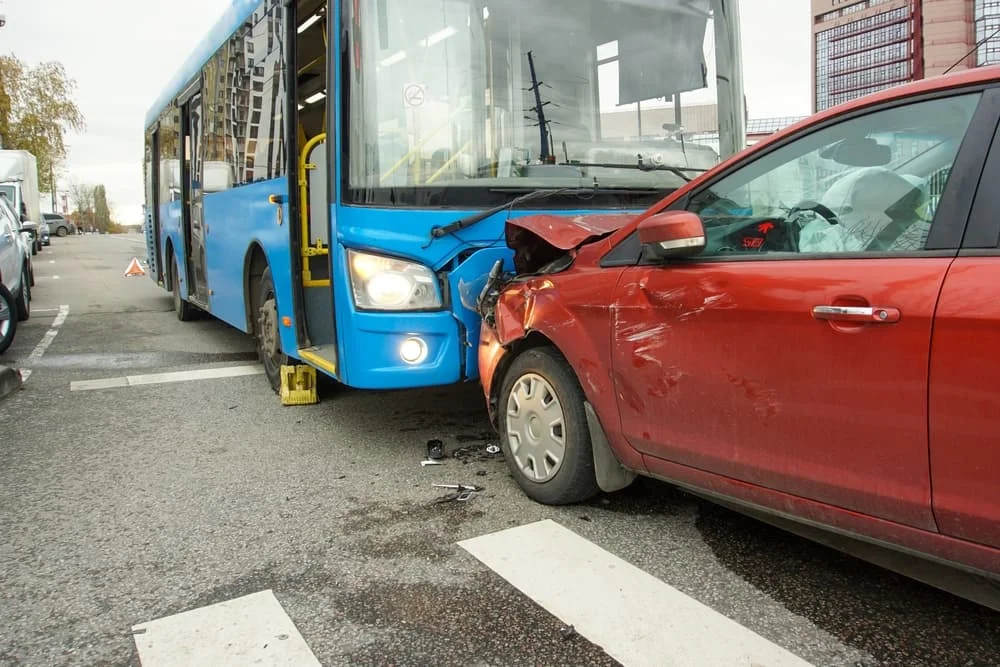
Everett is served by three separate public transit agencies, plus school district buses and private carriers, and each one is a different legal defendant with a different place to send a claim. Everett Transit is a department of the City of Everett. Community Transit and Sound Transit are separate agencies that appoint their own claim agents. Getting the operator right is the first real step in the case, because a claim delivered to the wrong entity does not count as presented.
Here is how the systems divide up. Everett Transit runs local service inside the city. Community Transit serves all of Snohomish County except Everett and operates the Swift bus rapid transit lines, Red, Green and Orange. Bus rapid transit, or BRT, means high frequency buses on a fixed corridor with limited stops, more like a rail line than a local route.
Sound Transit runs ST Express routes 510, 512 and 532 through town, along with Sounder N Line commuter rail.
No rider tracks any of that. You board the bus at the stop when you get there. That is especially true in a city where Boeing runs three shifts, putting buses on the road at hours most people never see, carrying riders headed to work at 4 a.m. or home at midnight.
The insurer knows exactly which entity it is. You are the one who has to figure it out.
| Operator | Who they legally are | Where the claim goes |
|---|---|---|
| Everett Transit | A department of the City of Everett, not an independent agency | To the City of Everett’s appointed claim agent, under RCW 4.96.020 |
| Community Transit | A separate public transit agency, legally distinct from the City of Everett | To Community Transit’s own appointed claim agent, under RCW 4.96.020 |
| Sound Transit | A separate regional transit agency, distinct from both the city and the county | To Sound Transit’s own appointed claim agent, under RCW 4.96.020 |
| A public school district bus | A local government entity in its own right | To that school district’s appointed claim agent, under RCW 4.96.020 |
| Greyhound, FlixBus or a private charter | Private companies, not government at all | No government claim form and no waiting period. An ordinary insurance claim or lawsuit |
One row of that table is changing. Everett Transit is being absorbed into Community Transit. A public open house was scheduled for August 19, 2026, a draft interlocal agreement was expected in September 2026, and the Everett City Council could vote as soon as October 2026. If it moves forward, the integrated network phases in starting March 2028, and Everett Transit employees transfer to Community Transit.
None of that is final. What it means for you is simple: the correct entity to name depends on the date of your crash and the state of the agreement when the claim is filed, and that is a question worth asking out loud rather than assuming.
One more thing people get wrong: light rail is not about to arrive in Everett. Construction on the Everett Link extension runs from 2030 to 2037, with service to the southwest Everett industrial center in 2037 and to SR 526 at Evergreen and to Everett Station in 2041. Lynnwood is still the northern end of the line.
For the next several years, buses are the transit system here. Bus claims in this city are not a niche category.
The 60 Day Rule That Catches Everett Bus Claims
 Before you can sue a Washington government entity, you have to present a written claim and then wait 60 calendar days. The statute of limitations is paused during that waiting period, so presenting the claim buys you time instead of spending it. Washington has no separate 90 day or 180 day claim deadline, which is the trap people arriving from other states expect and brace for.
For local governments, the rule is RCW 4.96.020. RCW stands for the Revised Code of Washington, where the state’s statutes are collected. Every local entity has to appoint an agent to receive claims, and the claim has to go to that entity’s own agent.
Everett Transit means the City of Everett’s agent. Community Transit, Sound Transit and a school district each have their own.
State agencies are a different chapter and a different address. Say the Washington State Department of Transportation is a defendant over how a state route was designed. That claim goes to the Office of Risk Management at the Department of Enterprise Services, on a mandatory standard form, under RCW 4.92.100 and RCW 4.92.110. The state publishes its claim filing instructions and the required form directly.
A local claim form sent to the state office, or a state form sent to a transit agency, accomplishes nothing.
Where the claim actually gets delivered
The waiting period runs 60 calendar days from presentation, not from the crash. During those 60 days, the three year filing clock stops. If the case has to be filed in court, a suit filed within five court days after the waiting period ends is treated as timely.
That is the whole mechanic. What goes wrong is almost never the law. It is a claim that sat with the wrong agency for four months while the clock ran, or was never formally presented at all because a call to a claims line felt like the same thing. It is not.
What If My Child Was Hurt on a School Bus in Everett?

A school bus injury claim in Washington is brought against the school district, and a school district is a local government entity, so the same written claim and the same 60 day waiting period apply. You are on the identical track as a transit claim, just with a different defendant. The difference is the evidence, because school buses in this state are inspected on a fixed schedule and that creates a paper trail.
The Washington State Patrol Commercial Vehicle Division inspects all public school buses under RCW 46.32.010. There is a summer inspection covering 100 percent of buses, plus an unannounced winter inspection of 25 percent of them. The Office of Superintendent of Public Instruction, usually written as OSPI, is the state agency that administers student transportation.
Why that matters to your claim: mechanical condition is documented, on a schedule, by an outside agency. If a brake, a door, a mirror or a wheelchair lift was part of what happened, records exist and they can be requested. That is a stronger starting position than most vehicle cases begin from.
Two defendants are common in these cases. If another driver caused the collision and the bus was struck, you may have a claim against the district on the government track and a claim against the private driver on the ordinary track at once. Those tracks have different rules and different deadlines, and they have to be managed together from the beginning.
Every day spent guessing which agency to write to comes off the front of your case, not the back. Call +1 (877) 999-9999 and we will identify the operator, prepare the claim, and present it to the agent who is actually authorized to receive it.
Why a Bus Is Held to a Higher Standard Than the Car Next to It
Washington holds common carriers, including buses and transit operators, to the highest degree of care rather than to ordinary care. That was stated plainly in Walker v. King County Metro, 126 Wn. App. 904, 908 (2005). The bar is higher than the one applied to a regular driver, and it applies most directly to what the carrier owes the passengers it is transporting.
A common carrier is a business that transports the general public for a fee or as a public service, as opposed to a private driver taking a private trip. The label carries a duty with it.
In practice, the difference shows up in small decisions. Pulling away from a curb before an older passenger has reached a seat. Braking hard to make a light. A driver looking at a fare dispute instead of the crosswalk.
Conduct that would be treated as an ordinary lapse behind the wheel of a car can fall below what a carrier owes the people riding it.
What the standard does not mean
It does not mean the agency loses automatically. Carriers are not insurers of passenger safety and are not strictly liable, so being injured on a bus is not by itself proof of anything. You still have to show what the operator did or failed to do, and that it caused your injuries.
The heightened standard changes the measuring stick. It does not remove the need to prove the case.
What If I Was Hit by a Bus While Driving, Walking, or Riding a Bike?

You do not have to be a passenger to bring a bus accident claim. Drivers, pedestrians and cyclists struck by a transit bus file through the same procedure against the same agency, with the same written claim and the same 60 day waiting period. Being outside the bus changes the evidence, not the paperwork.
In Everett, that matters more than it might elsewhere. Evergreen Way and SR 99, meaning State Route 99, is the deadliest corridor in the city. Everett’s Vision Zero high injury network also includes Broadway and Rucker Avenue.
There were 44 fatal crashes in Everett between 2018 and 2022, predominantly pedestrian involved. The city has proposed dropping Evergreen Way from 50 to 40 mph and Everett Mall Way from 40 to 35 mph.
Those are the same streets the buses run on, at the same hours people are walking to and from them.
Your own auto coverage can matter here too, and most people do not know what they bought. Washington is an at fault state, not a no fault state, and personal injury protection, known as PIP, is optional. Insurers must offer it under RCW 48.22.085 and you can turn it down in writing. Underinsured and uninsured motorist coverage, written as UIM and UM, works the same way under RCW 48.22.030.
If a private shuttle or charter operator is involved rather than a public agency, the vehicle may carry no more than the state minimum of 25/50/10, meaning $25,000 per person for bodily injury, $50,000 per accident, and $10,000 for property damage. That is when your own UIM policy becomes the difference between a partial recovery and a real one.
What a Bus Claim Is Worth in Snohomish County
A bus claim in Snohomish County is worth what the crash actually cost you: the medical care you have already had and the care still ahead, the income and earning capacity you lost, and the noneconomic harm. Noneconomic harm means pain, loss of function and the parts of a loss that never arrive as a bill. Two rules then shape the final figure, and both run in your favor here.
The first is fault. Under RCW 4.22.005, the state applies pure comparative negligence: your share of fault reduces the award proportionally, but it never eliminates it. Many states cut a claimant off entirely at 50 or 51 percent fault. Washington has no percentage cutoff at all.
The second is the cap, or rather the absence of one. The cap on noneconomic damages was struck down as unconstitutional in Sofie v. Fibreboard Corp., 112 Wn.2d 636 (1989). The legislature repealed the cap statute outright in 2023.
The deadline is three years under RCW 4.16.080(2), extended by the 60 day tolling described above once a government claim is presented. A Snohomish County bus case is filed at Snohomish County Superior Court, 3000 Rockefeller Ave in Everett.
When another vehicle shares the blame
A second at-fault driver usually means a second insurance policy, which can move the final number more than any argument about your own conduct. A bus crash rarely involves only a bus. If another passenger vehicle was part of the collision, our Everett car accident attorney page covers how those claims are built. If a commercial truck was involved, the federal rules and the corporate defendants change the analysis, and our Everett truck accident attorney page walks through that.
Partial fault does not end an Everett bus claim
Expect the argument anyway: you were standing instead of seated, you were not holding the rail, you crossed mid block, you were riding without a light.
Adjusters lead with this because in most states it works, and because a claimant who believes it is over stops calling.
In Washington it reduces a number. It does not close a file. Boohoff Law’s published case results include a $1.5 million recovery in a T-bone collision. Prior results do not guarantee a similar outcome, and every case turns on its own facts.
Everett Bus Accident Questions We Hear Most
Once the agency question is settled, the calls tend to turn to the same practical ground. Short answers are below.
You can still bring a claim. A collision is not what creates liability. Liability comes from the operator falling below the care a carrier owes, and that can happen with nothing else on the road: a hard stop that throws standing riders, a door closing on an arm, pulling away before an older passenger reaches a seat.
What changes is the evidence. There is no crushed bumper to point at, so the proof sits in the onboard video, the vehicle’s speed and braking data, the operator’s log and how many riders were standing. All of it belongs to the agency, and all of it is on a deletion cycle.
No, and you should not sign a broad one. A blanket authorization lets the entity you are claiming against pull your whole medical history, including years of records that have nothing to do with this crash. Those older records then become the argument that your injury started somewhere else.
There is a middle path. Records tied to the treatment at issue can be provided directly, in a set your lawyer has reviewed first. Ask which records are needed, and for what date range, before anyone signs.
It depends on who the defendant is, which is one more reason to identify the operator first. Against a public agency, each injured person presents a separate claim to that entity’s appointed agent under RCW 4.96.020, and yours is measured on your own medical record.
The concern is real with a private carrier. A vehicle carrying the state minimum has $50,000 available per accident for bodily injury, shared among everyone hurt in it. We confirm what coverage exists early rather than assuming, and we read your own underinsured motorist policy at the same time.
Send a written preservation demand to the correct entity as fast as possible, and do it in writing so there is a record of the date. Onboard and station video systems are often set to overwrite themselves on a cycle, and no one at the agency is going to preserve a recording for a claim they have not been told about.
This is one of the most time sensitive things we do on a transit case, and it is a concrete reason not to wait out the first few weeks. The same demand should cover driver logs, maintenance records, dispatch communications and any incident report the operator filed.
An early offer to pay medical bills is not a settlement of your claim, and it is usually far smaller than what the claim is worth. Accepting it can come with a release that closes everything, including the parts of your loss that have not appeared yet.
Have someone read the paperwork before you sign it. If the offer is genuinely fair, that review costs you nothing and confirms it.
Get the Claim in Front of the Right Agency

You do not need to know which bus system it was before you call. Bring us the route number, the date, the direction you were traveling, and anything the driver, dispatcher or a supervisor said afterward. We will identify the operator, present the claim to the agent authorized to receive it, and track the 60 day period and the three year deadline from there.
Call +1 (877) 999-9999. Free case review, day or night, English or Spanish. Recovery is personal, and it starts with getting the file into the right hands.
Recovery is personal.

We’re here for you.
We’re close by. And if you can’t make it to us, we’ll meet you where you need us, at home or in the hospital.







© 2025 Boohoff Law, P.A. — Auto Accident Lawyers.
The information on this website is for general information purposes only. Nothing on this site should be taken as legal advice for any individual case or situation. This information is not intended to create, and receipt or viewing does not constitute, an attorney-client relationship.
Disclaimer: The results and testimonials presented on this website are based on the unique facts and circumstances of each case. Past results do not guarantee or predict similar outcomes in future cases. Every legal matter is different, and you should not rely on prior case results as an expectation of future performance.
