No Fees
Unless We Win
Millions Recovered!

North Port Personal Injury Lawyer
Most people in North Port think the $10,000 on their auto policy is their claim. It is not. It is the first $10,000 of medical bills, it pays 80 percent of them, and in a serious crash it is gone before the first orthopedic appointment.
A North Port personal injury lawyer works on everything that comes after that, which is where the real value of an injury claim sits, whether you were hurt in a crash, on someone’s property, or by a careless driver while you were walking.
If a crash is what brought you here, a North Port car accident attorney from this office handles that claim, and our North Port car accident lawyer page covers how those cases get built. We also take pedestrian, premises liability and wrongful death claims across Sarasota County.
Boohoff Law has an office on Tamiami Trail in North Port. Your case review costs nothing and we work on a contingency fee.
Available 24/7
Our specialists are here to listen and help for free, no strings attached.
877-999-9999
for a free consultation

Where Does the Money Come From After an Injury in North Port?
From layers, in order, and most people only know about the first one.
| Source | What it pays | What people get wrong |
|---|---|---|
| Your PIP coverage | 80% of medical bills and 60% of lost wages, up to $10,000 | It is required in Florida and it applies no matter who caused the crash |
| The at-fault driver’s bodily injury liability | Your injuries beyond PIP, up to their policy limits | Florida does not require drivers to carry it at all |
| Your uninsured or underinsured motorist coverage | What the at-fault driver should have paid but cannot | Many drivers own it without knowing, or declined it without realizing |
| Other responsible parties | Employers of at-fault drivers, property owners, vehicle owners | Often the only meaningful coverage in a serious case |
The second row is the one that surprises people. As Florida Highway Safety and Motor Vehicles states, registered vehicles need $10,000 in PIP and $10,000 in property damage liability, and nothing more. Bodily injury coverage is optional for most drivers, so the person who hurt you may carry nothing at all for your injuries, no matter how clearly the crash was their fault.
That makes your own uninsured motorist coverage the most important line on your policy, and checking your declarations page is one of the first things we do.
What Your Attorney Actually Does on the Claim
Three things, in plain terms.
We move the money question out of your hands. That means opening the PIP claim correctly, identifying every policy that could apply, and dealing with the adjusters so a routine phone call does not become a recorded statement used against you later.
We build the proof while it still exists. Crash reports, scene photographs, business and intersection video before it is recorded over, witness contacts, and vehicle evidence before the car is sold for salvage.
We keep the medical record honest. Not by telling doctors what to write, but by making sure your complaints are documented and your treatment does not have unexplained gaps in it. If the pain is not in the records, the insurance company acts as if it never happened.
Cases Our North Port Office Handles
 Motor vehicle crashes make up most of them. For crash-specific questions about fault and evidence, our North Port car accident lawyer page goes deeper.
Commercial vehicle collisions bring federal safety rules and tight preservation deadlines, which our North Port truck accident lawyer page explains. Fatal accidents follow their own rules about who may file and what can be recovered, covered on our North Port wrongful death attorney page.
We also handle pedestrian and bicycle injuries, motorcycle crashes, dog bites, injuries on poorly maintained property, and catastrophic injury claims involving permanent disability.
What we do not handle, we say so up front and point you somewhere useful. Nobody benefits from a file sitting in the wrong office.
What Should You Do in the First Two Weeks?
Get medical care within 14 days, without exception. Florida requires initial services and care within that window for PIP benefits to apply under Florida Statute 627.736. Miss it and the coverage you have been paying for may not pay anything.
There is a second trap in the same statute. The full $10,000 is available only when a qualifying provider determines you had an emergency medical condition. Without that finding, benefits stop at $2,500.
Beyond the medical piece: report the crash to your own insurer, photograph the vehicles and the scene before anything is moved or repaired, write down what you remember while it is fresh, and hold off on the other driver’s insurance company until you have advice.
Unsure whether your treatment so far protects your claim? Ask us to review it at no cost.
How Long Do You Have to File in Florida?
Two years from the date of the accident for most negligence claims, under Florida Statute 95.11. Florida shortened this from four years in 2023, and people who remember the old rule are the ones who run out of time.
Claims involving a government vehicle or a public road hazard require written presuit notice before any lawsuit, and damages against a state agency or subdivision are capped by statute. Those need to be identified early, because the process adds months.
Can You Still Recover If You Were Partly Responsible?
Yes, unless you were mostly responsible. Florida reduces your recovery by your share of fault and bars it entirely if you are found more than 50 percent at fault, under Florida Statute 768.81.
That threshold is why insurers argue fault so aggressively in Sarasota County claims. Pushing you from 45 percent to 51 percent does not shrink the claim, it ends it.
Why Claims Here Get Undervalued
Because of who lives here, and because two specific arguments work well against that population.
The first is the degeneration argument. In an adult over 55, an MRI almost always shows some arthritis, disc drying, or wear. Insurers use those findings to claim the crash changed nothing and the pain was already there.
The answer is medical and specific: what the imaging showed before, what changed after, what the treating doctor attributes to the crash, and how the symptoms differed from day to day. Florida law does not let a defendant escape liability because an injured person was not in perfect health before the collision.
The second is the minimal damage argument, built on a photograph of a bumper. Vehicles absorb force differently, a tow hitch can leave a bumper looking untouched while the force reaches the people inside, and frame damage often hides behind panels that look fine.
When it matters, we get the repair estimate, ask whether anyone measured for structural damage, and in the right case pull the crash data from the vehicle’s own computer.
The third pattern is not about you at all. Adjusters lowball early and then go quiet, hoping the claim gets abandoned. That approach is cheap and it works often enough to remain standard.
Step by Step, Once We Take Your Case

The first days are about protection. We notify the insurers that you are represented, which stops the calls to you. We open or correct the PIP claim, confirm the 14-day treatment requirement has been satisfied, and make sure the emergency medical condition determination is in the file where it applies.
Then we collect what expires. The full crash report, which people involved in a collision can obtain through the state’s traffic crash report portal while it is still exempt from public release, along with photographs, any camera footage from nearby businesses or homes, witness contact information, and the vehicle itself before it is repaired or sold.
While you treat, we gather records and bills as they are produced, track your progress, and flag gaps before they become a problem. We also review every policy that might respond, including your own uninsured motorist coverage and any coverage held by a relative in your household.
When your treatment is complete or your future care is clear, we build the demand: medical documentation, wage records, the fault evidence, and a valuation that includes what still lies ahead. Carriers usually take a month or two to respond, and the first number is a position rather than an evaluation.
Negotiation follows, and if the carrier will not move, we talk with you about filing suit before the two-year deadline approaches. Most filed cases still settle, often at mediation, but the filing itself changes what a carrier is willing to pay.
Do You Have to Go to Court?
Usually not. The large majority of Florida injury claims settle without a trial, and many settle without a lawsuit ever being filed.
When a suit is necessary, most clients’ involvement is limited to a deposition, answering written questions, and possibly a defense medical examination. Mediation is typically required before trial, and a high percentage of cases end there.
If your case is one of the few that goes to a jury, you will know long before it happens, and nothing gets filed without your decision.
Injuries That Drive the Largest Claims Here
The ones that do not fully heal, and in an older population that is a wider category than people assume.
Spinal injuries, including herniated discs that lead to injections or fusion surgery, generate the highest values because the treatment is expensive and the limitations are permanent. Traumatic brain injuries follow, and they are frequently missed at first because the symptoms look like stress or age.
Hip and pelvic fractures are the ones we worry about most in adults over 65, since the recovery is long, the surgery carries real risk, and independence is often what is actually lost.
Shoulder tears from seat belts and steering wheels, knee injuries from dashboard contact, and wrist fractures from bracing all fall in the middle: surgery is common, recovery is usually good, and documentation decides value.
The through line is future care. A claim that accounts only for treatment already received is a claim that leaves out the most expensive part.
What If the At-Fault Driver Has No Insurance at All?
You are not out of options, though the path changes.
Your uninsured motorist coverage becomes the primary claim, and it is designed for exactly this: a driver with nothing, a driver with too little, or a hit-and-run vehicle that is never identified. If you declined UM coverage, check whether the rejection was properly documented, because Florida has specific requirements for how that rejection must be made.
Coverage may also exist elsewhere. A relative in your household may have a policy that applies to you. The vehicle the at-fault driver was using may be insured by its owner, even if the driver personally carries nothing. If the driver was working, an employer’s commercial policy may respond.
Suing an uninsured driver personally is possible and rarely productive. A judgment against someone with no assets is a piece of paper, and pursuing it costs money that usually exceeds what comes back. We tell clients that plainly rather than running up costs to prove it.
Where none of those sources exist, the claim shifts to what can actually be recovered: your PIP benefits, your health coverage, and any other policy in reach. That is a difficult conversation, and it is better to have it in week two than in month eight.
Mistakes That Cost Claimants the Most Money
Talking to the other driver’s adjuster without advice, first and foremost. That call has one purpose, and it is not your recovery.
Posting on social media comes second. A photo from a family gathering becomes an exhibit about how well you are doing, without the context of what you paid for it the next day.
Taking an early check is third. Quick offers arrive before anyone knows what your treatment will cost, and the release attached to them ends the claim permanently.
Last, and most common here, is quietly stopping treatment. People stop because of cost, because of transportation, or because they do not want to be a bother. Tell us instead, because there are usually ways to keep care going, and an unexplained gap is the cheapest argument an insurer can make.
What Local Experience Changes
Cases that get filed in Sarasota County are handled in the Twelfth Judicial Circuit, and how a claim is likely to be received there shapes settlement value long before any trial date exists.
The local road picture matters too. US-41, the Tamiami Trail, carries through-traffic past constant driveway turns. Sumter Boulevard, Price Boulevard, and Toledo Blade Boulevard move fast between long blocks with limited lighting, and the corridors feeding into the Wellen Park development have absorbed years of new traffic on road designs that predate it.
Seasonal traffic adds the rest: more drivers on the road from late fall through spring, many unfamiliar with the roads and driving rental cars insured in other states. Those claims take more work to place with the right carrier, and they are routinely mishandled by people who assume Florida rules apply to every policy.
How We Work With North Port Clients
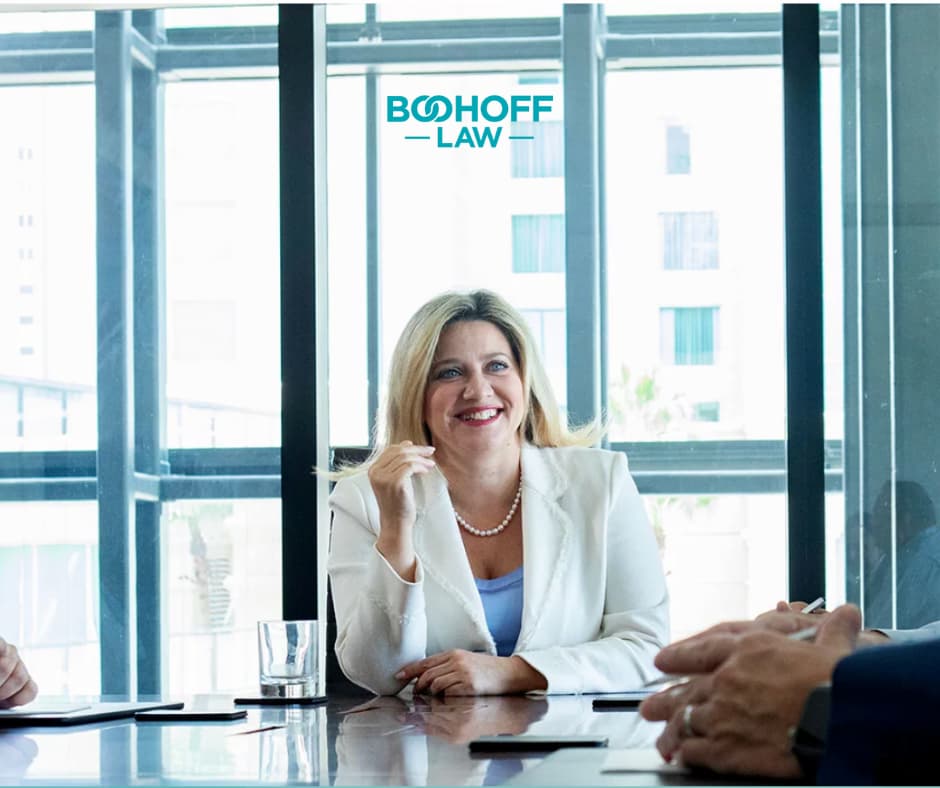
Our office is at 14900 Tamiami Trail. We handle claims in English and Spanish, and we meet clients at home or in a hospital room when getting to an office is not realistic.
You get one point of contact, updates that include the boring stretches, and a straight answer when the answer is not the one you wanted. Some clients want a phone call every few weeks, some want email only. We work the way you prefer.
Founder Tatiana Boohoff is admitted in Florida and Washington and is a Life Member of the Million Dollar Advocates Forum. The firm’s published results include $9,000,000 in a catastrophic highway crash, $1,300,000 in a fatal motorcycle collision, and $1,250,000 for a pedestrian struck near a marked crosswalk. Past results do not guarantee or predict similar outcomes in future cases.
We’re here for you, around the clock.
North Port Injury Questions We Answer Every Week
Usually yes. PIP generally follows you as a person rather than a vehicle, so your own policy typically covers your initial treatment when you were a passenger, a pedestrian, or a cyclist. If you do not own a policy, coverage may come from a relative in your household, and if neither exists, the vehicle owner’s policy may apply.
Using no-fault benefits after a crash you did not cause should not raise your premium by itself, since PIP is coverage you already paid for and it is designed to be used. If you see a rate change after a not-at-fault claim, ask for the reason in writing, because it may have nothing to do with the crash.
You can claim the losses you actually have, which look different after retirement. That includes part-time or seasonal work you can no longer do, volunteer commitments with a measurable value, and the household services you used to handle yourself and now have to pay someone for, such as yard work, cleaning, or driving. Those are real damages and they get overlooked constantly.
Usually yes, because most policies include a cooperation clause, and that is different from the other driver’s insurer, who you are not obligated to speak with at all. The distinction matters, and so does preparation.
We sit in on these when we represent a client, so a question about “how are you feeling today” does not become a quote about how you felt for the next two years.
It changes the paperwork more than the rights. Out-of-state policies often provide coverage in Florida under different terms, rental cars add a second layer of coverage, and some visiting drivers carry higher bodily injury limits than Florida drivers do. Identifying which policy responds, and in what order, is part of the early work.
Florida law requires a crash report in most situations involving injury, death, or significant property damage, and law enforcement generally files it when officers respond.
If police did not come to the scene, a driver-submitted report may be required within a set period. Either way, report the crash to your own insurer promptly, because your policy requires notice and your PIP claim cannot open without it.
Yes. Plenty of people drive themselves home, sleep badly, and realize the next morning that something is wrong. What matters is getting evaluated within the 14-day PIP window and telling the provider the symptoms began after a crash. Declining an ambulance is not evidence that you were uninjured, though an insurer will present it that way if nothing else in the record contradicts it.
Start With a Conversation That Costs Nothing

You do not need to decide whether you have a case. Bring us the crash report, the name of the insurer calling you, and a short account of your injuries, and we will tell you what your claim looks like and whether you need a lawyer at all.
If the answer is that you can handle it yourself, you will hear that from us.
Call for a free case review or send us your details online. We answer 24/7.

Recovery is personal.

We’re here for you.
We’re close by. And if you can’t make it to us, we’ll meet you where you need us, at home or in the hospital.











© 2025 Boohoff Law, P.A. — Auto Accident Lawyers.
The information on this website is for general information purposes only. Nothing on this site should be taken as legal advice for any individual case or situation. This information is not intended to create, and receipt or viewing does not constitute, an attorney-client relationship.
Disclaimer: The results and testimonials presented on this website are based on the unique facts and circumstances of each case. Past results do not guarantee or predict similar outcomes in future cases. Every legal matter is different, and you should not rely on prior case results as an expectation of future performance.
