Rideshare Accidents in Olympia: Uber and Lyft’s $1 Million Policy (and When It Actually Applies)
Collisions involving Uber and Lyft drivers often result from distracted driving, driver fatigue, speeding, or unfamiliarity with local road conditions. For victims, the aftermath may include painful injuries, mounting medical bills, and prolonged recovery periods that disrupt daily life.
Many people are surprised to learn that Uber and Lyft’s widely advertised $1 million insurance policy does not apply in every situation. Coverage depends on whether the driver was logged into the app, actively transporting a passenger, or between rides at the time of the crash.
A knowledgeable rideshare accident attorney at Boohoff Law, P.A. can support you if you suffered an injury in the crash. We can evaluate the circumstances of your crash, identify all available insurance policies, and pursue the full compensation you deserve for your injuries, losses, and long-term impact.
Key Takeaways about Uber and Lyft’s Policies and when They Apply
- Uber and Lyft’s $1 million insurance policy provides substantial coverage but applies only during active rides, with limited protection when the driver is offline or waiting for requests.
- Determining insurance responsibility depends on the driver’s status, third-party liability, and coordination among personal, rideshare, and other policies.
- Lyft drivers, other negligent motorists, vehicle owners, and even manufacturers may share liability, making legal guidance essential.
- After an Uber accident, seek medical care, file a police report, and consult an experienced rideshare attorney to investigate, file claims, negotiate with insurers, and litigate if necessary.
- Call a rideshare accident attorney to protect your right to fair compensation.
Uber and Lyft $1 Million Insurance Policy
Both Uber and Lyft provide substantial insurance coverage to protect drivers, passengers, and third parties during rideshare trips. Each company maintains a $1 million liability policy that activates once a driver accepts a ride request and remains in effect until the trip concludes.
This comprehensive coverage includes protection for bodily injury and property damage resulting from accidents that occur during active trips. The $1 million policy covers medical expenses, legal fees, and settlements if the driver is at fault in a collision.
Additionally, both companies offer uninsured/underinsured motorist coverage with the same $1 million limit, protecting riders and drivers when other parties lack sufficient insurance.
The coverage structure operates in phases. When drivers are offline, their personal insurance applies. Once the app is on, but no ride is accepted, limited contingent liability coverage exists. The full $1 million policy only applies from the time of ride acceptance through passenger drop-off.
However, the commercial insurance doesn’t cover drivers’ personal vehicle damage during trips. Instead, drivers need rideshare endorsements on their personal policies for comprehensive protection.
Passengers involved in accidents should document everything and may file claims directly with Uber or Lyft’s insurance providers if injuries or damages occur during their ride.
Whose Insurance Pays for a Rideshare Accident
Determining insurance coverage for a rideshare accident depends on the driver’s status at the time of the collision. Rideshare insurance operates in distinct phases, each triggering different coverage levels.
When the driver’s app is completely offline, their personal auto insurance bears full responsibility for any accidents. Once the app activates, different coverage rules apply.
Period 1: App On, Waiting for Requests
When drivers have their rideshare app turned on but haven’t accepted a ride request, they enter a gray area. During this period, Uber and Lyft provide contingent liability coverage, typically around $50,000 per person and $100,000 per accident for bodily injury, plus $25,000 for property damage.
This coverage only applies if the driver’s personal insurance denies the claim. Many personal policies exclude coverage during commercial activities, necessitating this contingent coverage.
Period 2 and 3: Active Ride Coverage
The most robust coverage activates once a driver accepts a ride request. From acceptance through passenger drop-off, both Uber and Lyft’s $1 million liability policies take effect. This commercial insurance becomes the primary coverage, protecting against injuries and property damage caused by the driver.
The companies also provide $1 million in uninsured/underinsured motorist coverage and contingent comprehensive and collision coverage, though deductibles may be high.
When Other Drivers Are at Fault
If another driver causes the accident, their insurance should cover damages to rideshare passengers and drivers. Passengers can file claims against the at-fault driver’s policy for medical expenses and other losses.
If the responsible party lacks sufficient insurance, Uber or Lyft’s uninsured motorist coverage can fill the gap during active rides.
Multiple Insurance Coordination
Some rideshare accidents may involve multiple insurance policies working together. Personal insurance, rideshare company coverage, and third-party policies may all contribute, depending on the determination of fault and coverage limits.
Insurance companies typically negotiate among themselves to determine primary and secondary responsibility. Injured victims should report accidents to all potentially applicable insurers, as coordination between policies can impact claim outcomes and settlement timelines.
Who Is Liable in a Lyft Accident
Determining liability in a Lyft accident is rarely straightforward, as multiple parties may share responsibility depending on the circumstances surrounding the crash. A rideshare accident attorney can investigate the crash to determine liability.
Here are the parties who may be liable:
The Lyft Driver
The Lyft driver may be directly liable if the accident resulted from negligent behavior such as distracted driving, speeding, fatigue, or driving under the influence. Liability often hinges on whether the driver breached their duty of care and whether that breach caused the collision.
The driver’s status in the Lyft app, whether offline, available, or actively transporting a passenger, also helps determine the applicable insurance policy.
Lyft’s Insurance Coverage
Although Lyft classifies its drivers as independent contractors, the company provides tiered insurance coverage that may apply after an accident.
When a driver is logged into the app and waiting for a ride request, Lyft offers limited third-party liability coverage. If the driver has accepted a ride or is transporting a passenger, Lyft’s $1 million liability policy may apply. Disputes frequently arise over the driver’s app status at the time of the crash.
Other Negligent Drivers
In many Lyft accidents, another motorist may be wholly or partially at fault. For example, a third-party driver may have run a red light, failed to yield, or driven recklessly.
In these cases, the at-fault driver’s auto insurance may be the primary source of compensation, with Lyft’s coverage potentially providing excess or supplemental protection.
Vehicle Owners or Employers
If someone other than the driver owned the Lyft vehicle, the vehicle owner may share liability under Washington’s permissive use or negligent entrustment principles. Additionally, if the at-fault driver was operating a vehicle for work purposes outside of Lyft, that employer’s insurance may apply.
Manufacturers and Maintenance Providers
In some cases, a defective vehicle component or negligent maintenance contributes to a Lyft accident. Brake failures, tire blowouts, or steering defects may give rise to claims against manufacturers, parts suppliers, or maintenance companies.
What to Do After an Uber Accident
Taking the right steps after an Uber accident can protect your health, legal rights, and ability to recover compensation. Because rideshare claims involve unique insurance rules and multiple parties, your actions immediately following the crash matter.
Here are the actions you should take after the crash:
Seek Immediate Medical Attention
Even if you believe your injuries are minor, seek medical attention as soon as possible. Some injuries, such as concussions, internal bleeding, soft tissue damage, or spinal trauma, may not produce obvious symptoms right away.
A healthcare provider can diagnose hidden injuries and initiate a treatment plan. They will also generate medical records, which can link the injuries to the accident. A rideshare accident attorney can use emergency room records, diagnostic imaging, and follow-up treatment notes to support your compensation claim.
Prompt medical attention also protects your legal rights. Insurers use gaps in treatment to argue that injuries were not serious or resulted from another cause.
File a Police Crash Report
You should also call law enforcement to the scene to document the collision. They will generate a police crash report that provides an official, neutral account of the accident, including the date, time, location, involved parties, witness statements, and any citations issued.
A rideshare accident attorney can use the document in determining fault.
Once the report is available, obtain a copy for your records. Insurance companies, including Uber’s insurers, routinely rely on police reports when assessing liability and coverage. Without one, your claim may face unnecessary delays or disputes.
Notifying the police about the crash also helps you adhere to legal requirements. In Washington, each driver must report a crash within 4 days if no police investigate the collision and it involves:
- Bodily Injury
- Fatality
- At least $1,000 in property damage
Consult a Rideshare Accident Lawyer
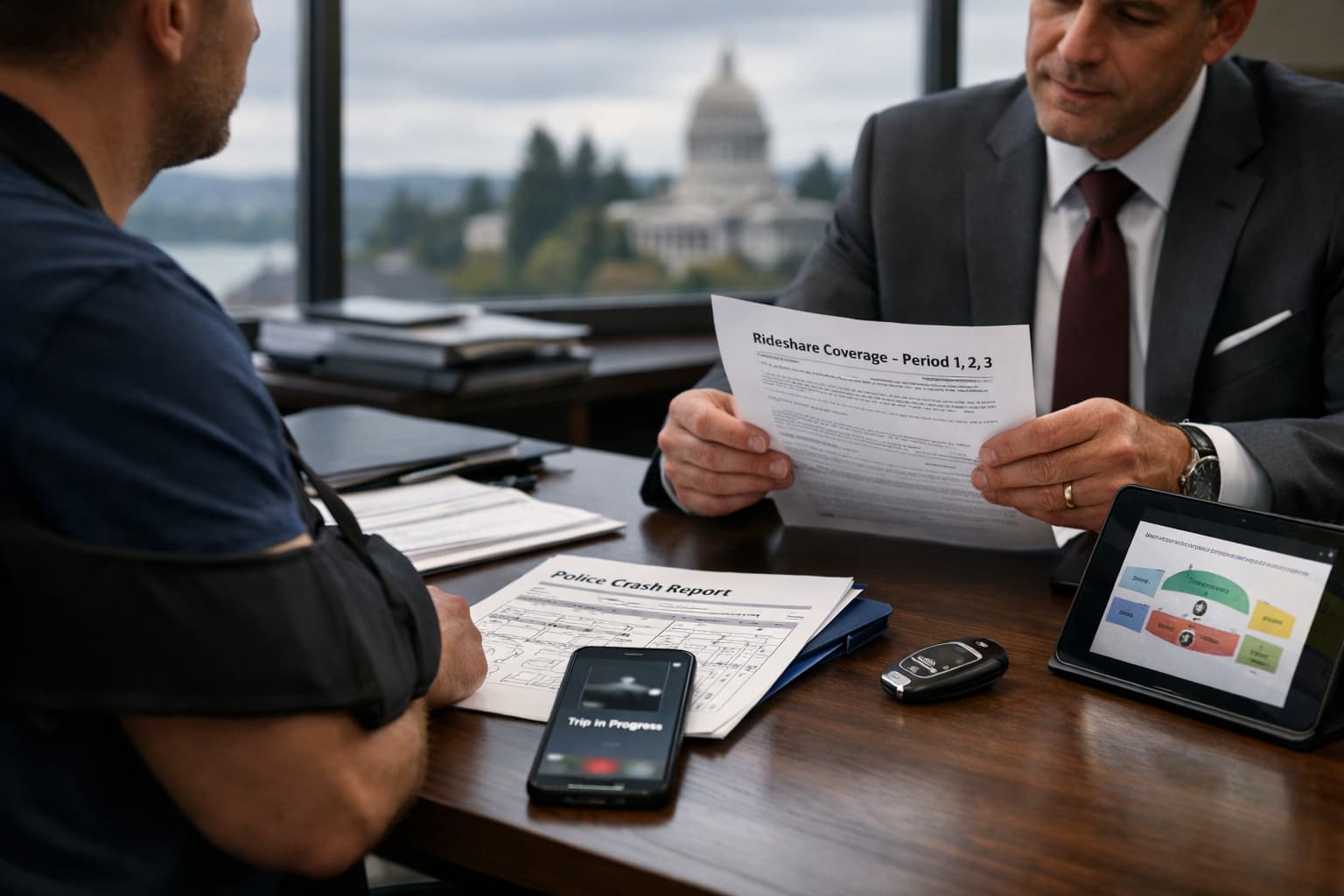
You should also consult a rideshare accident attorney after being injured in an Uber accident. Here is how they can help after the crash:
Investigating the Crash
A rideshare accident lawyer conducts a thorough investigation to determine how the crash occurred and who is responsible. The process may include reviewing Uber app data and driver status logs, analyzing vehicle damage, obtaining surveillance or traffic camera footage, and interviewing witnesses.
They can preserve and organize the evidence immediately after the crash. A rideshare accident lawyer can use the evidence to establish liability, identify the applicable insurance policies, and strengthen your compensation claim.
Initiating the Injury Claim
Uber accident claims often involve multiple insurance policies and strict procedural requirements. A rideshare accident attorney ensures all claims are properly prepared and filed with the correct insurers, preventing errors that can delay or reduce compensation.
In Washington, you generally have three years from the date of the accident to file a personal injury claim. A rideshare accident attorney in Olympia files a timely claim to protect your right to compensation.
Negotiating With Insurance Companies
Insurance companies often work to reduce or deny claims for Uber accidents. A rideshare accident lawyer manages all communications and negotiations, protecting you from tactics designed to minimize payouts.
During the negotiation process, a rideshare accident attorney will:
- Challenge low or unfair settlement offers.
- Dispute unsupported liability arguments.
- Present medical records and damage evidence.
- Calculate the value of your losses.
- Advocate for fair compensation.
By handling negotiations strategically, a rideshare accident attorney strengthens their position, leading to a fair settlement or court award.
Litigating in Court
If negotiations fail, a rideshare accident attorney may file a lawsuit for a fair assessment of your claim before a judge and jury. The process includes presenting evidence, working with medical or accident reconstructionists, and challenging the defense’s arguments.
For example, a professional may testify about how the Uber driver’s negligence caused your injuries, strengthening your case before a judge or jury.
Get the Compensation You Deserve After a Rideshare Accident
You may be entitled to compensation if injured in a rideshare accident caused by someone else’s negligence. Even so, rideshare claims often involve multiple insurers, disputed coverage, and aggressive defense tactics that can delay or reduce compensation.
Our rideshare accident lawyers at Boohoff Law, P.A., have years of experience and understand when the $1 million insurance policy applies. You can, therefore, count on us to fight for the compensation you deserve for your losses.
FAQs: Rideshare Accidents in Olympia
How Much Can I Get for My Rideshare Accident?
There is no standard value you can get for your rideshare accident claim. The value of a rideshare accident claim depends on factors like injury severity, availability of evidence, duration of recovery period, and shared liability.
Other factors affecting the value include the negligent party’s insurance coverage and the quality of legal representation.
How Much Does a Rideshare Accident Attorney Charge?
Most rideshare accident attorneys work on a contingency fee basis, meaning you pay nothing up front. The fee is a percentage of your recovery and depends on factors such as the nature of the case, the severity of injuries, insurance disputes, and whether litigation is required.
How Long Do Injury Cases Take?
Most rideshare injury cases settle within several months to two years. Timeline depends on injury severity, treatment duration, negotiation complexity, insurance company responsiveness, and whether litigation becomes necessary.
Cases with disputed liability or serious injuries typically take longer.