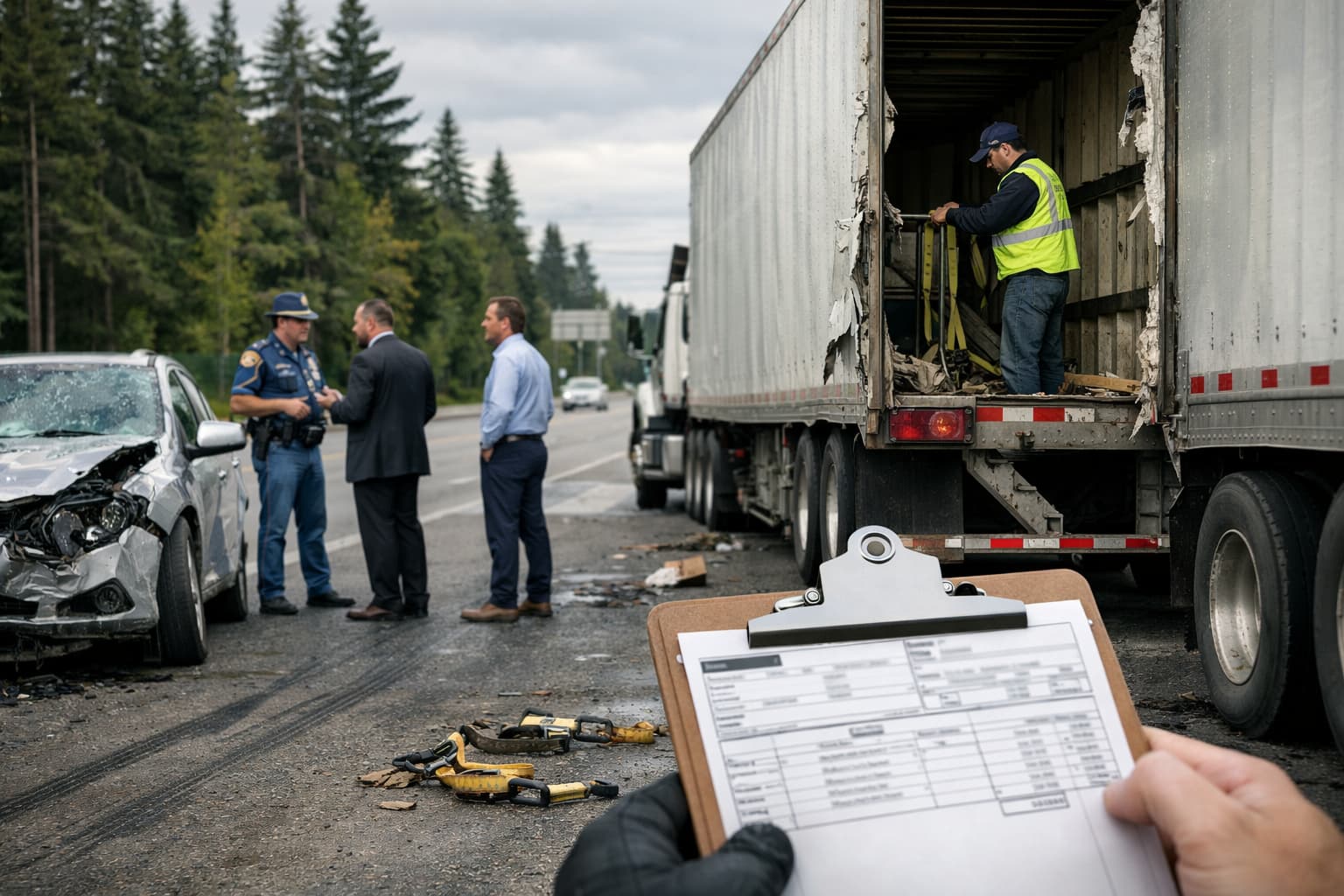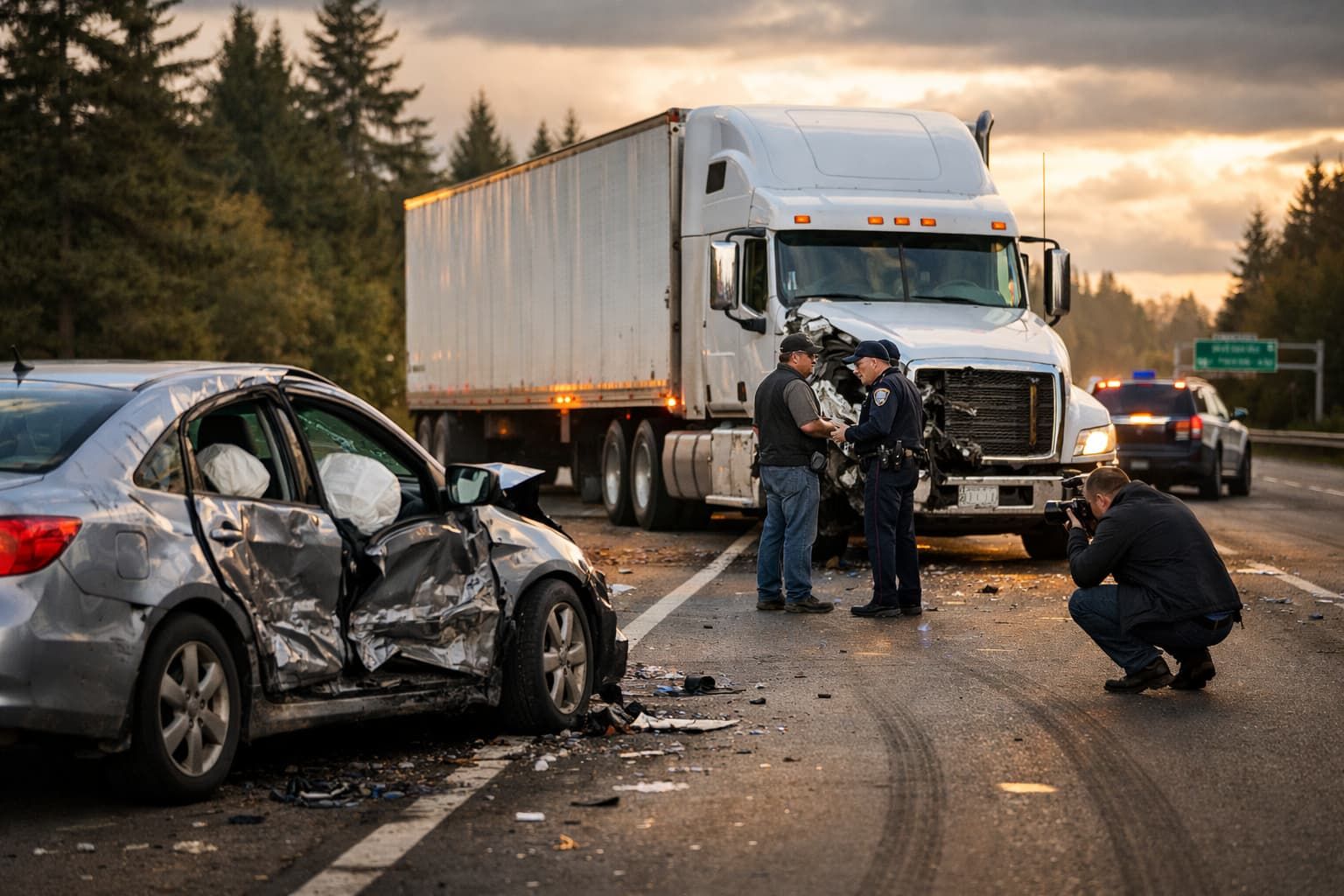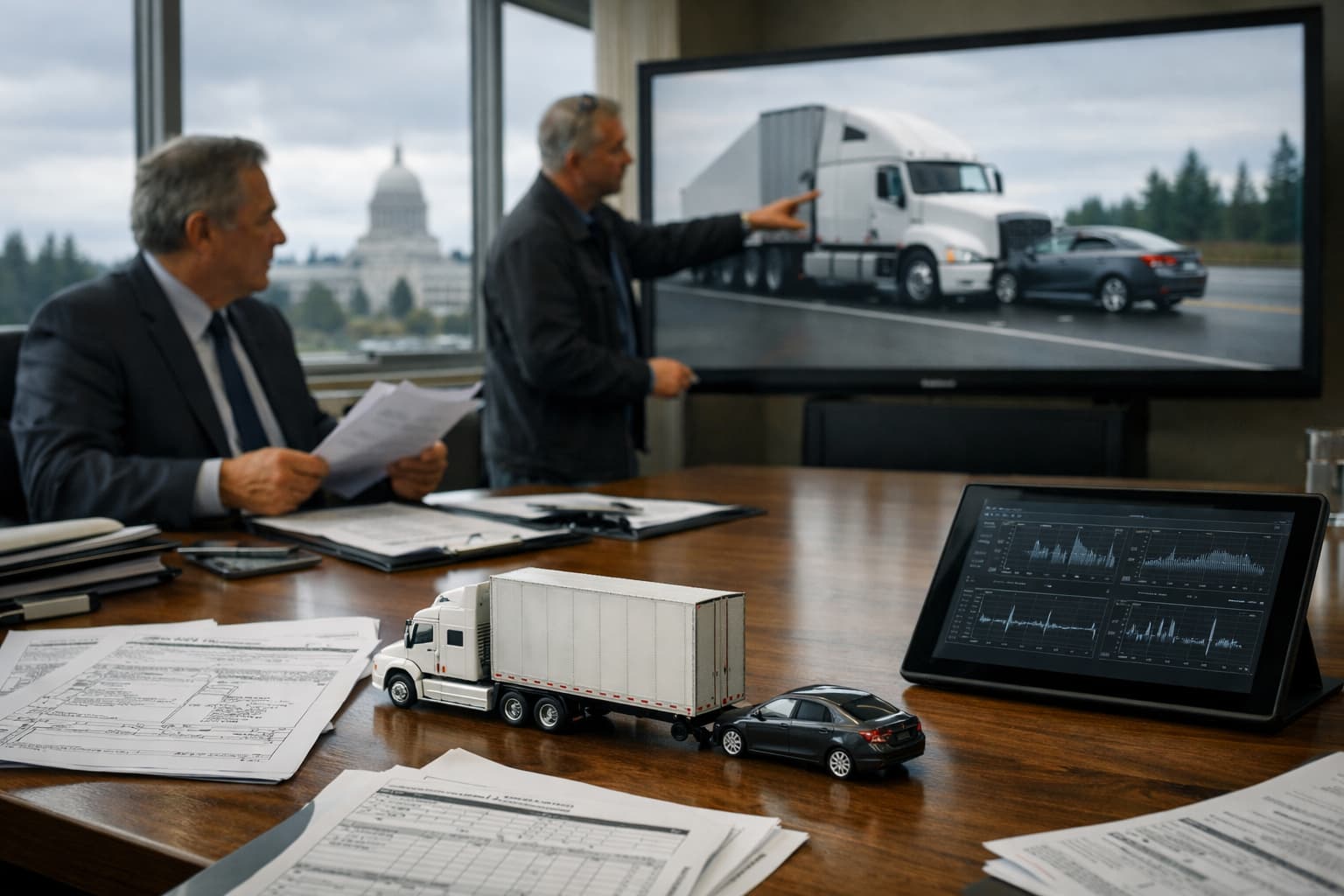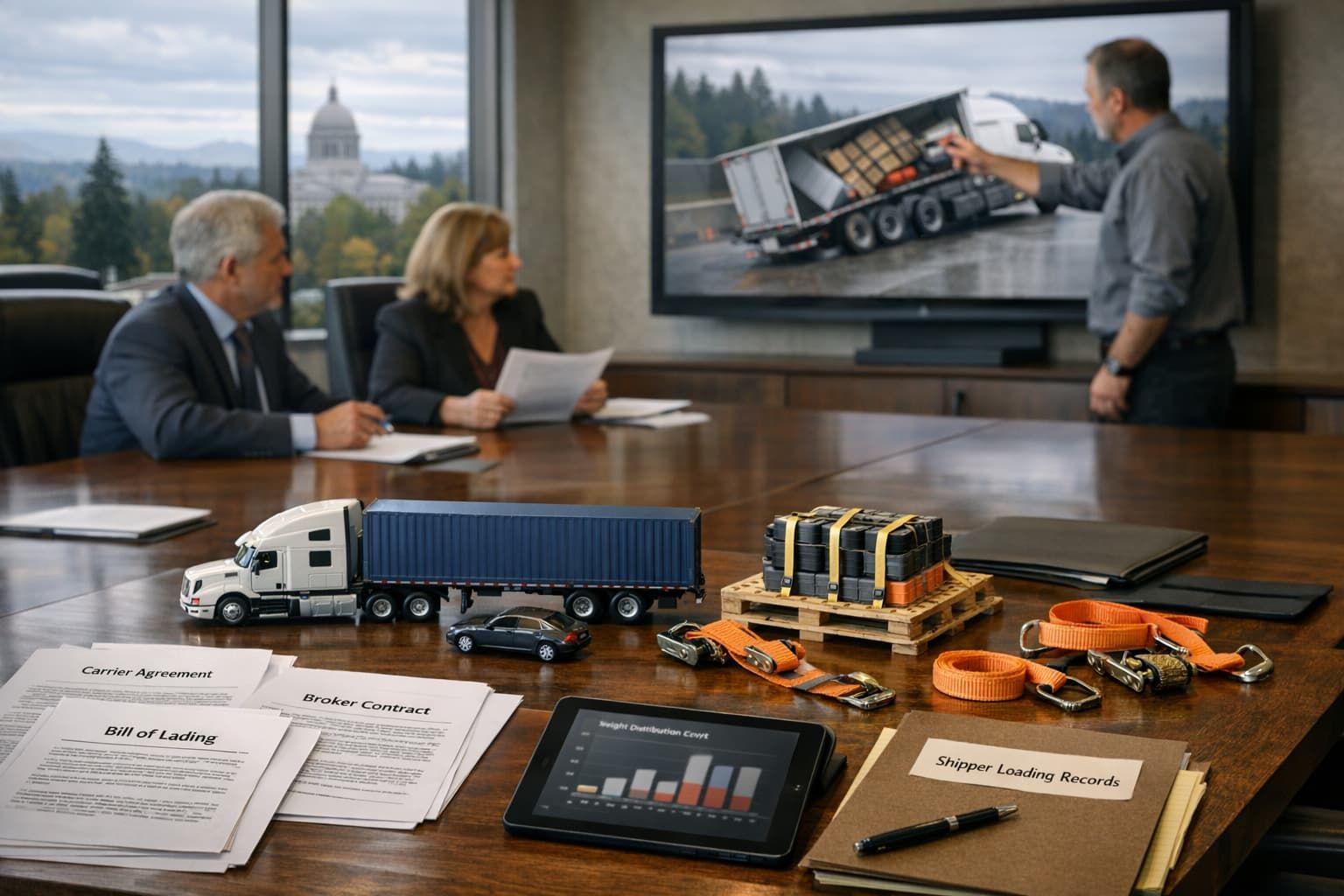
Fatigued truck driver standing near tractor-trailer after highway crash in Washington, symbolizing dispatcher pressure and Hours-of-Service violations.

Dispatcher Pressure Accidents: Employer Liability When Companies Push Drivers to Violate HOS

Commercial truck accidents often result in severe, life-altering injuries because of the immense size and weight of tractor-trailers. In many cases, these crashes are not caused solely by driver error but by dispatcher pressure that pushes drivers to violate federal hours-of-service (HOS) rules.

When trucking companies prioritize delivery deadlines over safety, fatigued drivers are placed on the road, increasing the risk of collisions. Under Washington law, injured motorists have the right to pursue compensation when employer practices contribute to a crash.

Get A Free Consultation

Even so, they must prove dispatcher pressure and employer liability by investigating company policies, communications, and scheduling practices.

Our experienced truck accident attorneys at Boohoff Law, P.A. can support you after the crash. We know how to uncover evidence of HOS violations and pursue compensation claims against the negligent party on your behalf.

Dispatcher Pressure Accidents Key Takeaways

  • Truck drivers must follow strict Hours-of-Service (HOS) rules to prevent fatigue and reduce accident risks.
  • Liability for dispatcher pressure accidents may extend beyond the driver to trucking companies, dispatchers, fleet managers, and third-party logistics providers.
  • Proving liability involves gathering evidence such as dispatch communications, driver logbooks, company policies, witness testimony, and black box data.
  • Victims injured in these crashes can pursue compensation for economic, non-economic, and punitive damages.
  • Call a truck accident lawyer for legal support after the crash.

Hours of Service Rules for Truck Drivers

The Federal Motor Carrier Safety Administration (FMCSA) established Hours of Service (HOS) regulations to prevent driver fatigue and reduce truck accidents. These rules mandate strict limits on how long commercial truck drivers can operate vehicles before taking required rest breaks.

Current HOS regulations limit truck drivers to 11 hours of driving after 10 consecutive hours off duty. Drivers cannot exceed 14 consecutive hours on duty, after which they must take a 10-hour break.

Drivers must also take a 30-minute rest break after eight cumulative hours of driving. Weekly limits restrict drivers to 60 hours on duty over seven consecutive days or 70 hours over eight consecutive days.

When dispatchers pressure drivers to violate these HOS rules to meet unrealistic delivery schedules or maximize profits, they create dangerous conditions on highways. Fatigued drivers have slower reaction times, impaired judgment, and increased accident risk.

Employers who knowingly encourage or turn a blind eye to HOS violations can be held liable for resulting accidents under federal regulations and negligence principles.

Electronic logging devices, now mandatory, make it easier to detect dispatcher pressure and HOS violations. If a driver exceeds legal limits and causes an accident, the trucking company faces liability for prioritizing profits over public safety and regulatory compliance.

Who Is Liable for a Dispatcher Pressure Accident

Determining liability in dispatcher pressure accidents requires examining multiple parties within the trucking industry’s complex operational structure. When companies push drivers to violate Hours of Service regulations, responsibility often extends beyond the individual driver.

Here are the parties who may be liable for the accident:

The Trucking Company

The trucking company bears primary liability when its policies, practices, or culture encourage HOS violations. Employers may be liable for creating an environment where drivers feel compelled to exceed legal driving limits.

Their liability may arise for setting unrealistic delivery schedules, offering bonuses for faster deliveries, or threatening termination for missed deadlines.

Companies can be held liable under the doctrine of respondeat superior, making them responsible for employee actions performed within the scope of employment. Additionally, companies that fail to monitor driver compliance or ignore electronic logging device warnings demonstrate negligent supervision.

Dispatchers and Fleet Managers

Individual dispatchers who directly pressure drivers to violate HOS rules may face personal liability. When dispatchers send messages instructing drivers to falsify logs, continue driving despite fatigue, or skip mandatory rest breaks, they become personally culpable for resulting accidents.

Fleet managers may also be liable for establishing quotas impossible to meet within legal driving hours. Their liability can also arise for retaliating against drivers for HOS compliance and creating dangerous conditions.

The Driver

Drivers remain responsible for their actions, but their liability often decreases when they operate under employer pressure. Drivers who knowingly violate HOS regulations contribute to accident causation, but courts recognize the economic duress drivers face when threatened with job loss.

Documentation showing dispatcher communications demanding HOS violations can shift liability away from drivers and toward their employers.

Third-Party Logistics Companies

Brokers and logistics companies that contract with trucking firms can also be liable for injury-related losses. Their liability arises if they impose impossible delivery deadlines while knowing, or should have known, that these schedules require HOS violations.

When third parties impose unreasonable expectations that pressure drivers, litigation can include them as defendants.

How to Prove Liability in Dispatcher Pressure Accidents

Dispatcher pressure accidents occur when trucking companies or their representatives push drivers to violate hours-of-service (HOS) regulations to meet unrealistic delivery deadlines. These practices place fatigued drivers on the road and expose the company to direct liability.

Proving liability requires demonstrating not only that the driver was fatigued, but that the employer’s actions caused or encouraged the violation. A truck accident attorney can use the following sources of evidence to prove liability:

Dispatch Communications and Messages

Dispatch communications are often the most direct evidence of employer pressure. Text messages, emails, mobile app messages, and recorded calls may show dispatchers instructing drivers to continue driving despite exhausted hours or threatening penalties for delays.

A truck accident lawyer can subpoena these communications and use them to prove the company knowingly encouraged HOS violations, establishing employer negligence.

Common Dispatch Evidence Includes:

  • Text messages demanding faster delivery
  • Emails discouraging rest breaks
  • Dispatch app timestamps
  • Recorded phone calls
  • Internal scheduling alerts

Driver Logbooks and Hours-of-Service Records

Driver logbooks show whether the driver exceeded HOS limits. A truck accident attorney can compare paper logs, ELD data, fuel receipts, and GPS records to identify discrepancies. When logs show violations aligned with dispatcher demands, a truck accident lawyer can directly link employer pressure to illegal driving hours and fatigue-related crashes.

Here are a few records they can use:

  • Paper logbooks or ELD data
  • Fuel and toll receipts
  • GPS and telematics data
  • Weigh station timestamps
  • Delivery confirmations

Company Policies and Training Materials

Trucking company manuals, safety policies, and training documents demonstrate whether the employer prioritized safety or delivery speed. A truck accident attorney can review these materials to show a pattern of disregarding HOS rules or failing to discipline dispatchers for unsafe practices.

Evidence of inadequate training or enforcement supports claims of negligent supervision.

Witness Testimony

Testimony from drivers, former employees, dispatchers, or third-party witnesses can expose systemic pressure. A truck accident lawyer interviews coworkers who can confirm that dispatchers routinely pushed drivers beyond legal limits or punished those who refused.

They can use witness testimony to establish a pattern of misconduct rather than an isolated incident.

Here are a few witnesses who can support a dispatcher pressure accident:

  • Other company drivers
  • Former dispatchers
  • Safety managers
  • Accident witnesses
  • Industry professionals

Black Box and Telematics Data

Event data recorders and telematics systems provide objective evidence of driving behavior. A truck accident lawyer can analyze speed, braking, driving duration, and rest periods to confirm fatigue-related patterns. When black box and telematics data contradict the company’s claims of compliance, it strengthens liability arguments against the employer.

Accident Reconstruction and Professional Analysis

Accident reconstructionists analyze vehicle damage, skid marks, impact angles, and roadway conditions to determine how fatigue affected the crash. A truck accident attorney uses professional opinions to link excessive driving hours to slower reaction times or loss of vehicle control, thereby proving causation.

A truck accident lawyer can use the following professional advice:

  • Accident reconstruction reports
  • Fatigue and human factors analysis
  • Commercial trucking compliance professionals
  • Mechanical engineering assessments
  • Medical professional evaluations

Internal Company Records

Internal audits, disciplinary logs, performance metrics, and bonus structures can reveal incentives for HOS violations. A truck accident lawyer can use these records to show the company rewarded unsafe behavior or ignored repeated violations, reinforcing claims of corporate negligence.

Medical and Fatigue Evidence

Medical records documenting exhaustion, delayed reaction, or fatigue-related impairment help establish that the driver’s condition contributed to the crash. A truck accident lawyer correlates these findings with dispatch pressure and excessive driving hours to complete the liability chain.

Can I Get Compensation for a Dispatcher Pressure Accident

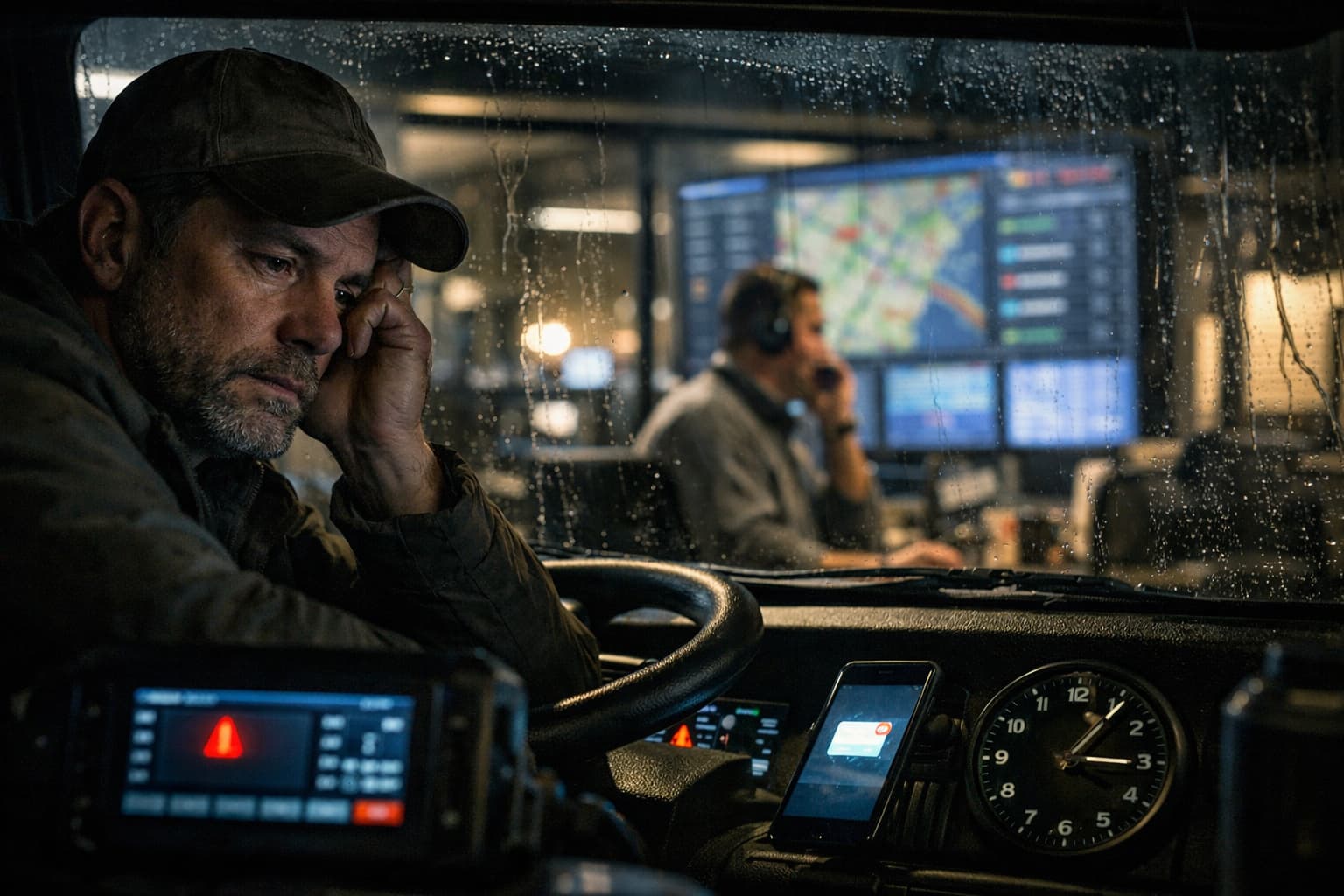
Exhausted truck driver inside tractor-trailer at night with electronic logging device warning light, symbolizing dispatcher pressure and Hours-of-Service violations.

You can file a personal injury claim or lawsuit to obtain compensation for your losses. You can pursue the following damages in a dispatcher pressure accident:

Medical Expenses

Victims of dispatcher pressure accidents may recover compensation for all reasonable and necessary medical expenses related to the crash. This includes emergency care, hospitalization, surgeries, physician visits, diagnostic testing, prescription medications, rehabilitation, physical therapy, and future medical treatment.

You can also pursue compensation for ongoing care for chronic pain or long-term impairments.

Lost Income

When injuries prevent you from working, you may recover compensation for lost income and diminished earning capacity. A truck accident attorney documents these losses using employment and financial records.

Here are the components of lost income that you can pursue compensation for:

  • Income lost during recovery
  • Missed overtime or bonuses
  • Used sick leave or vacation time
  • Reduced future earning capacity
  • Loss of employment benefits

Pain and Suffering

Pain and suffering compensate for the physical pain, discomfort, trauma, and inconvenience resulting from the accident. These damages include both immediate pain and long-term or chronic suffering resulting from fatigue-related truck crashes caused by employer pressure.

Loss of Enjoyment of Life

Serious injuries may prevent you from participating in activities you once enjoyed. For example, if injuries limit your ability to exercise, travel, or engage in hobbies, you may recover damages for diminished quality of life.

Loss of Consortium

Loss of consortium compensates a spouse for the loss of companionship, affection, intimacy, and support caused by the injured victim’s physical or emotional limitations following the accident.

Emotional Anguish

Dispatcher pressure accidents often cause psychological harm, including anxiety, depression, post-traumatic stress disorder, and sleep disturbances. These non-economic damages recognize the mental and emotional toll of the crash.

Permanent Disability or Disfigurement

You may pursue additional compensation if the accident results in permanent physical limitations, scarring, or disfigurement. These damages may result in lifelong impairments, reduced independence, and long-term impacts on daily living and employment.

Punitive Damages

A judge and jury may award you punitive damages when dispatcher pressure reflects willful misconduct or reckless disregard for public safety. These damages aim to punish egregious behavior and deter similar conduct.

A truck accident attorney can use the following evidence to make a case for punitive damages:

  • Dispatch communications demanding HOS violations
  • Company policies encouraging unsafe scheduling
  • Repeated HOS violation records
  • Internal emails or performance incentives tied to delivery speed
  • Testimony showing management knowingly ignored fatigue risks

Protect Your Right to Compensation After a HOS Violation Truck Accident

You may be entitled to compensation if you suffered an injury in a truck accident caused by dispatcher pressure and hours-of-service violations. Even so, you must prove employer misconduct that requires preserving communications, schedules, and driver records before they are altered or destroyed.

Our truck accident attorneys at Boohoff Law, P.A. have a proven track record of obtaining favorable settlements for injured victims and their families. You can count on us to protect your right to fair compensation after the crash.

Get A Free Consultation

FAQs: Dispatcher Pressure Accidents & Employer Liaiblity

Will My Case Settle Before Trial?

Most dispatcher pressure accident cases settle before trial because trucking companies want to avoid public exposure of their HOS violations and safety failures. However, settlement timing depends on the strength of the evidence, the clarity of liability, and the progress of negotiations between the parties.

Do I Need a Lawyer for Personal Injury?

Yes, dispatcher pressure accidents involve federal regulations, corporate liability issues, and sophisticated defense teams for trucking companies. An experienced truck accident lawyer can support you to investigate HOS violations, analyze Electronic Logging Device data, identify all liable parties, and maximize your compensation.

How Much Can I Sue for a Dispatcher Pressure Accident?

There is no standard value you can sue for a dispatcher pressure accident. The amount varies based on factors such as the severity of the injury, the availability of evidence, and the insurance coverage of the negligent party.

Police officer reviewing truck driver paper logbook after Washington semi-truck accident investigation

Falsified Logbooks in Washington Truck Accidents: Proving Paper Log Fraud Before 2024 ELD Mandate

Commercial truck accidents in Washington can cause devastating, life-altering injuries due to the sheer size and weight of these vehicles. Victims often face severe physical trauma, long hospital stays, and substantial financial losses.

Truck drivers are required to maintain accurate logbooks that document their hours of service; however, falsified or “paper” logs can conceal driver fatigue, thereby increasing the risk of catastrophic crashes.

Get A Free Consultation

Our experienced truck accident attorneys at Boohoff Law, P.A., understand commercial trucking regulations and investigative techniques needed to uncover fraudulent records. We can protect your rights by working closely with professionals to analyze logs, driver schedules, and company practices.

Proving Fraud in a Truck Accident: Key Takeaways

  • Proving paper log fraud before the 2024 ELD mandate requires analyzing logbooks, GPS data, dispatch records, professional testimony, and medical evidence.
  • Liability may extend beyond the truck driver to trucking companies, maintenance providers, manufacturers, and other negligent parties.
  • After a truck accident, seek medical care, file a police report, and consult a truck accident lawyer.
  • Injured victims may recover compensation for medical costs, lost income, pain and suffering, and, in fraud cases, potential punitive damages.
  • Call a truck accident attorney to protect your right to compensation.

How to Prove Paper Log Fraud Before the 2024 ELD Mandate

Before the 2024 electronic logging device (ELD) mandate, many truck drivers relied on paper logbooks to document hours of service. Unfortunately, some drivers and trucking companies falsified these records to avoid violating federal regulations or to maximize deliveries, which can lead to fatigued driving and catastrophic accidents.

Proving paper log fraud is the foundation of your compensation claim after a truck crash. An experienced truck accident attorney can use a variety of evidence sources to establish falsified logs and link them to the accident.

Driver Logbook Analysis

A truck accident lawyer can examine paper logs for inconsistencies, gaps, repeated entries, or handwriting discrepancies. Unexplained missing hours or identical entries across multiple days may indicate falsification.

They can also compare the logs with other records and reveal discrepancies that point to negligence.

Electronic and GPS Records

Even before the ELD mandate, many trucking companies maintained GPS tracking, dispatch records, or telematics data. These records can confirm vehicle locations, driving hours, and speed, often contradicting the driver’s paper logs.

A truck accident lawyer can use the records to demonstrate that a driver was on the road longer than legally allowed, creating a direct link to fatigue-related crashes.

Dispatch and Trip Records

Dispatch notes, load sheets, and delivery schedules provide context for a driver’s actual hours on the road. A truck accident attorney can review these documents to show pressure from the company to exceed legal driving limits, supporting claims that falsified logs contributed to the accident.

Accident Reconstruction and Professional Testimony

Professionals in accident reconstruction can analyze vehicle damage, skid marks, and road conditions to estimate how the crash occurred and whether driver fatigue was a likely factor. Combined with logbook discrepancies, professional testimony strengthens the case that falsified hours directly led to the accident.

Witness Testimony

Coworkers, dispatchers, or even other drivers may provide testimony about unrealistic schedules, repeated overtime, or company pressure to falsify records. They can use the evidence to establish a pattern of negligence that contributed to the crash.

Medical and Fatigue Reports

Medical evaluations, including fatigue-related impairments observed at the time of the crash, can support claims that the driver was overworked or exhausted. A truck accident lawyer can use these reports alongside logbook evidence to show causation between falsified logs and the accident.

Who Is Liable for a Truck Accident

Determining liability in truck accidents requires legal analysis due to multiple potentially responsible parties and strict federal regulations. Liability depends on the accident’s specific circumstances, evidence available, and applicable commercial trucking laws that govern the industry and establish the duty of care.

Here are the potential parties who may be liable:

Truck Driver Liability

The truck driver is usually the first party considered when assigning liability. Drivers have a duty to operate the vehicle safely, follow traffic laws, and comply with federal hours-of-service regulations.

Negligence by a driver may include speeding, distracted driving, driving under the influence, or exceeding allowable driving hours, which can lead to fatigue-related crashes.

An experienced truck accident lawyer can use the following sources of evidence to establish fault:

  • Driver Logbooks: Comparison of paper logs, GPS records, or ELD data to verify hours driven and rest periods.
  • Accident Reports: Police or commercial carrier reports documenting traffic violations, citations, or preliminary fault determinations.
  • Vehicle Damage Analysis: Assessing the location and extent of damage to reconstruct how the collision occurred.
  • Witness Testimony: Accounts from other drivers, passengers, or pedestrians observing the crash.
  • Event Data Recorder (Black Box) Data: Speed, braking, and steering information recorded immediately before the accident.

Trucking Company Liability

Trucking companies can also be held liable under the legal doctrine of vicarious liability, which holds employers responsible for the actions of their employees while performing work duties. Additionally, companies may be directly liable if they fail to properly maintain vehicles, ignore driver fatigue regulations, or pressure drivers to exceed legal limits.

A truck accident lawyer examines company policies, dispatch records, maintenance logs, and training procedures to identify negligence.

They can use the following sources of evidence to establish liability:

  • Maintenance and Inspection Records: Proof of deferred or improper vehicle maintenance that contributed to the crash.
  • Driver Training and Hiring Records: Evidence of inadequate training, failure to verify driving history, or negligent hiring.
  • Dispatch and Scheduling Logs: Records showing unrealistic delivery deadlines or pressures to drive beyond legal hours.
  • Internal Communications: Emails, messages, or memos encouraging unsafe driving practices.
  • Surveillance and Telematics Data: GPS and onboard tracking systems showing deviations from safe driving practices.

Other Parties

In some cases, additional parties may share liability. Vehicle or component manufacturers can be held responsible for mechanical failures or defective parts. Third-party maintenance companies may be liable if faulty repairs contributed to the crash.

Roadway authorities can also share fault if hazardous road conditions or inadequate signage contributed to the collision.

What to Do After a Truck Accident

Your actions after a truck accident can enhance your wellness and protect your legal rights. Here is what you should do if injured in a truck accident:

Seek Immediate Medical Attention

You should seek immediate medical attention even if involved in a minor crash or seem initially alright. Many serious injuries, including internal bleeding and spinal damage, don’t present obvious symptoms immediately but can worsen without prompt treatment.

A healthcare provider can diagnose hidden injuries and initiate a treatment plan. They can also generate medical records that link your injuries to the accident.

A truck accident lawyer can use the evidence when proving damages in cases involving falsified logbooks. Trucking companies and their insurers will scrutinize your medical history to minimize liability, so consistent, contemporaneous medical documentation strengthens your position.

Delaying medical care allows insurance companies to argue your injuries weren’t severe or weren’t caused by the accident.

Additionally, prompt medical evaluation can uncover evidence that supports logbook fraud claims. For instance, the severity of impact-related injuries may indicate excessive speed or driver fatigue, both of which are potential results of hours-of-service violations that drivers conceal through paper log manipulation.

A truck accident attorney can use medical records as evidence to demonstrate the trucker’s negligence and the company’s role in encouraging fraudulent record-keeping.

File a Police Crash Report

You should notify the local police department if you suffered an injury in a truck accident. Truck accidents often involve complex liability issues, including potential negligence by the driver, trucking company, or third parties.

A police report creates an official, neutral record of the crash, documenting the time, location, road conditions, vehicle positions, and statements from involved parties and witnesses. Officers may also note traffic violations, signs of driver fatigue, or equipment defects, which are especially relevant in commercial truck cases.

The police crash report also serves as foundational evidence when investigating issues such as hours-of-service violations, falsified logbooks, or improper vehicle maintenance. A truck accident lawyer relies on police crash reports to corroborate other evidence, challenge insurer disputes, and establish fault.

Filing a police crash report also helps you meet statutory requirements. In Washington state, you must file a collision report within four days if it involves:

  • Bodily Injury
  • Death
  • Property damage over $1,000

Consult a Truck Accident Attorney

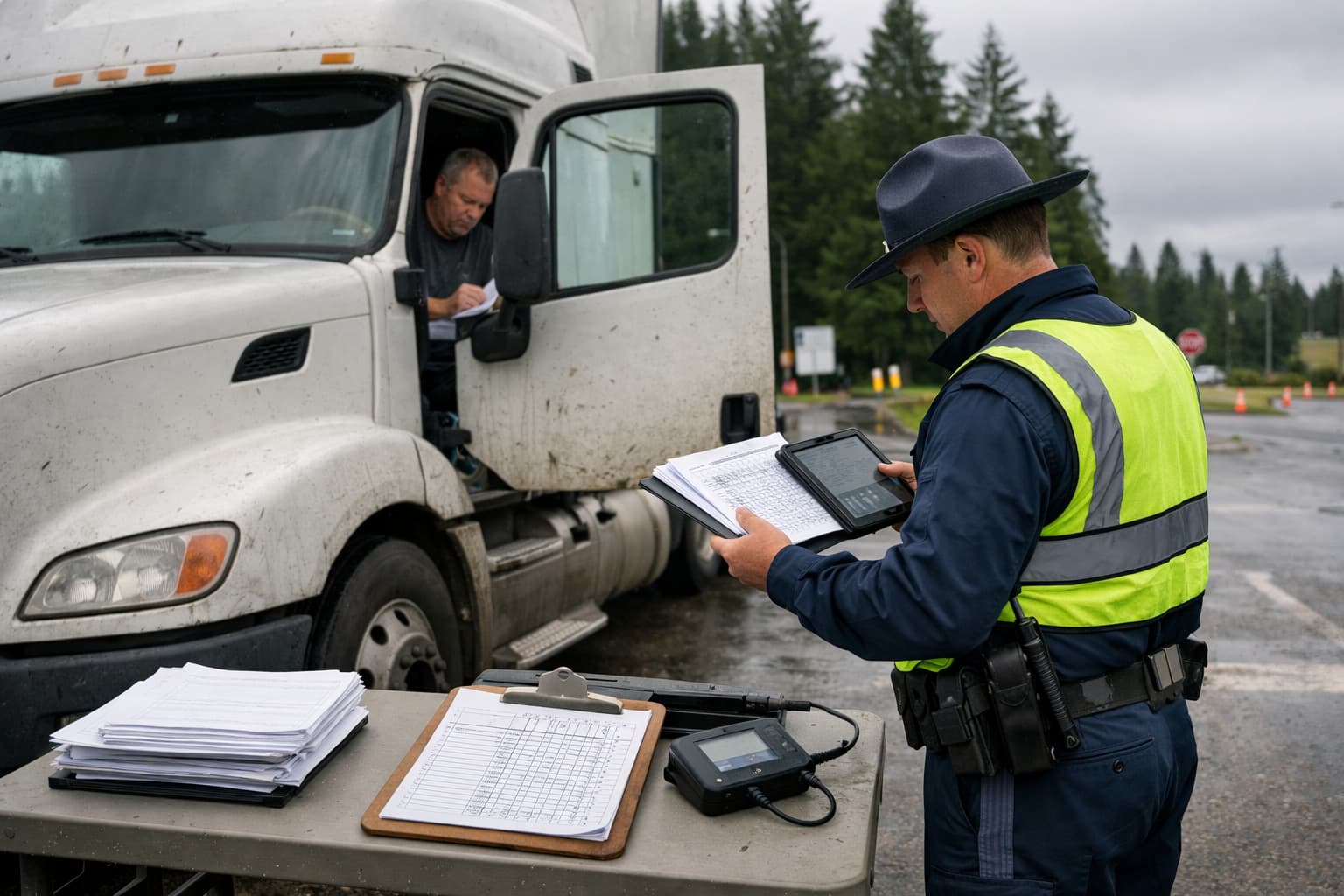
State trooper comparing truck driver paper logbook with GPS data during Washington roadside inspection

You should also consult a truck accident attorney, especially when a crash involves falsified logbooks and paper record fraud. These cases require a detailed understanding of federal trucking regulations, investigative strategies, and Washington personal injury law.

An experienced truck accident lawyer can protect your rights while building a strong case tied directly to paper log fraud before the 2024 ELD mandate.

Here is how they can benefit you:

Evaluating the Case

A truck accident attorney will conduct a comprehensive case evaluation to determine whether falsified paper logs contributed to the crash. This includes reviewing driver logbooks, dispatch records, GPS data, delivery schedules, and maintenance files.

They can also work with professionals to identify inconsistencies indicating fatigue or hours-of-service violations, and to assess how those violations caused or worsened the accident.

Adhering to Legal Timelines

Washington law generally gives you three years to file a personal injury lawsuit after a truck accident. Failing to meet this statute of limitations can permanently bar your right to compensation.

A truck accident attorney files all claims on time and preserves evidence early.

Negotiating With Insurers

Trucking company insurers aggressively defend logbook fraud claims and often attempt to minimize liability. A truck accident attorney can handle all communications and negotiations on your behalf.

They can present clear evidence of falsified records to demand fair compensation for your current and future losses.

Representation in Court

If settlement negotiations fail, a truck accident attorney is prepared to take your case to court. They can present professional testimony, challenge fraudulent records, and advocate for maximum compensation before a judge or jury.

Can I Get Compensation if Injured in a Truck Accident

Yes, you can pursue compensation for injuries sustained in a truck accident caused by negligence, including cases involving falsified logbooks. Your compensation typically encompasses both economic and non-economic damages.

Economic damages include quantifiable financial losses such as medical expenses, hospitalization costs, rehabilitation fees, prescription medications, lost income from missed work, and reduced earning capacity.

Non-economic damages compensate for intangible losses that lack precise monetary value. These include physical pain and suffering, emotional distress, mental anguish, loss of enjoyment of life, permanent disability or disfigurement, and loss of consortium affecting your relationships with loved ones.

In cases involving fraudulent logbooks, punitive damages may also be available if the trucking company’s conduct demonstrated willful disregard for safety. The total compensation depends on injury severity, evidence quality, and the defendant’s insurance coverage or assets.

Get Legal Support After a Truck Accident Involving a Falsified Logbook

You may be entitled to compensation if injured in a truck accident caused by someone else’s negligence. Even so, you must prove paper log fraud and demonstrate how their actions contributed to the accident and your losses.

Our truck accident attorneys at Boohoff Law, P.A. have years of experience representing victims of truck accidents and their families. You can count on us to fight for your right to fair and just compensation.

Get A Free Consultation

Truck Accidents Frequently Asked Questions

Why Is My Lawyer Taking So Long to Settle My Case?

Cases involving falsified logbooks take longer because a truck accident attorney must conduct a thorough investigation. They must examine records to uncover paper log fraud, consult professionals, and counter aggressive trucking insurers before negotiating a fair settlement.

When do I Hire a Truck Accident Lawyer?

Hire a truck accident lawyer immediately after the collision to preserve evidence like driver logbooks, electronic data, and company records. Early legal representation ensures proper investigation of potential logbook fraud before trucking companies destroy or alter documentation.

How Much Does an Injury Lawyer Cost?

Most injury lawyers work on a contingency fee basis, meaning they only collect payment if you win your case. A truck accident lawyer will, therefore, collect a percentage of your final settlement or verdict, with no upfront costs.

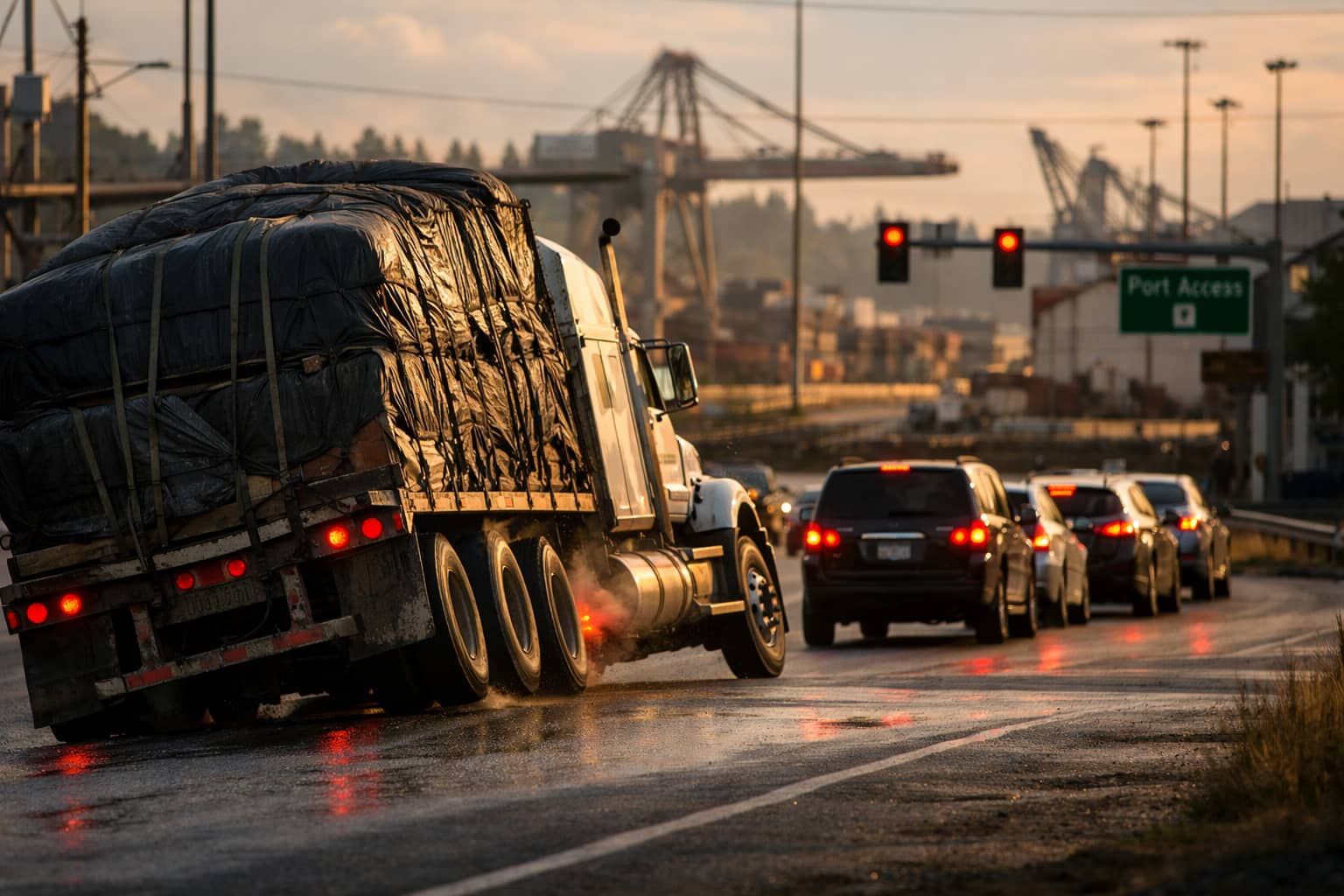
Overweight commercial truck traveling on Marine Drive near the Port of Olympia, showing strain and instability in a port-access area.

Port of Olympia Access Road Accidents: Liability for Overweight Trucks on Marine Drive

Commercial trucks on Marine Drive near the Port of Olympia pose serious safety concerns, particularly when overweight trucks operate in restricted port-access areas. Overweight trucks require longer stopping distances and place excessive strain on braking systems.

They, therefore, cause collisions that result in severe injuries and long-term consequences for motorists, cyclists, and port workers. Injured victims have the right to pursue compensation for their injury-related losses.

Get A Free Consultation

Even so, the negligent party may frustrate your compensation claim by stating you were partly to blame for the crash. You must also prove how their actions contributed to the accident and your injuries.

At Boohoff Law, P.A., our experienced truck accident attorneys understand the unique regulations governing port access roads and commercial vehicle weight limits. We investigate Marine Drive accidents, identify regulatory violations, and aggressively pursue fair and just compensation for your losses.

Overweight Truck Accidents Key Takeaway

  • Overloading a truck increases stopping distances, causes mechanical failures, and creates serious safety hazards that often lead to severe accidents on Marine Drive.
  • Proving liability requires evidence such as weight records, cargo documents, black box data, and professional analysis linking overloading to the crash.
  • Liability may extend beyond the driver to trucking companies, loaders, shippers, and maintenance providers.
  • If injured, seek medical care, report the crash, and consult a truck accident attorney.
  • Call a truck accident lawyer to understand your rights and legal options.

What Happens if You Overload a Truck

Overloaded trucks pose serious dangers on Marine Drive and throughout the Port of Olympia access routes. When trucking companies exceed weight limits, they create hazardous conditions that can lead to catastrophic accidents.

Here is how overloading causes truck accidents:

Brake Failure and Extended Stopping Distances

Excess weight increases the force required to stop a truck. Overloaded vehicles need much longer distances to brake, making it nearly impossible for drivers to react to sudden traffic changes or emergencies on Marine Drive’s busy corridors.

Tire Blowouts

When trucks carry weight exceeding tire ratings, the excessive pressure overheats the tires and causes structural failure. Tire blowouts at highway speeds can cause drivers to lose control, leading to rollover accidents or collisions with nearby vehicles.

Loss of Vehicle Control

Overloading affects a truck’s center of gravity, making it unstable during turns and lane changes. This instability is particularly dangerous on Marine Drive’s curves and intersections, where proper vehicle control is essential for safety.

Structural and Mechanical Failures

Excessive weight strains axles, suspension systems, and frame components beyond their design limits. These failures can occur without warning, causing devastating accidents that put everyone on the road at risk.

How to Prove Liability for an Overweight Truck

Proving liability in an overweight truck accident requires detailed evidence showing the vehicle exceeded legal weight limits and that the violation caused or contributed to the crash. A truck accident lawyer can use the following types of evidence to prove liability:

Weigh Station and Scale Records

Weigh station tickets and portable scale records provide direct proof that a truck exceeded legal weight limits. A truck accident attorney can obtain these records to show the vehicle was overweight before entering the roadway.

Comparing these measurements to state and port access weight restrictions helps establish a clear regulatory violation.

Bills of Lading and Cargo Manifests

Shipping documents list the type and weight of the cargo the truck carries. A truck accident lawyer can review bills of lading to calculate total vehicle weight and demonstrate that cargo loaders or shippers contributed to the violation.

They can use the evidence to extend liability beyond the driver to other negligent parties.

Truck Inspection and Maintenance Records

Overweight loads accelerate wear on brakes, tires, and suspension systems. A truck accident lawyer can analyze inspection and maintenance records to show that the truck was unsafe for operation due to excessive weight.

Evidence of mechanical failure linked to overloading strengthens the argument that the truck should not have been on the road.

Event Data Recorder (Black Box) Information

Most commercial trucks use electronic data recorders to capture speed, braking, and engine performance. A truck accident attorney can use the data to demonstrate delayed braking or loss of control consistent with an overweight vehicle.

The technical evidence connects the weight violation to the cause of the crash.

Driver Logs and Electronic Logging Devices (ELDs)

Driver logs and ELD data reveal route choices, driving times, and stops. A truck accident attorney can use the information to show whether drivers bypassed weigh stations or ignored route restrictions designed for overweight vehicles. These records can establish intentional or negligent conduct.

Port Authority and Permit Records

Overweight trucks often require special permits to operate on port access roads. A truck accident lawyer can use port authority records to determine whether the driver or company lacked proper authorization. Missing or expired permits provide strong proof of regulatory noncompliance.

Surveillance and Traffic Camera Footage

Video footage from port facilities, traffic cameras, or nearby businesses may capture the truck’s movement, load distribution, or difficulty maneuvering. A truck accident attorney can use visual evidence to demonstrate instability, slow stopping, or other characteristics of an overloaded vehicle.

Professional Analysis and Accident Reconstruction

Accident reconstruction professionals can reconstruct the crash scene by analyzing physical evidence, vehicle dynamics, and roadway conditions. A truck accident attorney can rely on their professional testimony to explain how excessive weight increased stopping distance, reduced vehicle control, and caused the collision.

Professional analysis ties all evidence together to clearly establish liability.

Who Is Liable for an Overweight Truck Accident

Determining liability in overweight truck accidents involves identifying all parties whose negligence contributed to the crash. Multiple entities may share responsibility, and an experienced truck accident lawyer can investigate and initiate a compensation claim on your behalf.

Here are the parties who may be liable for the crash:

The Trucking Company

Trucking companies bear primary responsibility for ensuring their vehicles comply with weight regulations. They can be liable if they pressured drivers to exceed limits, failed to properly weigh loads, or ignored safety protocols to maximize profits.

Companies that prioritize schedules and revenue over safety demonstrate negligence that directly endangers public safety on Marine Drive and Port of Olympia access roads.

The Truck Driver

Drivers have a duty to refuse to transport overloaded cargo and report any weight violations. If a driver knowingly operates an overweight vehicle, accepts improper loading, or falsifies weight documentation, they share liability for any resulting accidents.

Professional drivers must understand weight limits and follow safe practices, even under pressure from the company.

Loading Companies and Cargo Handlers

Third-party loading facilities at the Port of Olympia must properly distribute and secure cargo within legal weight limits. If loaders improperly balance freight, exceed capacity, or fail to accurately document weights, they contribute to accident liability.

These companies have specialized knowledge and equipment to ensure compliance with weight regulations.

Shipping Companies and Cargo Owners

The businesses shipping goods may be liable if they demanded transportation of overweight loads, provided inaccurate weight information, or contractually required drivers to carry illegal loads.

Shippers cannot escape responsibility by outsourcing transportation when they are aware that their cargo exceeds legal limits.

Maintenance Providers

Truck maintenance companies that failed to identify or report weight-related mechanical damage may share liability if inspections overlooked worn brakes, damaged suspension, or tire issues from chronic overloading, and maintenance providers’ negligence contributed to the accident.

Government Entities

In rare cases, if weight stations failed to enforce regulations or government agencies inadequately inspected known violators, they might bear partial responsibility. However, governmental immunity often limits these claims.

What to Do If Injured in an Overloaded Truck Accident

Although being injured in a truck accident is overwhelming, your actions can enhance your wellness and legal rights. Here’s what you should do if injured in a truck accident:

Seek Immediate Medical Attention

If you’re involved in an overloaded truck accident, seek immediate medical care to protect your health and legal claim. Overweight truck crashes often result in severe injuries due to the excessive force involved in collisions.

Many serious injuries, including internal bleeding, traumatic brain injuries, and spinal damage, may not show immediate symptoms. A thorough medical evaluation ensures hidden injuries are diagnosed and treated before they worsen.

A healthcare provider will also generate medical records linking your injuries directly to the accident. Insurance companies may also argue that delayed treatment shows the injuries weren’t serious or resulted from another cause.

File a Police Crash Report

Filing a police crash report after an accident involving an overloaded truck on Marine Drive or I-5 helps protect your legal rights and preserve evidence. In Washington State, law enforcement involvement ensures an official record of the collision.

Here are a few reasons to notify the police after an overloaded truck accident:

  • Official Documentation of the Crash: A police report provides an impartial, timely account of the accident, including statements from drivers, witnesses, and responding officers.
  • Evidence of Regulatory Violations: Officers can document weight-related issues, citations, or out-of-service statuses that may not be evident later, strengthening claims against overweight truck operators.
  • Accurate Recording of Injuries and Conditions: A police report notes visible injuries, road conditions, and vehicle positions, all of which can help reconstruct the crash or clear fault disputes.
  • Legal Compliance: Reporting the accident to law enforcement helps satisfy legal obligations and prevents potential penalties.

Washington Police Crash Report Requirements

In Washington, you must report the crash to law enforcement if the accident results in injury, death, or property damage exceeding $1,000. Police will typically file a report at the scene or shortly thereafter.

If law enforcement does not respond, you may be required to submit a collision report form to the Washington State Patrol within four days of the accident.

Consult a Truck Accident Attorney

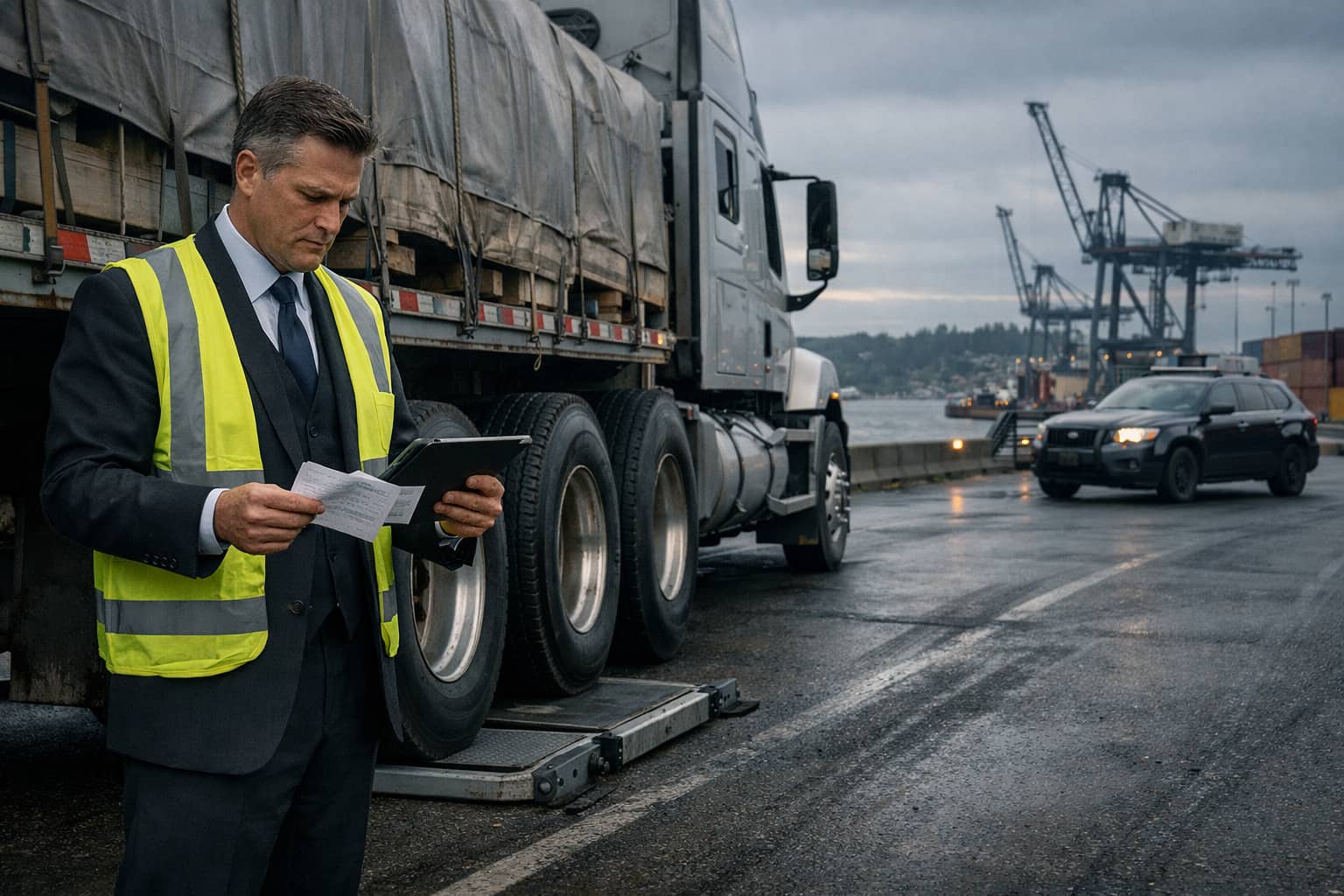
Truck accident attorney reviewing weigh station records beside an overweight commercial truck on Marine Drive near the Port of Olympia.

You should consult a truck accident attorney after an overloaded truck crash for peace of mind during an overwhelming time. They can manage investigations, evidence preservation, and communications, allowing you to focus on medical treatment and recovery.

A truck accident lawyer also ensures adherence to legal timelines. Washington law imposes strict 3-year deadlines for filing personal injury claims. Missing these deadlines can diminish your right to compensation.

A truck accident attorney can also support you during the negotiation process with insurers. Insurance companies often minimize claims by disputing liability or downplaying injuries. A truck accident attorney understands these tactics and uses evidence of overloading and regulatory violations to pursue a fair settlement.

If settlement efforts fail, a truck accident attorney is ready to represent you in court. They present technical evidence, question expert witnesses, and clearly demonstrate how the overloaded truck caused your injuries, strengthening your case before a judge or jury.

Get Legal Support if Injured in an Overweight Truck Accident

When trucks exceed their legal weight limits, the resulting crashes can cause serious injuries and lead to compensation disputes. You, therefore, deserve representation from a legal professional who’ll fight for your right to fair compensation.

Our experienced truck accident attorneys at Boohoff Law, P.A. have years of experience representing injured victims. You can count on us to handle the legal aspects of your claim, allowing you to focus on getting better.

Get A Free Consultation

FAQs: Overweight Truck Accidents 

Will My Case Go to Court?

Most overloaded truck accident cases settle out of court, but if parties dispute liability or insurers deny fair compensation, the case may proceed to trial to protect your rights.

How Much Can I Sue for a Truck Accident?

There is no standard value you can sue for a truck accident. The amount can vary based on factors such as the severity of the injury, the availability of evidence, and the insurance coverage of the negligent party.

A truck accident lawyer pursues a court award to cover current and future losses.

How Long Does an Injury Settlement Take?

An injury settlement timeline depends on injury severity, evidence of overloading, and liability disputes. Complex truck cases may take months or longer to resolve, especially when multiple parties are involved.

Washington’s Commercial Vehicle Out-of-Service Violations: Liability When Trucks Shouldn’t Have Been on I-5

Commercial vehicles operating while out of service or in violation of safety regulations pose a heightened risk, making crashes more likely and more devastating. Truck accidents on Interstate 5 can be catastrophic, often resulting in severe injuries and life-altering consequences for victims and their families.


When a truck shouldn’t have been on I-5 due to mechanical issues or regulatory violations, liability can fall on the trucking company, driver, or other responsible parties. Even so, they may object to your compensation claim by stating you were partly to blame for the crash.


At Boohoff Law, P.A., our experienced truck accident attorneys help you after a crash involving an out-of-service commercial vehicle. We can investigate the collision, establish liability, and initiate a compensation claim or lawsuit on your behalf.


Get A Free Consultation

Key Takeaways about Truck Accidents Due to Out-of-Service Violations

  • Trucks on I-5 should be off the road if out of service, overloaded, mechanically unsafe, or operated by unqualified drivers.
  • Fault can be proven using GPS logs, driver records, traffic camera footage, witness testimony, and FMCSA compliance reports.
  • Liability may extend to the driver, trucking company, shippers, maintenance providers, or government agencies.
  • Compensation depends on injury severity, evidence, shared liability, legal representation, and recovery duration.
  • Call a truck accident attorney to understand your legal options.

When Trucks Shouldn’t Be on I-5

Commercial trucks are subject to strict regulations to ensure the safety of all motorists, particularly on high-speed highways like Interstate 5. Trucks that are out of service, overloaded, mechanically unsafe, or operated by drivers lacking proper qualifications should never be on the road.


Allowing such vehicles on I-5 increases the risk of severe accidents, endangering both truck occupants and other drivers.


Trucks should not be on I-5 under the following circumstances:


  • Out-of-Service Orders: Vehicles flagged by the Department of Transportation as unsafe due to mechanical defects or regulatory violations.
  • Driver Disqualification: Drivers with suspended, revoked, or invalid commercial licenses or a history of serious traffic violations.
  • Overweight or Improperly Loaded Trucks: Vehicles exceeding federal or state weight limits, or carrying unsecured cargo.
  • Mechanical Failures: Trucks with faulty brakes, steering issues, tire problems, or other safety defects.
  • Expired Inspections or Registration: Vehicles operating without current safety inspections or valid registration documents.
  • Hours-of-Service Violations: Drivers exceeding federally regulated limits on driving hours, leading to fatigue and impaired reaction times.
  • Substance-Impaired Drivers: Operators under the influence of drugs, alcohol, or other impairing substances.

In accidents where trucks on I-5 should have been off the road, liability can extend to the trucking company, the driver, and even maintenance or inspection providers. A truck accident attorney can investigate these violations, gather supporting evidence, and use it to pursue compensation from the negligent parties.


How to Prove Fault When Liability When Trucks Shouldn’t Have Been on I-5

When commercial trucks travel on restricted routes, such as certain sections of I-5, establishing liability requires comprehensive evidence collection. A truck accident lawyer can employ multiple forms of documentation to demonstrate that a trucking company or driver violated regulations.


Here are different types of evidence a truck accident attorney can use to prove fault:


Route Restriction Signs and Municipal Codes

A truck accident attorney can obtain photographs of posted signage indicating truck restrictions along I-5 corridors. By cross-referencing these signs with municipal ordinances and state transportation codes, lawyers demonstrate that clear warnings existed.


These signs and municipal codes establish that the truck driver knowingly or negligently ignored explicit prohibitions, forming the foundation of a negligence claim.


GPS and Electronic Logging Device (ELD) Data

Modern commercial trucks contain electronic logging devices that track routes, speeds, and timing. A truck accident lawyer can subpoena GPS data to create a precise timeline showing the truck’s presence on restricted I-5 sections.


The digital evidence is particularly powerful because it’s objective and difficult to dispute, clearly demonstrating that the driver chose a prohibited route.


Trucking Company Dispatch Records

A truck accident attorney can request internal communications between dispatchers and drivers, including route assignments and delivery instructions. They can prove corporate negligence using records that show the company directed drivers onto restricted routes to save time or fuel costs.


A truck accident lawyer can use the evidence to reveal patterns of systematic violations that strengthen liability claims.


Commercial Driver’s License (CDL) and Training Records

A truck accident attorney can examine whether drivers received proper training regarding route restrictions and local traffic laws. Inadequate training documentation suggests the trucking company failed its duty to ensure drivers understood the I-5 limitations.


Weight Station Bypass Records and Permits

A truck accident lawyer can investigate whether vehicles had proper permits for their routes. Weight station data and bypass records reveal if trucks avoided mandatory checkpoints where violations might have been caught.


Missing permits or bypass patterns demonstrate deliberate evasion of regulatory oversight, strengthening negligence arguments.


Traffic Camera and Surveillance Footage

A truck accident lawyer can collect footage from traffic cameras, nearby businesses, and dashboard cameras that show the truck on restricted sections of I-5. They can use visual evidence as irrefutable proof of the violation’s occurrence.


A truck accident lawyer can use timestamps to correlate footage with accident timing, establishing a direct connection between the illegal route and the collision.


Witness Testimony from Other Drivers

A truck accident attorney can interview witnesses who observed the truck on restricted routes or acting suspiciously. Commercial drivers familiar with I-5 restrictions make particularly credible witnesses.


Their testimony can establish that reasonable and competent truck drivers would have been aware of and avoided the restricted areas.


Federal Motor Carrier Safety Administration (FMCSA) Compliance Records

A truck accident lawyer can research the trucking company’s safety history through FMCSA databases. Previous violations, accidents, or inspection failures create a pattern of negligence. If records show prior citations for route violations, they can demonstrate systematic disregard for regulations, supporting claims for punitive damages.


Who Is Liable for a Truck Accident

Liability in truck accidents can involve multiple parties, particularly when a commercial vehicle shouldn’t have been on I-5 due to out-of-service violations or other regulatory breaches.


Here are the parties who may be liable for injury-related losses following the crash:


  • The Truck Driver: Drivers can be held directly liable if they were operating the vehicle while fatigued, distracted, under the influence, or in violation of safety regulations. For example, a driver ignoring an out-of-service order or driving an overloaded truck may be primarily at fault.
  • The Trucking Company: Employers are often responsible under the legal doctrine of vicarious liability. If the company failed to properly maintain the vehicle, enforce safety rules, or hire qualified drivers, it can be held accountable for negligence. It includes allowing trucks with mechanical defects or expired inspections to operate on I-5.
  • Vehicle Maintenance Providers: Companies responsible for servicing or inspecting the truck may share liability if their negligence contributed to mechanical failure. For instance, improperly repaired brakes or faulty tires can make the truck unsafe.
  • Cargo Loaders or Shippers: Improperly loaded or secured cargo can shift during transit, causing loss of control. Shippers who fail to ensure safe loading practices may be partially liable.
  • Government Agencies: In rare cases, government entities may bear some responsibility if road conditions, signage, or regulatory enforcement contributed to the accident.

How Much Can You Get for a Truck Accident

There is no standard value you can receive for a truck accident associated with out-of-service regulations. The 

Washington’s Commercial Vehicle Out-of-Service Violations: Liability When Trucks Shouldn’t Have Been on I-5

amount of compensation a victim can recover varies in each case and depends on several factors.


Here are the factors that influence how much you can receive for a truck accident:


Severity of Injury

The extent and type of injuries determine whether you’ll receive a higher or a lower settlement value. Catastrophic injuries such as traumatic brain injuries, spinal cord damage, or multiple fractures typically result in higher settlements.


The higher settlement values or court awards cover medical costs, long-term care needs, and permanent disability. In contrast, less severe injuries, like a dislocated shoulder or minor lacerations, generally lead to lower compensation because treatment is shorter and long-term impacts are minimal.


Quality of Legal Representation

Representation from an experienced truck accident attorney can enhance the value of your lawsuit. Here’s how a truck accident lawyer can enhance the value of your claim:


  • Investigate the accident and identify all liable parties
  • Gather and preserve supportive evidence, including DOT records and driver logs
  • Document medical treatment and future care needs to support the damages
  • Negotiate effectively with insurance companies to maximize settlements
  • Prepare and present cases for trial 

Availability of Evidence

Evidence is the foundation of all legal claims, including truck accidents. The strength and quantity of evidence directly influence settlement amounts. Dashcam footage, truck maintenance records, driver logs, cell phone records, and eyewitness testimony can support your compensation claim.


A truck accident attorney can use evidence to establish fault and demonstrate the role of regulatory violations, such as out-of-service orders, in causing the accident. Therefore, the stronger the evidence, the better your chances of receiving a higher settlement value.


Shared Liability

Washington follows the shared liability system, which reduces recovery based on the victim’s percentage of fault. For example, if a jury finds a victim 20 percent at fault for not wearing a seatbelt, their total award is reduced by 20 percent.


In multi-party truck accidents, liability may be shared among the driver, trucking company, shippers, or other drivers, which can impact the final compensation.


Duration of Recovery Period

The length of time required to recover from injuries impacts the total value you can recover for your losses. Victims of traumatic brain injuries may require years of treatment and rehabilitation, leading to higher settlements.


By contrast, someone with a shoulder dislocation may recover in a few weeks, resulting in a lower overall claim.


Can I Get Compensation for an Accident When the Truck Shouldn’t Have Been on I-5

If you suffered an injury in an accident involving a truck that violated I-5 restrictions, you may be entitled to compensation. The truck driver’s or the company’s disregard for route restrictions can strengthen your claim.


A truck accident lawyer can help pursue the following damages:


  • Economic Damages: These damages cover measurable financial losses, including medical expenses, lost income, out-of-pocket expenses, and future healthcare costs. These losses are easy to calculate because they have a direct dollar value.
  • Non-economic Damages: These compensate injured victims for intangible suffering such as pain, emotional distress, reduced quality of life, and loss of enjoyment of activities. While harder to quantify, these damages recognize the personal impact of your injuries.
  • Punitive Damages: A judge and jury can award you punitive damages when the trucking company’s conduct was particularly reckless or egregious. If they knowingly allowed drivers to violate restrictions, courts might award punitive damages to punish this behavior and deter future violations.

Get Legal Support After an Out-of-Service Violations Truck Accident 

You may be entitled to compensation if injured in an out-of-service violation truck accident caused by someone else’s negligence. Even so, you may face resistance from the at-fault party, who may assert that another driver or entity, not the truck, caused the accident.


Our truck accident lawyers at Boohoff Law, P.A. has decades of combined work experience representing injured victims and their families. You can count on us to fight for a fair and just settlement for your losses.


Contact our truck accident attorneys for a free consultation.


FAQs: Truck Accidents Due to Out-of-Service Violations 

How Can a Truck Accident Lawyer Help?

A truck accident lawyer investigates negligent drivers by examining logbooks, maintenance records, and route violations. They identify liability, negotiate with insurance companies, and build strong cases to maximize your compensation.


Their experience in truck crashes allows you to pursue fair and just compensation from the negligent truck companies.


When Should I Hire a Truck Accident Attorney?

You should always hire a truck accident lawyer if injured in a truck accident caused by out-of-service violations. You should seek their assistance if the crash causes severe injury or the wrongful death of a loved one.


How Long Will My Injury Claim Take?

Cases involving out-of-service trucks on I-5 may take months or even years to resolve. The length of a truck accident injury claim depends on injury severity, evidence, and liability disputes.

Get A Free Consultation

Holiday Delivery Surge Accidents: When Amazon’s “Peak Season” Creates Dangerous Olympia Roads

During the holiday season, Olympia streets are filled with a surge of delivery vehicles as Amazon ramps up its “peak season” operations. Tight schedules, high package volumes, and driver fatigue increase the risk of accidents.


Victims of delivery truck accidents endure severe injuries, long-term medical expenses, and emotional trauma. You may be entitled to compensation if injured in a delivery truck accident caused by someone else’s negligence.


However, protecting your rights is complicated as it involves multiple parties, including Amazon, its Delivery Service Partners (DSPs), and independent contractors.


At Boohoff Law, P.A., our experienced truck accident attorneys helps injured victims in Olympia hold negligent parties accountable. We can guide you through every step of the claims process, from gathering evidence to negotiating with insurers.

Get A Free Consultation


Amazon Holiday Accidents: Key Takeaways

  • Accidents during Amazon’s peak season are often caused by driver fatigue, unrealistic delivery quotas, inadequate training, neglect of vehicle maintenance, distracted driving, hazardous weather, and increased traffic congestion.
  • Liability may be attributed to Amazon, Delivery Service Partners (DSPs), Flex drivers, other motorists, or third parties, depending on the specific circumstances.
  • Victims may recover compensation for medical expenses, lost income, out-of-pocket costs, pain and suffering, emotional anguish, loss of enjoyment of life, loss of consortium, permanent disability, and punitive damages.
  • Call a truck accident lawyer for legal support.

What Causes Accidents During Amazon’s Peak Season?

Amazon’s peak season, spanning from October through December, represents the most dangerous period for delivery-related accidents. The combination of increased volume, compressed timelines, and operational pressures creates a perfect storm for vehicular incidents involving Amazon’s delivery fleet.


Here are the common causes of crashes:


Driver Fatigue and Extended Hours

During peak season, delivery drivers routinely work 12-14-hour shifts to meet unprecedented package volumes. Amazon’s delivery service partners push drivers beyond reasonable limits, with some reporting minimal breaks between routes.


Exhaustion impairs reaction times, decision-making abilities, and overall alertness behind the wheel. Fatigued drivers struggle with traffic, misjudge distances, and fail to respond appropriately to sudden road hazards.


Inadequate Driver Training

The rush to onboard seasonal drivers during peak periods often results in abbreviated training programs. New drivers receive minimal instruction on vehicle handling, route optimization, and safety protocols before being thrust into high-pressure delivery scenarios.


The lack of comprehensive training leaves drivers unprepared for challenging weather conditions, heavy traffic, and the physical demands of operating delivery vehicles in residential areas.


Unrealistic Delivery Quotas

Amazon’s algorithm-driven delivery expectations create dangerous pressure on drivers. Peak season quotas often require 300+ packages to be delivered daily, leaving mere minutes per stop. This relentless pace forces drivers to speed, run stop signs, and take dangerous shortcuts to meet performance metrics.


The fear of negative ratings or termination drives reckless behavior that compromises road safety.


Vehicle Maintenance Neglect

The surge in delivery vehicle usage during peak season accelerates wear and tear on brakes, tires, and steering systems. Many delivery service partners defer maintenance to keep as many vehicles operational as possible, resulting in mechanical failures at critical moments.


Worn brake pads, bald tires, and faulty lighting systems contribute to accidents that proper maintenance schedules would prevent.


Distracted Driving from Delivery Apps

Drivers constantly interact with handheld devices and dashboard-mounted tablets to receive route updates, scan packages, and manage stops. The technology dependence creates continuous distraction, with drivers checking screens every few minutes.


The cognitive load of managing digital interfaces while driving diverts attention from road conditions and surrounding traffic.


Hazardous Weather Conditions

Peak season coincides with winter weather across much of the United States. Rain, snow, ice, and reduced visibility increase the risk of accidents. Delivery drivers often lack experience operating vehicles in adverse conditions, and the pressure to maintain delivery schedules can discourage them from exercising appropriate caution during storms.


Slippery roads combined with aggressive driving create particularly hazardous scenarios.


Increased Traffic Congestion

Holiday shopping drives higher overall traffic volumes, causing Amazon delivery vehicles to saturate roadways. The combination of increased delivery trucks, a rise in passenger vehicles, and distracted holiday shoppers creates chaotic traffic conditions.


Delivery drivers in unfamiliar neighborhoods, while dealing with congestion, frequently misjudge gaps in traffic, leading to collisions at intersections and during lane changes.


Who Is Liable for an Amazon Delivery Truck Accident

Establishing liability in an Amazon delivery truck accident is the foundation of your compensation claim. Liability often depends on the driver’s employment status, the circumstances of the crash, and any third-party contributing negligence.


Here are the parties who may be liable:


Amazon’s Direct Employee Drivers

When an Amazon-employed driver operating a branded Amazon vehicle causes an accident, Amazon is generally liable under its commercial auto insurance. These employees are covered by Amazon’s primary liability policy, which is designed to protect victims injured in delivery accidents.


Liability is straightforward in these cases, as the company assumes responsibility for the driver’s actions performed within the scope of employment.


Delivery Service Partners (DSPs)

Many last-mile drivers are employed by Amazon’s Delivery Service Partners (DSPs), independent companies contracted to handle deliveries. In accidents involving DSP drivers, liability can be shared or contested:


  • The DSP company may hold primary commercial auto insurance covering its drivers.
  • Amazon maintains a $1 million contingent liability policy that may apply if the DSP’s insurance is insufficient.
  • The driver may be partly liable if negligence, such as distracted driving or speeding, contributed to the crash.
  • Third-party motorists involved in multi-vehicle accidents can share liability depending on the circumstances.
  • Vehicle maintenance records and company training protocols may influence which party bears responsibility.

Amazon Flex Drivers

Amazon Flex drivers operate as independent contractors using personal vehicles. While they may be liable for the crash, a few complications may arise, including:


  • Amazon provides commercial auto liability coverage for drivers while actively delivering packages.
  • The driver’s personal auto insurance may also be involved during portions of delivery operations.
  • Determining which policy applies depends on the timing of the accident and whether the driver was on an active delivery route.

Other Potentially Liable Parties

Other parties may share liability depending on the circumstances of the accident. These can include:


  • Other motorists involved in the collision
  • Pedestrians or cyclists who contributed to the accident
  • Vehicle manufacturers or maintenance providers, if a mechanical defect caused the crash
  • Local government agencies, if road conditions or traffic control issues contributed to the accident

Identifying all potentially liable parties can allow the injured party to obtain attorney maximum compensation. An experienced truck accident attorney can establish liability and initiate a compensation claim on your behalf.


Can I Get Compensation for an Amazon Truck Accident

Victims of Amazon truck accidents may be entitled to various forms of compensation depending on the severity of their injuries, the circumstances of the crash, and the evidence available to prove their losses.


An experienced truck accident attorney can help pursue the following types of damages:


Medical Expenses

You are likely to incur medical expenses as you recover from the injuries resulting from the truck accident. Medical costs are often the most immediate and substantial damages after a truck accident.


Medical expenses damages allow you to recover the following damages:


  • Emergency room visits and hospital stays
  • Surgeries and surgical follow-ups
  • Doctor and specialist consultations
  • Prescription medications
  • Physical therapy and rehabilitation
  • Assistive devices, such as wheelchairs or braces
  • Home health care or in-home nursing

A truck accident lawyer can use medical records to prove the extent of your injuries and establish a basis for compensation.


Lost Income

Lost income includes income, overtime, bonuses, and benefits you are unable to earn while recovering from your injuries. It can extend to future lost earning capacity if your injuries affect your ability to work in the long term.


A truck accident lawyer can calculate these losses using pay stubs, tax records, and employment documentation.


Out-of-Pocket Expenses

Accident victims often incur additional out-of-pocket costs related to recovery. For example, they may incur repair costs while making structural adjustments to their vehicle or home to accommodate long-term injury.


Other out-of-pocket expenses that warrant compensation include co-pay contributions, transport costs to and from medical appointments, over-the-counter medications, and medical devices and equipment.


A truck accident lawyer can use the following types of evidence to prove these losses:


  • Receipts for medical supplies and prescriptions
  • Bank statements
  • Childcare or eldercare expenses incurred due to injuries
  • Costs of home modifications, such as ramps or bathroom aids
  • Receipts for assistive devices like crutches or braces
  • Bills for temporary household help or services

Pain and Suffering

Pain and suffering compensate injured victims for the physical discomfort, disability, and inconvenience caused by the accident. An injured victim who endures chronic pain after an injury may pursue compensation for pain and suffering,


A truck accident lawyer can prove these losses using medical records, expert testimony, and a personal journal.

Holiday Delivery Surge Accidents: When Amazon’s “Peak Season” Creates Dangerous Olympia Roads

Emotional Anguish

Injured victims may experience a psychological toll or emotional anguish after being injured in a truck accident. Emotional distress resulting from an Amazon truck accident can include anxiety, depression, insomnia, and post-traumatic stress disorder (PTSD).


A truck accident lawyer can use psychological evaluations, therapy records, and personal accounts to substantiate claims for emotional anguish.


Loss of Enjoyment of Life

If your injuries limit daily activities, hobbies, or social interactions, you may recover damages for loss of enjoyment of life. For example, an amputated arm can prevent you from participating in golf, a favorite sport.


A truck accident attorney can use the following evidence to prove these losses:


  • Personal diaries or journals documenting activity limitations
  • Testimony from family or friends
  • Medical and psychological records noting lifestyle changes
  • Documentation of canceled plans or missed events
  • Expert testimony on the impact of injuries on daily life
  • Photographs or videos showing pre- and post-accident activity levels

Loss of Consortium

Spouses and family members may pursue damages for loss of consortium if their loved one dies or sustains an injury in an Amazon truck accident. These damages cover the loss of companionship, affection, and support due to the injuries caused by the accident.


Permanent Disability or Disfigurement

Serious Amazon truck accidents can result in permanent disability or disfigurement. These damages cover reduced earning capacity, ongoing medical care, and long-term lifestyle limitations.


A truck accident attorney can prove these losses using employment records, medical opinions, and vocational assessments.


Punitive Damages

In some cases, punitive damages are available when the at-fault party’s conduct was particularly reckless or egregious. A truck accident lawyer can build a case for punitive damages by demonstrating actions such as:


  • Repeated speeding or traffic violations by the driver
  • Failing to adhere to federal or state trucking safety regulations
  • Ignoring vehicle maintenance or inspection requirements
  • Violating hours-of-service regulations leading to driver fatigue
  • Deliberate misconduct, such as distracted driving or reckless operation

Protect Your Rights After an Amazon Delivery Truck Accident

You may be entitled to compensation if injured in an Amazon truck accident caused by someone else’s negligence. Even so, you must prove how their actions contributed to the collision and your losses.


Our truck accident lawyers at Boohoff Law, P.A. have years of experience representing injured victims and their loved ones. You can, therefore, count on us to fight for the compensation you deserve after the crash.


Contact our truck accident lawyers for a free consultation.


Amazon Holiday Accidents: Frequently Asked Questions

How Much Can You Sue for an Amazon Truck Accident?

Compensation amounts depend on the severity of the injury, with victims of catastrophic injuries receiving higher settlement values. Strong evidence, like police reports and medical records, strengthens your claim.


Available insurance coverage, including Amazon’s commercial policies and driver liability limits, also determines potential settlement values.


How Long Will My Claim Take?

The timeline for an Amazon truck accident claim varies depending on the severity of the injuries, the insurer’s cooperation, and any liability disputes.


Minor cases may settle in a few months, while serious accidents involving multiple parties, disputed coverage, or extensive medical treatment can take a year or longer to reach a fair resolution.


How do Cases Settle Before Trial?

A truck accident lawyer can negotiate with insurers, gather evidence, and calculate full damages to secure a fair settlement. Their experience can help resolve your Amazon truck accident claim without the time and expense of going to court.

Get A Free Consultation


Amazon’s “Last Mile” Delivery Insurance: The $1 Million Policy You Didn’t Know Existed

Amazon’s “last mile” delivery vehicles are a common sight on the roads, but the speed and pressure under which these drivers operate can lead to serious crashes. When these crashes occur, injured victims often face severe physical injuries, financial distress, and long-term emotional distress.

Many victims are unaware that Amazon maintains a $1 million insurance policy that may apply to certain last-mile delivery accidents. Furthermore, accessing adequate compensation can be confusing due to complex insurance structures, independent contractor classifications, and aggressive insurer tactics designed to limit payouts.

You should, therefore, work with a legal professional to understand your rights and identify all available insurance coverage.

At Boohoff Law, P.A., our experienced truck accident attorneys help injured victims investigate Amazon delivery crashes, uncover applicable insurance policies, and pursue fair and just compensation for their losses.

Get A Free Consultation

Amazon Truck Crashes: Key Takeaways

  • Amazon’s last-mile delivery insurance provides up to $1 million in coverage, but it can vary due to driver status and contractor arrangements.
  • Determining whose insurance pays depends on whether the driver is an Amazon employee, DSP, or Flex driver.
  • After an accident, seek immediate medical attention, file a police report, and consult a truck accident lawyer.
  • Fault can involve multiple parties, including Amazon, DSPs, and other drivers.
  • The value of an Amazon truck accident claim depends on injury severity, available evidence, and whether liability is shared.
  • Call a truck accident attorney to protect your right to fair compensation.

Amazon Last Mile Delivery Insurance

Amazon’s “last mile” delivery insurance is a little-known but important source of coverage for victims injured in crashes involving Amazon delivery vehicles. While many last-mile drivers operate branded Amazon vans, they are often employed by Delivery Service Partners (DSPs) or classified as independent contractors.

To address the risks associated with these delivery operations, Amazon maintains a commercial auto liability policy that provides up to $1 million in coverage for certain last-mile delivery accidents.

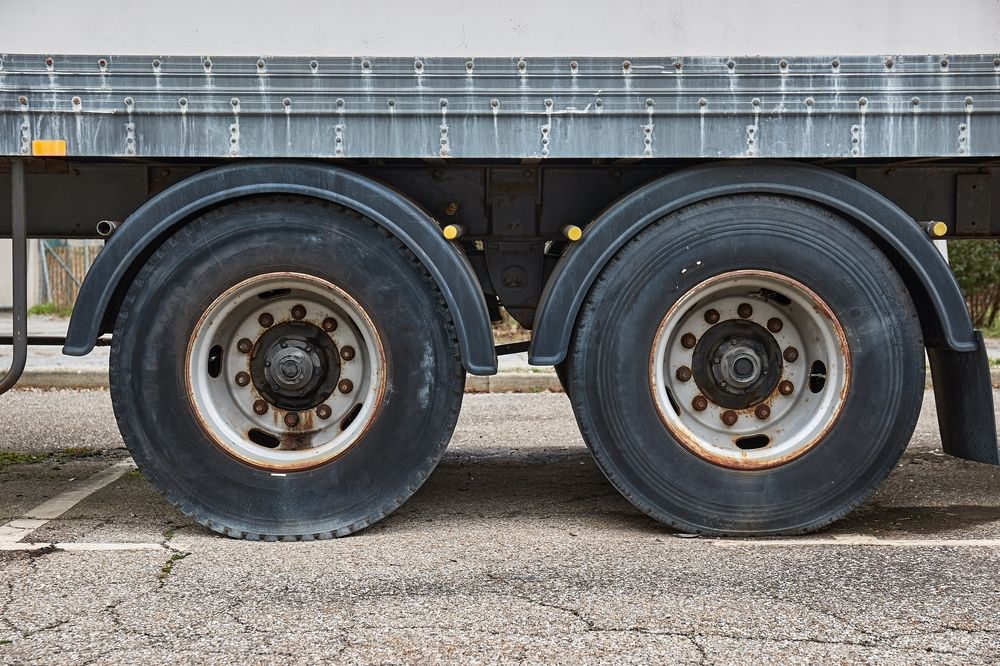
Two large dual rear tires on a semi-trailer, viewed from the side, with a blue checkmark in the upper right corner

This policy applies when a delivery driver is actively performing Amazon-related work, such as transporting packages or completing scheduled deliveries. However, coverage is not always straightforward.

Insurance eligibility often depends on the driver’s status, whether the vehicle was in service at the time of the crash, and how the accident is reported. As a result, injured victims may face delays, denials, or attempts to shift responsibility to lower-limit policies.

Common challenges associated with Amazon’s last-mile delivery insurance include:

  • Determining whether the driver was on an active delivery route
  • Identifying whether Amazon’s policy or a DSP’s policy applies
  • Disputes over independent contractor classifications
  • Insufficient personal auto insurance coverage
  • Aggressive insurer efforts to minimize or deny claims

A truck accident attorney can investigate the delivery arrangement, secure documentation, and pursue all available insurance coverage.

Whose Insurance Pays for an Amazon Truck Accident

Establishing liability in Amazon delivery accidents requires examining the employment relationship between Amazon and its drivers. The relationship directly impacts which insurance policy responds to your claim.

Here are the parties who may pay for your injury-related losses:

Amazon’s Direct Employee Drivers

When Amazon-employed drivers operating blue Amazon-branded vehicles are involved in accidents, Amazon’s commercial auto insurance typically covers the resulting damages. These drivers fall under Amazon’s primary liability coverage, which includes substantial limits designed to protect accident victims.

Third-Party Delivery Service Providers

The situation is different with Amazon’s Delivery Service Partners (DSPs). These independent contractors operate their own fleets using Amazon-branded vans.

While DSPs maintain their own commercial insurance, Amazon’s contingent liability policy, the $1 million policy referenced in last-mile delivery operations, serves as backup coverage when the DSP’s primary insurance proves insufficient or when coverage disputes arise.

Amazon Flex Drivers

Flex drivers using personal vehicles present unique insurance scenarios. Amazon provides commercial auto liability coverage exceeding $1 million while drivers are actively delivering packages.

However, the driver’s personal auto insurance may apply during certain phases of delivery, creating potential coverage gaps that complicate claim resolution.

What to Do After an Amazon Truck Accident

Your actions after an Amazon truck accident can enhance your wellness and protect your legal rights. Here are the actions you can take after an Amazon truck accident:

Seek Immediate Medical Attention

You should seek immediate medical attention after an Amazon truck accident, even if your injuries initially seem minor. Collisions involving delivery trucks often involve significant force, and some injuries, such as internal bleeding or head injuries, may not present symptoms right away.

Prompt medical evaluation ensures your injuries are properly diagnosed and treated before they worsen. A healthcare provider will also generate medical records, which can establish a connection between the accident and the resulting injuries.

Seeking medical attention also protects your rights, as it makes it more difficult for insurance companies to argue that your condition was pre-existing or unrelated. Insurers can use delayed treatment against you to reduce or deny your claim.

A truck accident lawyer can use medical records to prove the severity of the injury and support your compensation claim.

File a Police Crash Report

You should also file a police crash report after being injured in an Amazon truck crash. Here are a few reasons to file the report after the crash:

  • Legal Documentation: A police report creates an official record of the accident, establishing when and where it occurred. This neutral, third-party documentation proves invaluable if disputes arise about fault or circumstances.
  • Insurance Claims: Insurance companies rely heavily on police reports when processing claims. The report provides essential details like driver information, witness statements, and the officer’s assessment, streamlining your claim process.
  • Evidence Preservation: Officers document accident scenes professionally, noting road conditions, vehicle damage, and traffic violations. This evidence might disappear quickly as vehicles are moved and weather changes conditions.
  • Liability Determination: The police report often includes the officer’s determination of fault based on traffic laws and evidence. A truck accident lawyer can use the crash report in settlement negotiations and potential legal proceedings against Amazon or their contracted drivers.

Consult a Truck Accident Attorney

You should also consult a truck accident attorney after an Amazon last-mile delivery crash. These cases often involve insurance arrangements, multiple liable parties, and aggressive defense strategies.

Therefore, working closely with a legal professional can lead to a positive outcome in your claim. A truck accident attorney can help in the following ways after a crash:

  • Evaluating the merits of your case: They can help you to assess liability, identify all responsible parties, and determine whether Amazon’s $1 million last-mile delivery insurance may apply. The evaluation stage helps establish the full value of your claim, including current and future damages.
  • Adhering to legal timelines: Truck accident claims are subject to strict statutes of limitations and procedural deadlines. Missing a filing deadline or failing to provide a timely notice can jeopardize your ability to recover compensation.
  • Negotiating with insurers: Insurance companies often attempt to minimize payouts by disputing coverage or fault. A truck accident lawyer can handle all communications, present compelling evidence, and push back against unfair settlement tactics.
  • Litigation: If a fair settlement cannot be reached, litigation in court may be necessary. A truck accident attorney can prepare your case for trial, advocate on your behalf, and pursue the maximum compensation available under the law.

Who Is At-Fault in an Amazon Delivery Truck Accident

Determining fault in an Amazon delivery truck accident requires careful investigation and strong evidence. A legal professional can help, as multiple parties may share responsibility, including the driver, Amazon, the delivery service provider, or even third-party contractors.

A skilled truck accident lawyer can use the following types of evidence to establish fault:

Electronic Logging Device (ELD) Data

Modern commercial vehicles are equipped with ELDs that track crucial information about the truck’s operation. A truck accident attorney can subpoena this data to reveal whether the driver was speeding, braking erratically, or violating hours-of-service regulations. They can use the data to establish if driver fatigue or reckless driving contributed to the crash.

Dashcam and Surveillance Footage

Video evidence from the truck’s dashcam, nearby traffic cameras, or business security systems can provide an objective account of how the accident occurred. A truck accident lawyer can analyze the footage to demonstrate negligent actions such as unsafe lane changes, running red lights, or distracted driving.

Driver Training and Employment Records

Amazon’s relationship with delivery service providers can complicate liability. A truck accident lawyer can investigate the driver’s employment records, training documentation, and safety certifications to determine if inadequate training or improper hiring practices contributed to the accident.

They can use driver training and employment records to establish negligence on the part of Amazon or the contracting company.

Vehicle Maintenance Records

Poor vehicle maintenance can cause or contribute to accidents. A truck accident lawyer can examine inspection reports, repair logs, and maintenance schedules to identify mechanical failures such as brake defects or tire blowouts.

If negligent maintenance is discovered, it strengthens claims against the company responsible for fleet upkeep.

Driver Logbooks and Delivery Schedules

Unrealistic delivery quotas can pressure drivers to rush or skip required rest breaks. A truck accident lawyer can analyze delivery schedules, route assignments, and actual driving hours to prove that excessive workload demands created unsafe conditions that led to the accident.

Witness Statements and Accident Reconstruction

Eyewitness testimony provides firsthand accounts of the accident, while accident reconstruction experts analyze physical evidence, such as skid marks, vehicle damage, and road conditions. A truck accident attorney uses these professional analyses to create a detailed picture of the collision, demonstrating how specific actions or negligence caused the crash.

How Much Is an Amazon Truck Accident Claim

There is no standard value you can receive for an Amazon truck accident. The value of an Amazon truck accident claim depends on several factors that directly affect how much compensation an injured victim may recover.

Here are factors that influence how much you can recover for your losses:

  • Severity of the Injury: Claims involving catastrophic injuries such as traumatic brain injuries or permanent disability typically result in higher compensation due to extensive medical treatment, long-term care needs, and lost earning capacity. Less severe injuries may still warrant compensation but generally result in lower claim values.
  • Availability of Evidence: Strong evidence, including medical records, crash reports, delivery logs, vehicle data, and witness statements, can enhance the value of your claim. The more complete and well-documented the evidence, the harder it is for insurers to dispute liability or downplay your losses.
  • Shared Liability: Shared fault may also affect the value of your compensation claim. If multiple parties, such as the Amazon delivery driver, a delivery service partner, or another motorist, are partly to blame, your recovery may be adjusted under shared liability rules. An experienced truck accident attorney can identify all liable parties and pursue the maximum compensation available under the law.

Do Not Let Insurance Loopholes Limit Your Recovery

Amazon’s last-mile delivery insurance can provide up to $1 million in coverage. However, insurance loopholes, contractor classifications, and layered policies often make recovery difficult for injured victims.

Without proper legal guidance, you may be pressured into accepting far less than your claim is worth. Our truck accident attorneyw at Boohoff Law, P.A. has years of experience and can help you overcome these challenges, protect your legal rights, and guide you through the compensation claim process.

Contact our truck accident attorneys for a free consultation.

Amazon Truck Crashes: Frequently Asked Questions

How Much Does a Truck Accident Lawyer Cost?

Most truck accident attorneys work on a contingency fee basis, meaning you pay only if they recover compensation for you. Their fee is a percentage of the settlement or court award, with no upfront fees.

When should I Hire a Truck Accident Lawyer?

You can speak to a truck accident lawyer if an Amazon delivery vehicle caused severe injuries or the wrongful death of a loved one. You can also speak to an attorney if insurance companies offer inadequate settlements that don’t cover your losses.

How Can a Truck Accident Lawyer Help?

A truck accident lawyer can investigate Amazon delivery crashes, identify all liable parties, and help understand the insurance policies. They can also negotiate with insurers and, if necessary, represent you in court to protect your right to fair compensation.

Get A Free Consultation

Two large dual rear tires on a semi-trailer, viewed from the side, with a blue checkmark in the upper right corner

Load Securement Failures: When Cargo Shifting Causes Olympia Truck Accidents

Commercial trucks transport essential goods through Olympia and across Washington, carrying a wide range of items, including timber, farm products to manufactured goods, and building materials. When cargo is not properly secured, these huge trucks become a danger on the road.

Shifting loads can cause trucks to tip over, jackknife, or spill cargo, resulting in injuries and damage to other vehicles. Federal rules require safe load securement, and when companies fail to follow them, they must be held responsible. If you or a loved one suffered an injury in an Olympia truck accident caused by shifting cargo or a lost load, understanding how these regulations protect you can make a significant difference. Boohoff Law, P.A., Olympia truck accident attorney will fight for fair compensation.

Get A Free Consultation

Load Securement Failures: Key Takeaways

  • Shifting cargo is extremely dangerous. Improperly secured loads can cause rollovers, jackknife accidents, lost-load crashes, and chain-reaction collisions.
  • Federal regulations exist to protect drivers. FMCSA rules require drivers to secure cargo to resist forces in all directions, applying special standards for heavy or irregular items.
  • Common violations increase risks. Inadequate tie-downs, improper techniques, wrong equipment, uneven loading, and skipped inspections often lead to catastrophic accidents.
  • Multiple parties may be liable. Trucking companies, drivers, loaders, brokers, and equipment manufacturers can share responsibility when cargo shifts.
  • Call our lawyers. Contact Boohoff Law immediately to preserve evidence, hold negligent parties accountable, and pursue maximum compensation after a load securement accident.

Federal Load Securement Regulations

Truck accident. At the rear, a passenger car destroyed in an accident in a ditchThe Federal Motor Carrier Safety Administration establishes comprehensive load securement requirements under 49 CFR Part 393. These regulations instruct drivers on how to secure cargo to prevent shifting, loss, or falling, which can cause truck accidents or injuries.

General Securement Requirements

Cargo must be firmly immobilized or secured on or within a vehicle by structures of adequate strength, dunnage or dunnage bags of appropriate size and strength, shoring bars, tie-downs, or a combination of these. Drivers must secure cargo to prevent it from shifting, falling, or interfering with the vehicle’s stability, maneuverability, or operation.

Specific Performance Criteria 

Tie-downs and securing devices must resist forces in both forward and rearward directions equal to at least 80 percent of the cargo weight. Sideways forces equal to fifty percent of cargo weight, and upward forces equal to twenty percent of cargo weight. These requirements ensure cargo remains stable during acceleration, braking, turning, and encountering road irregularities.

Special Commodity Rules

Beyond general requirements, specific commodity regulations govern different cargo types, including logs and timber, metal coils, paper rolls, concrete pipe, large boulders, heavy machinery, and intermodal containers. Each commodity presents unique securement challenges requiring specialized knowledge and equipment.

Why Proper Load Securement Matters

The physics of commercial trucking make load securement critical for safety. An eighty-thousand-pound truck traveling at highway speeds generates tremendous momentum and inertial forces. When cargo shifts, several dangerous consequences result:

  • Stability Loss: Shifting cargo raises the truck’s center of gravity, creating an uneven weight distribution. This significantly increases the risk of rollover, particularly during turns, lane changes, or emergency maneuvers. Trucks that remain stable with properly secured loads can become unstable and roll over when the cargo shifts.
  • Handling Problems: Unbalanced loads affect steering, braking, and vehicle control. Drivers struggle to maintain lane position, can’t maneuver safely around hazards, and lose the ability to respond to traffic conditions.
  • Catastrophic Rollovers: When shifting cargo causes trucks to exceed their stability thresholds, devastating rollovers can occur. The massive vehicles barrel across multiple lanes, crushing passenger vehicles and causing multi-vehicle accidents.
  • Lost Load Accidents: Improperly secured cargo falls from trucks, creating immediate hazards. Logs, steel coils, construction materials, and other items become deadly projectiles or obstacles that cause horrific accidents.
  • Brake Effectiveness: Shifting cargo affects brake balance and stopping distances. Trucks with forward-shifted loads require longer distances to stop safely, while rearward-shifted loads can cause rear axle lockup and loss of control.

Common Load Securement Violations in Olympia-Area Trucking

Despite clear federal requirements, load securement violations occur regularly. Several factors contribute to these dangerous violations:

Inadequate Tie-Downs

Using too few tie-downs or tie-downs with insufficient working load limits represents the most common violation. Regulations specify the minimum number of tie-downs based on cargo length and weight, but cost-cutting companies or lazy workers often use fewer than required.

Improper Tie-Down Techniques

Even with sufficient tie-downs, using improper techniques makes them ineffective. Common problems include incorrect angles that don’t restrain cargo in all necessary directions, loose tie-downs that allow cargo movement, damaged straps or chains that fail under load, and improper attachment points that don’t distribute forces adequately.

Wrong Equipment for Cargo Type

Different commodities require specific securement equipment. Using standard tie-downs for cargo that requires specialized securement—such as logs that need bolsters and bunks or steel coils that require specific blocking—creates dangerous conditions.

Loading Errors

How cargo is loaded fundamentally affects securement. Problems include uneven weight distribution, creating instability, exceeding axle weight limits, improper stacking that shifts during transport, and failing to use appropriate dunnage or blocking between items.

Failure to Inspect and Adjust

Federal regulations require drivers to inspect cargo securement within the first fifty miles after beginning trips and periodically thereafter. Many drivers skip these inspections or fail to adjust loosened tie-downs, allowing cargo to shift progressively until accidents occur.

Time and Economic Pressures

Properly securing loads takes time and effort. Trucking companies facing tight delivery schedules pressure drivers and loading personnel to rush, cutting corners on securement. Some companies inadequately train their workers or fail to provide them with proper equipment.

Olympia-Area Locations Where Load Securement Accidents Occur

Certain Olympia corridors and conditions see higher rates of load securement accidents. The Interstate 5 Corridor carries constant commercial traffic, featuring hills, curves, and varying speeds that can cause improperly secured loads to shift, leading to rollovers and lost cargo.

State Route 101 handles timber and agricultural trucks on winding, hilly terrain, where load failures can cause serious accidents. US Route 12 connects I-5 to eastern Washington through mountain passes, where grades, curves, and weather increase the risks of catastrophic load shifts.

Port of Olympia Access Routes: see trucks transporting containers facing securement challenges to distribution centers. Curves and Highway Ramps create lateral forces that destabilize trucks when cargo is improperly secured, frequently causing rollovers and serious accidents. Proper load securement is critical to prevent these dangerous incidents.

Types of Accidents Caused by Load Securement Failures

truck accident typesCargo securement failures often result in specific and catastrophic types truck accident scenarios. Rollover accidents occur when shifting cargo raises a truck’s center of gravity, causing it to tip during turns, lane changes, or emergency maneuvers, crushing nearby vehicles and blocking lanes. Jackknife accidents occur when forward or rearward cargo movement during braking causes the trailer to swing out from the tractor, striking multiple vehicles.

Lost Load Accidents involve cargo falling from trucks, such as logs, steel coils, or construction materials, creating hazards that lead to collisions or evasive crashes. Crushing accidents occur when unsecured cargo in rollovers or jackknifes crushes adjacent passenger vehicles, resulting in severe injuries or fatalities.

Chain-Reaction Crashes often follow, as other drivers brake, swerve, or collide with displaced cargo, causing multi-vehicle pileups and widespread damage. Proper cargo securement is essential to prevent these devastating incidents.

Catastrophic Injuries from Load Securement Accidents

Accidents caused by shifting cargo or lost loads are often violently destructive, resulting in severe injuries and property damage. Traumatic Brain Injuries occur from impacts, rollovers, or striking fallen cargo, leading to concussions, cognitive deficits, and permanent disability.

Spinal Cord Injuries can result in partial or complete paralysis, dramatically altering victims’ lives. Crush Injuries happen when trucks roll onto vehicles or cargo falls, causing complex fractures, internal injuries, and requiring extensive surgery.

Multiple Fractures break bones throughout the body, necessitating implants and long-term rehabilitation. Sharp cargo edges, broken glass, or twisted metal cause lacerations and Traumatic Amputations. Burn Injuries can result from fuel spills during crashes. Sadly, fatalities are common, leaving families devastated and emphasizing the critical importance of proper cargo securement to prevent these entirely avoidable tragedies.

Proving Load Securement Violations

Holding trucking companies accountable for load securement failures requires thorough investigation. Accident Scene Documentation captures cargo position, tie-down conditions, load distribution, and damage patterns showing how cargo shifted or fell.

Cargo Securement Records, such as bills of lading and loading logs, reveal how loads were supposed to be secured. Pre-trip inspection logs can indicate whether drivers have properly checked cargo, with gaps indicating potential regulatory violations.

Equipment Examination identifies inadequate or improperly used tie-downs, chains, and straps. Photographic and Video Evidence from witnesses or traffic cameras preserves critical details. Professional Analysis by cargo securement specialists compares evidence to federal requirements and explains causation.

Company Policy Review uncovers systemic training or procedural failures. A similar incident history identifies previous violations, demonstrating patterns of negligence that strengthen claims for accountability and compensation.

Multiple Liable Parties in Load Securement Cases

These accidents often involve multiple defendants sharing responsibility:

Trucking Companies: Primary liability for ensuring proper load securement, providing adequate equipment and training, enforcing inspection requirements, and maintaining securement equipment.

Drivers: Personal liability for failing to properly secure loads, skipping required cargo inspections, or operating vehicles with known securement problems.

Shipping and Loading Companies: Entities responsible for loading cargo may share liability when improper loading techniques, uneven weight distribution, or failure to provide adequate securement cause accidents.

Cargo Brokers: Companies arranging freight transportation may face liability when they create schedules that require rushed loading, compromising proper securement.

Equipment Manufacturers: When defective tie-downs, straps, chains, or securement hardware fail and cause accidents, manufacturers face product liability.

Maintenance Providers: Companies responsible for maintaining securement equipment may share liability when inadequate maintenance causes equipment failures.

We identify all responsible parties and pursue maximum compensation from every available source.

Washington State Legal Framework

Washington law provides strong protections for load securement accident victims:

  • Negligence Per Se: Violations of federal cargo securement regulations constitute negligence per se in Washington courts. The regulatory violation itself proves negligence without requiring additional evidence.
  • Corporate Liability: Trucking companies face vicarious liability under the doctrine of respondeat superior for the actions of their employee drivers, as well as direct liability for negligent policies, inadequate training, and regulatory violations.
  • Modified Comparative Fault: Under RCW 4.22.005, even if you’re partially at fault, you can recover damages reduced by your fault percentage, provided your fault doesn’t exceed fifty percent.
  • Substantial Damages Available: Washington allows recovery of all economic and non-economic damages, and in egregious cases involving willful misconduct, it also permits the recovery of punitive damages to punish and deter.

How Boohoff Law Fights for Load Securement Accident Victims

At Boohoff Law, we hold negligent parties accountable when load securement failures cause devastating accidents. Investigating the accident immediately documents the scene, preserves evidence, and photographs cargo conditions before critical details disappear. A comprehensive analysis examines loading records, inspection logs, securement documentation, and company policies to establish violations and causation.

Professional Testimony from cargo security specialists clarifies regulatory breaches and accident causes. The Multi-Defendant Strategy targets trucking companies, drivers, and loading firms to maximize compensation. Aggressive Representation and complete damage calculation by a skilled truck accident lawyer ensures you recover all current and future damages.

We provide Compassionate Client Service while handling complex legal processes. No Fees Unless We Win makes professional representation accessible. Early action is crucial, as evidence can be lost, tie-downs discarded, and records destroyed, which can impact your ability to build a strong case.

You Deserve Full Justice and Accountability

Law consultancy concept A male client explaining some confusing detail of the contract to the prosecutorWhen trucking companies cut corners on load securement, pressure drivers, or ignore federal safety regulations, they make conscious choices that endanger everyone on Washington roads. When these choices cause accidents that devastate Olympia families, full accountability is essential. You did not cause this accident.

At Boohoff Law, our personal injury attorneys have recovered millions for clients and hold negligent trucking companies accountable through professional analysis, thorough investigation, and aggressive representation. Clients like Elissa M. say, “Boohoff Law stands behind integrity and is truly a people person,” and Brandy K. adds, “They jumped through every hoop to get me the settlement I deserved.”

If you or a loved one has suffered an injury in a load securement accident in Olympia or anywhere in Washington, contact Boohoff Law for a free consultation.

Get A Free Consultation

FAQs: Load Securement Failures Causing Olympia Truck Accidents

What is a load securement failure?

A load securement failure happens when cargo isn’t properly tied down or restrained. Shifting or falling cargo can cause trucks to tip, jackknife, or spill their loads, creating serious hazards for other drivers on Olympia roads.

Why do trucks roll over or jackknife when cargo shifts?

When cargo moves, it raises the truck’s center of gravity and unbalances the weight. This makes steering, braking, and handling unpredictable, increasing the risk of rollovers, jackknife crashes, or lost-load accidents that can result in injury or death.

What causes load securement violations in the Olympia trucking industry?

Common problems include using too few tie-downs, improper securing techniques, selecting the wrong equipment for the cargo, uneven loading, or failing to conduct required inspections. Time pressures, tight schedules, and inadequate training also lead drivers to take shortcuts.

How do investigators prove load securement caused a crash?

They inspect the accident scene, pre-trip logs, cargo bills, and tie-downs. Professionals analyze whether drivers properly restrained loads, compare practices to federal regulations, and identify systemic company failures that contributed to the crash.

Trucks in a row with containers in the parking lot. Logistic and Transport concept

Defective Brake Systems: Product Liability vs Maintenance Negligence in Truck Crashes

When an eighty-thousand-pound commercial truck loses its brakes, the results can be life-changing in an instant. These accidents happen across the country, including Florida and Washington, leaving serious injuries in their wake. Determining the cause of the brake failure is crucial. Some failures stem from defective parts, while others result from poor maintenance, pointing to different parties that may be responsible.

If you or a loved one has suffered an injury in a truck crash caused by brake failure, you need a team that will dig deep, gather evidence, and fight for justice. Turn to Boohoff Law, P.A., your truck accident attorney, ready to guide you.

Get A Free Consultation

Defective Brake Systems Key Takeaways

  • Brake failures can result from defective parts or poor maintenance.
  • Product defects include design flaws, manufacturing errors, or missing warnings.
  • Maintenance negligence includes worn brakes, leaks, or skipped inspections.
  • Liability can involve manufacturers, trucking companies, mechanics, and drivers.
  • Victims may recover medical bills, lost income, pain and suffering, and punitive damages.
  • Contact a truck accident lawyer to protect your rights and pursue full compensation.

Understanding Commercial Truck Brake Systems

Types of Defective Product LawsuitsModern commercial trucks use complex air brake systems that differ significantly from the hydraulic brakes in passenger vehicles. Understanding these systems is essential when analyzing brake failures.
Air brake components include air compressors, reservoirs, brake chambers, brake shoes or pads, slack adjusters, and brake drums or rotors. When the driver presses the brake pedal, compressed air flows to brake chambers, pushing rods that activate brakes at each wheel.

Modern trucks also feature anti-lock braking systems to prevent wheel lockup and maintain steering control, as well as spring brakes that engage automatically if air pressure drops, providing a fail-safe mechanism. Despite these safety measures, brake systems can fail due to manufacturing defects or inadequate maintenance, often resulting in catastrophic accidents that lead to serious injuries or fatalities.

Product Liability: When Brake Systems Are Defectively Designed or Manufactured

Product liability law holds manufacturers responsible when defective products cause injuries. In cases of truck brake failure, product liability may apply when a defective design renders brake systems inherently unsafe.

Manufacturing defects result in brake components that don’t meet specifications, or inadequate warnings fail to inform users about proper operation, limitations, or maintenance requirements.

Common Brake System Defects

Truck brake failure cases often involve several common types of defects. Design defects involve fundamental flaws in how brake systems are engineered, such as insufficient brake capacity for the truck’s weight, brake components prone to overheating and fade, inadequate redundancy in critical components, or systems that fail to properly integrate with other vehicle systems.

Manufacturing defects occur during production, such as brake shoes manufactured with improper friction materials, drums or rotors that don’t meet specifications, faulty air compressors or valves, or improperly assembled brake chambers. Warning defects involve failure to provide adequate instructions about proper brake maintenance requirements, system limitations under various conditions, or warning signs of potential failure.

Identifying Product Liability

Determining whether brake failure resulted from product defects requires extensive investigation. We examine maintenance records to rule out inadequate servicing, analyze brake components to identify manufacturing defects or design flaws, review technical specifications and industry standards, and investigate whether similar defects affected other vehicles. We also consult with brake system engineers and product liability professionals who analyze components and provide testimony.

Potentially Liable Parties

Product liability claims may involve brake component manufacturers, truck manufacturers that integrate brake systems into vehicles, companies that design brake systems, distributors that sell defective components, and any company in the chain of distribution of defective products.

Maintenance Negligence: When Brake Failures Result from Inadequate Servicing

More commonly, truck brake failures result from inadequate maintenance rather than product defects. Federal regulations require rigorous brake inspections and maintenance; failure to comply represents negligence.

  • Federal Brake Maintenance Requirements: The Federal Motor Carrier Safety Administration establishes detailed brake maintenance requirements. Regulations require pre-trip inspections to check brake system components before every trip, periodic inspections at specified intervals to thoroughly examine brake systems, immediate repair of any defects that affect safe operation, and documentation of all inspections, repairs, and brake adjustments.
  • Common Maintenance Failures: Several maintenance failures lead to brake system problems. Worn brake shoes or pads that the driver fails to replace promptly reduce braking effectiveness. Out-of-adjustment brakes create excess travel before brakes engage. Air system leaks that reduce pressure below safe levels, contaminated air systems with moisture or oil that damages components, damaged brake drums or rotors that create uneven braking, and worn or damaged air hoses and connections.
  • Potentially Liable Parties: Maintenance negligence claims may involve trucking companies responsible for maintaining their fleets, maintenance contractors hired to service trucks, independent mechanics who performed inadequate repairs, and truck drivers who failed to conduct required pre-trip inspections or report known defects. Fleet managers who deferred necessary maintenance to save costs.

Distinguishing Product Liability from Maintenance Negligence

Determining whether brake failure resulted from product defects or maintenance negligence requires professional analysis:

Maintenance Records Review: Thorough maintenance records that show proper servicing suggest product defects, while gaps in maintenance or deferred repairs point to negligence.

Component Examination: A physical examination of brake components determines whether failures resulted from wear and inadequate maintenance or from defects present at the time of manufacture.

Failure Pattern Analysis: If multiple trucks with the same brake components experience similar failures, product defects are likely to be present. Isolated failures more often indicate maintenance problems.

Professional Analysis: Brake system engineers, metallurgists, and accident reconstruction professionals analyze components, review maintenance histories, and determine failure causes.

Industry Standards Comparison: Comparing maintenance practices to federal regulations and industry standards helps determine whether carriers have met their obligations.

In many cases, multiple parties share responsibility. For example, a brake component might have a design flaw that proper maintenance may have detected and mitigated, but inadequate inspections allowed the defect to cause failure. We pursue claims against all responsible parties.

Comprehensive Investigation Is Essential

Successfully prosecuting brake failure cases requires a prompt and thorough investigation. We start with accident scene documentation, capturing skid marks, yaw marks, debris patterns, and final vehicle positions before evidence disappears. Truck accident attorneys use spoliation letters to preserve brake components and prevent repair or destruction.

We obtain complete maintenance records through discovery, subpoenas, or court orders to document inspections, repairs, and replacements. Pre-accident inspection logs reveal whether drivers reported brake issues.

Brake system professionals examine components, conduct metallurgical analysis, and determine if failures stemmed from defects or maintenance negligence. We also investigate similar incidents involving the trucking company, manufacturer, or maintenance provider.

Finally, we retain respected professionals in brake system design, truck maintenance standards, accident reconstruction, and injury causation to provide compelling professional testimony that supports the case and maximizes compensation for victims.

Multiple Defendants and Maximum Recovery

Truck accidents caused by brake failures can be devastating, often resulting in serious injuries, permanent disability, or death. These cases frequently involve multiple parties, and understanding who may be liable is critical to securing full compensation.

Manufacturer Defendants

Brake failure cases often involve multiple manufacturers, including brake component producers, truck manufacturers, and system designers. Each may face product liability claims if defects or design flaws contributed to the accident.

Maintenance Defendants

Liability can also extend to trucking companies, maintenance contractors, fleet service providers, and mechanics who failed to perform proper inspections or repairs. Inadequate maintenance can directly lead to catastrophic brake failures.

Driver and Carrier Defendants

Truck drivers who ignored warning signs or continued operating vehicles with known brake issues, along with carriers who deferred necessary repairs, may be held responsible for negligence.

Insurance Coverage

Multiple defendants create multiple insurance policies, increasing the potential compensation available for victims of serious injuries.

Boohoff Law investigates thoroughly to identify all responsible parties and pursue recovery from every source. Our goal is to ensure victims receive full compensation for medical expenses, lost income, pain and suffering, and long-term impacts caused by brake failure accidents.

Damages in Brake Failure Cases

Delivery Truck AccidentVictims of truck accidents caused by brake failures are entitled to comprehensive compensation that addresses every aspect of their losses. Economic damages include all medical expenses, from emergency care and hospitalization to surgery, rehabilitation, ongoing treatment, and lifetime medical needs. Lost income and reduced earning capacity due to permanent injuries are also included, along with property damage, necessary home and vehicle modifications, and all other financial losses.
Non-economic damages cover pain and suffering, emotional distress, anxiety, post-traumatic stress, loss of enjoyment of life, permanent disability or disfigurement, loss of consortium, and other quality-of-life impacts. Courts may award punitive damages when responsible parties act with willful disregard for safety, such as knowingly deferring critical brake maintenance or continuing to produce defective components despite being aware of the dangers. These damages punish wrongdoing and deter future misconduct.

At Boohoff Law, we fight aggressively to ensure victims receive full compensation and hold all responsible parties accountable. We combine technical experience, legal knowledge, and dedicated advocacy to support clients through complex brake failure cases and maximize recovery for every loss suffered.

Why a Truck Accident Lawyer Matters

Brake failure truck accident cases require immediate evidence preservation because brake components can get fixed, destroyed, or lost, making prompt action critical. Successfully prosecuting these cases requires technical experience, including knowledge of complex air brake systems, federal maintenance regulations, and product liability law.

Victims often face multiple defendants, including truck manufacturers, component suppliers, and trucking companies, all of which have substantial resources and experienced defense teams. Therefore, having the capability to fight them effectively is crucial. Expert witness networks, including brake system engineers, metallurgists, truck maintenance specialists, and accident reconstruction professionals, strengthen cases.

Additionally, these cases involve complex insurance coverage, including primary and excess policies, as well as potential disputes. Aggressive representation is necessary to navigate these technical, legal, and insurance complexities, ensuring victims receive full accountability and fair compensation for the devastating consequences of brake failure truck accidents.

How Boohoff Law Fights for Brake Failure Accident Victims

At Boohoff Law, we hold all responsible parties accountable when brake failures cause devastating accidents. We take immediate action, preserving brake components, documenting accident scenes, and securing evidence before it is destroyed or disappears.

Our comprehensive investigation examines maintenance records, analyzes brake systems, reconstructs accidents, and builds compelling cases proving liability. We retain leading professionals to identify defects or maintenance failures and provide powerful testimony.

Our multi-defendant strategy targets manufacturers, maintenance providers, trucking companies, and other entities to maximize compensation. We provide aggressive representation, refusing inadequate settlements and taking cases to trial when needed. A complete damage calculation ensures that all current and future medical costs, lost income, and pain and suffering from truck accident are included.

We offer compassionate support, handling legal challenges so that victims can focus on their healing. With no fees unless we win, clients pay nothing upfront. Statutes of limitations, typically four years in Florida and three in Washington, make early action critical.

You Deserve Full Justice and Accountability

How to Prove a Truck Accident CaseWhether a truck accident resulted from defective brakes or negligent maintenance, you deserve full compensation, and all responsible parties must be held accountable. You were simply going about your day when a truck that should have stopped couldn’t, and your life changed forever. The injuries, medical bills, lost income, pain, and trauma are not your fault.
At Boohoff Law, recovery is personal. We combine technical experience, extensive resources, and relentless determination to hold manufacturers, trucking companies, and all liable parties accountable—work led by an experienced personal injury lawyer dedicated to your recovery. Our proven results include millions recovered, recognition from the Multi-Million Dollar Advocates Forum, and thousands of satisfied clients praising our integrity and dedication.

We handle the legal complexities while you focus on healing. If you or a loved one has suffered an injury in a truck accident involving brake failure in Florida or Washington, contact Boohoff Law for a free, confidential consultation.

Get A Free Consultation

FAQs: Defective Truck Brakes vs Maintenance Negligence

Why do truck brake failures cause such severe crashes?

Because an eighty-thousand-pound truck can’t slow down without a working brake system, when brakes give out, trucks run through intersections, hit stopped traffic, or jackknife across highways. The force is massive, and the damage is often life-changing.

How do I determine if a defective product or poor maintenance caused the brake failure?

A deep investigation is needed. Professionals inspect the brake parts, review maintenance logs, compare failures to industry standards, and check whether the same defect has happened on other trucks. Worn parts usually point to poor maintenance. Broken or faulty components often signal a product defect.

Who can be held responsible for a brake-failure crash?

Several parties may share blame. Manufacturers may be liable for defective design or faulty parts. Trucking companies, mechanics, or maintenance contractors may be responsible for skipped inspections, worn brake pads, out-of-adjustment brakes, or ignored warning signs. Drivers can also be liable if they fail to report brake issues.

What kinds of crashes happen when truck brakes fail?

Brake failures commonly cause rear-end collisions, red-light crashes, jackknife accidents, runaway trucks on hills, and multi-vehicle pileups. These violent impacts often lead to traumatic brain injuries, paralysis, crush injuries, amputations, burns, or fatalities.

Truck accident. At the rear, a passenger car destroyed in an accident in a ditch

Restart Violation Truck Accidents: When Drivers Don’t Get Required 34-Hour Reset

Commercial truck drivers must follow strict federal rules to prevent crashes caused by fatigue. One of the most important is the restart rule, which gives drivers thirty-four hours off to reset their weekly hours and recover. When companies pressure drivers to disregard this rule or adjust schedules to circumvent the system, serious accidents can occur.

Roads in Olympia become hazardous when tired drivers operate large trucks without adequate rest. If you or a loved one suffered injuries in an Olympia truck crash, understanding how missed rest periods can cause wrecks and why the company may bear responsibility proves valuable. Seek support from Boohoff Law, P.A., your Olympia truck accident attorney, ready to protect your rights.

Get A Free Consultation

Restart Violation Truck Accidents – Key Takeaways

  • Fatigue is deadly: Skipping the 34-hour restart builds exhaustion, raising crash risk on Olympia roads.
  • Federal rules exist: Drivers must get 34 consecutive hours off weekly, including two overnight periods.
  • Violations are common: Pressure from companies and tight schedules leads to skipped rest.
  • Typical accidents: Rear-end crashes, lane drift, highway departures, intersections, and multi-vehicle pileups.
  • Evidence matters: ELD data, schedules, company policies, and professional analysis prove violations.
  • Multiple parties liable: Trucking companies, dispatchers, shippers, brokers, and leasing firms.
  • Compensation available Includes Medical bills, lost income, pain and suffering, and, in some cases, punitive damages.
  • Act fast: Boohoff Law preserves evidence, investigates, and fights for full recovery.

Understanding the 34-Hour Restart Rule

How Trucking Regulations Impact Your Accident ClaimFederal Motor Carrier Safety Administration regulations strictly limit truck driver hours to prevent fatigue-related accidents. Under 49 CFR 395.3, drivers cannot exceed sixty hours on duty in seven days or seventy hours in eight days without completing a restart.
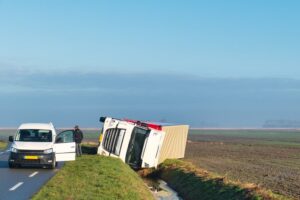
A restart requires at least thirty-four consecutive hours off duty, including two periods between 1:00 AM and 5:00 AM, with no work tasks allowed. Drivers can only use one restart per week. These rules are grounded in fatigue science, circadian rhythm research, and accident data, ensuring drivers have adequate rest to maintain alertness and reduce crash risks.

Why the 34-Hour Restart Exists

Truck driving is physically and mentally demanding. Even when drivers comply with daily hour limits, cumulative fatigue builds throughout the week. By the sixth or seventh consecutive day of driving, even well-rested drivers show measurable performance degradation each night.

The thirty-four-hour restart serves multiple critical purposes:

  • Cumulative Fatigue Recovery: While nightly ten-hour breaks address daily fatigue, they don’t eliminate the cumulative exhaustion that builds up over multiple consecutive workdays. The thirty-four-hour restart provides time for complete physical and mental recovery.
  • Sleep Debt Repayment: Drivers operating on compressed sleep schedules accumulate sleep debt that nightly breaks don’t fully resolve. The longer restart period allows catching up on missed sleep.
  • Circadian Rhythm Restoration: Requiring two overnight periods within the restart ensures drivers get proper nighttime sleep, which is more restorative than daytime rest due to how human circadian rhythms function.
  • Mental and Physical Break: The extended time off allows drivers to decompress from work stress, attend to personal matters, spend time with their families, and return to work mentally refreshed.
  • Safety Improvement: Research consistently shows that properly rested drivers have better reaction times, superior judgment, sustained attention, and dramatically lower accident rates compared to drivers operating with inadequate rest.

How Restart Violations Happen in Olympia-Area Trucking

Despite federal restart mandates, violations are common in Olympia and across Washington due to multiple pressures. Economic pressure from carriers pushes drivers to manipulate logs or shorten rest periods to maximize revenue.

Driver pay structures based on miles or loads incentivize skipping or shortening restarts. Competitive market pressures and high shipping demand in the Pacific Northwest further encourage drivers to exceed limits.

Operations along the I-5 corridor add schedule pressure. Some drivers attempt to manipulate electronic logging devices, while smaller carriers may misunderstand regulations, resulting in dangerous violations. These factors combine to increase fatigue-related crash risks significantly.

Dangerous Fatigue Effects from Skipping Rest Periods

When truck drivers skip proper thirty-four-hour restarts, cumulative fatigue creates extremely dangerous conditions on the road. Severe cognitive impairment reduces decision-making and information processing, comparable to or worse than intoxicated driving.

Extended reaction times and microsleep events make it nearly impossible to avoid hazards, while attention failures cause drivers to miss signals, vehicles, pedestrians, and other road hazards. Impaired judgment leads to unsafe passing, following distances, and speed choices.

Physical deterioration affects steering, lane control, and precise handling. Finally, mood and emotional instability make drivers irritable, aggressive, and more likely to take unnecessary risks. Together, these factors dramatically increase the likelihood of serious or fatal accidents.

Common Olympia-Area Accident Scenarios

Restart violations lead to specific accident patterns on Washington roads. Interstate 5 crashes often involve rear-end collisions, lane drift, or running off the road as drivers exceed weekly limits without proper rest.

Early morning accidents occur when cumulative fatigue combines with circadian sleepiness, increasing crash risk. Highway departures happen when exhausted drivers lose control, crash through guardrails, roll vehicles, or strike fixed objects.

Intersection collisions occur due to missed signals, failure to yield, or misjudged timing, resulting in severe T-bone and head-on crashes. Multi-vehicle chain reactions occur when fatigued drivers cannot brake in time, triggering collisions that involve multiple cars and result in widespread injuries.

Proving Restart Violations in Washington Truck Accident Cases

Holding trucking companies accountable for restart violations necessitates a detailed and methodical approach. These cases involve complex regulations, company policies, and driver behavior, making thorough investigation and professional analysis essential to proving liability and securing justice for accident victims.

Electronic Logging Device Analysis

Modern ELDs track detailed driving time, on-duty periods, and off-duty rest periods. We examine these records to identify violations where drivers skipped required thirty-four-hour restarts or failed to include the mandated overnight periods. This analysis establishes objective evidence of fatigue and regulatory noncompliance.

Seven or Eight-Day Work Period Reconstruction

We reconstruct the complete work schedules of drivers leading up to accidents. By calculating cumulative on-duty hours, we identify when restarts should have occurred but were missed, showing a clear link between fatigue and the crash.

Company Policies and Practices

Trucking company schedules, dispatcher communications, and economic incentives often pressure drivers to skip required rest. We analyze these policies to reveal systematic practices that encourage violations, demonstrating corporate responsibility for unsafe operations.

Driver Testimony

Statements from drivers provide firsthand insight into company pressure, actual rest practices, and levels of exhaustion. Depositions help corroborate data from ELDs and company records, strengthening the case.

Carrier Safety Records

We review FMCSA records, past violations, and compliance patterns. This demonstrates a history of restart violations and a disregard for driver safety standards.

Professional Testimony and Industry Comparison

Industry and fatigue specialists analyze the evidence and compare practices to accepted safety standards. Their testimony demonstrates how restart violations directly contributed to accidents and highlights negligence on the part of the carrier.

Multiple Parties May Share Liability

Overturned truck lies in rural ditch; driver stands nearby, awaiting help in isolated farm area.Restart violation cases often involve multiple defendants. Trucking companies face direct liability for creating schedules that result in restart violations, pressuring drivers, and failing to adequately monitor compliance.

Dispatchers and logistics managers may be personally liable when they enforce impossible schedules. Shippers and brokers share responsibility if delivery deadlines require drivers to skip restarts. Leasing companies can also be liable for ensuring regulatory compliance in leased arrangements.

We conduct thorough investigations to identify all responsible parties and pursue maximum compensation from every available source, holding each entity accountable for its role in causing fatigue-related accidents.

Washington State Legal Framework

Washington law provides strong protections for truck accident victims. Negligence per se applies when federal hours-of-service violations, including restart violations, occur, meaning the violation alone proves negligence.

Corporate liability holds trucking companies responsible under the doctrine of respondeat superior for the actions of their drivers and directly for negligent policies, inadequate training, and safety regulation violations. Modified shared fault under RCW 4.22.005 allows recovery even if the victim is partially at fault, as long as fault does not exceed fifty percent.

Substantial damages include all economic and non-economic losses, with punitive damages possible in cases of willful or reckless conduct to punish wrongdoing and deter future violations.

Comprehensive Compensation for Victims

Olympia truck accident victims injured by drivers who skipped required restarts deserve full compensation. Economic damages encompass all medical expenses, including emergency care, hospitalization, surgery, rehabilitation, ongoing and future treatment, lost income, lost earning capacity, property damage, and necessary modifications to home or vehicle.

Non-economic damages include pain and suffering, emotional distress, anxiety, post-traumatic stress, loss of enjoyment of life, permanent disability, disfigurement, and loss of consortium. Punitive damages may apply when trucking companies willfully ignore safety, pressuring drivers to violate restart rules. Truck accident cases often result in higher compensation than typical car crashes due to the severity of injuries and the substantial commercial insurance coverage involved.

Why You Need Legal Representation

Skilled legal representation protects victims’ rights in restart violation truck accident cases. Immediate action is crucial because companies can overwrite electronic logging data and destroy records. We preserve evidence quickly using spoliation letters and emergency court orders when necessary.

Complex federal regulations require in-depth knowledge of FMCSA hours-of-service rules, restart provisions, electronic logging requirements, and their impact on accidents. Resources to fight the trucking industry are essential, as commercial defendants have substantial financial and legal power. We have the capability and determination to take them on.

Expert witness networks include trucking industry specialists, fatigue scientists, accident reconstructionists, and medical professionals who provide compelling testimony. Insurance coverage complexity requires navigating primary policies, excess coverage, umbrella policies, and disputes to ensure victims receive full compensation.

How Truck Accident Lawyers Fight for Olympia Truck Accident Victims

At Boohoff Law, we are committed to holding trucking companies accountable when restart violations lead to accidents. A comprehensive investigation begins immediately, involving the securing of electronic logging devices, analysis of company records, reconstruction of work periods, and gathering of all evidence to prove violations and causation.

Leading industry specialists provide professional analysis and testimony, identifying violations and explaining how restart breaches caused the accident. Aggressive representation ensures you reject inadequate settlement offers and take cases to trial when necessary. A complete damage calculation accounts for both current and future medical costs, lost income, and all other associated losses. Compassionate client service enables victims to focus on their recovery while we handle the legal complexities.

Clients pay no fees unless we win, making experienced representation accessible. Washington’s statute of limitations gives three years to file, but waiting can ruin cases as critical evidence disappears and electronic data gets overwritten. Immediate action is essential to preserve evidence and protect your rights after a truck accident.

You Deserve Full Justice after Restart Violation Truck Accidents

Settling or Litigating a Truck Accident ClaimWhen trucking companies prioritize profits over safety, pressure drivers to skip required restarts, or ignore fatigue risks, they put everyone on Washington roads in danger. When these choices cause accidents that devastate Olympia families, those responsible must be held fully accountable. You did not cause this accident. The injuries, pain, medical expenses, lost income, and trauma are not your fault, and you deserve full compensation.
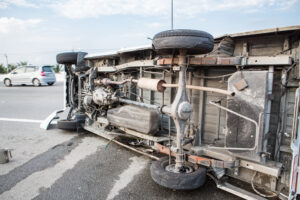
At Boohoff Law, recovery is personal. We have recovered millions for clients, including $27,000,000 in truck accident cases. The Multi-Million Dollar Advocates Forum has recognized our team, awarded the 2024 PIA Badge, and acknowledged our membership in state bars in Washington and Florida. Thousands of clients praise our integrity and the support we provide. Contact us for a free, confidential consultation.

Get A Free Consultation

FAQs: Restart Violations and 34-Hour Reset Truck Crashes in Olympia

Why do restart violations cause so many serious truck crashes in Olympia?

Because drivers never get the true thirty-four hours of rest they need. When they skip the reset, cumulative fatigue builds up throughout the week. By the sixth or seventh day, their reaction time drops, judgment slips, and even a few seconds of microsleep can cause an eighty-thousand-pound truck to enter traffic on I-5 or busy Olympia roads.

How do trucking companies push drivers to break the 34-hour restart rule?

They create impossible delivery schedules, pressure drivers to keep moving, or encourage them to “reset early” so the truck doesn’t sit still. Some companies manipulate electronic logs or look the other way when drivers falsify off-duty time. These shortcuts prioritize profits over safety, leading to preventable crashes.

What signs show that a restart violation caused a truck accident?

Investigators look at electronic logging device data, dispatch messages, delivery timestamps, and weekly driving patterns. Missing overnight rest periods, back-to-back long days, or incomplete off-duty stretches are clear warning signs. These records often reveal that the driver should have stopped days earlier.

What kinds of accidents happen when drivers don’t get proper restarts?

Fatigued drivers drift out of lanes, rear-end stopped traffic, run red lights, or lose control on I-5. Early-morning crashes are common because a lack of sleep and circadian fatigue often coincide. These collisions often lead to multi-vehicle pileups, highway departures, and devastating injuries.

Why should I call Boohoff Law after a suspected restart-violation crash?

Restart cases are complex and time-sensitive. Boohoff Law actively preserves logging data before it’s lost, exposes company pressure, works with fatigue professionals, and identifies every liable party. They calculate full damages and fight aggressively for maximum compensation. You pay nothing unless they win.
Are punitive damages common in Washington truck accident cases?

The court only awards punitive damages when it finds the trucking company acted willfully or recklessly to violate safety rules, such as pressuring a driver to skip restarts. Washington law intends these damages to punish wrongdoing and deter future misconduct. Because of the high standard, the claim requires strong evidence showing corporate indifference to safety.

Is the truck driver or the trucking company the main defendant in a restart violation case?

The trucking company usually becomes the primary defendant because it carries a substantial commercial insurance policy. We pursue truck accident claim process against the company for their negligent policies, unsafe scheduling, and failure to monitor drivers under the legal doctrine of respondeat superior. 

While the driver’s actions cause the accident, the company’s systemic violations may enable the driver’s fatigue, making the company the key party responsible for paying compensation.

Two large dual rear tires on a semi-trailer, viewed from the side, with a blue checkmark in the upper right corner

30-Minute Break Violations: Short-Haul Driver Fatigue in Port-to-Distribution Runs

Washington State relies on busy ports and steady trucking routes to keep goods moving across the region. Olympia sits at the center of this activity, with trucks carrying cargo from Tacoma and Seattle to stores and warehouses every day. These short trips may look simple, yet drivers often face tight deadlines and constant pressure.

Some skip their required thirty-minute breaks, and tired minds and bodies can lead to serious crashes. Local families suffer the most when a moment of fatigue turns into a heavy impact. If you suffered an injury in Olympia by a truck on a short run, it helps to know how missed breaks play a role in these wrecks. For guidance, speak with Boohoff Law, P.A., your Olympia truck accident attorney, ready to support you fully today.

Get A Free Consultation

30-Minute Break Violations Key Takeaways

  • Short-haul truck drivers in Washington often skip their required thirty-minute breaks, which increases their risk of fatigue and crashes.
  • Federal rules mandate off-duty breaks after eight hours of driving to prevent accidents caused by fatigue.
  • The short-haul break exception is frequently misused, putting drivers and other road users at risk.
  • Port-to-distribution routes are high-risk due to intense concentration, multiple trips, time pressure, start-and-stop driving, and environmental stressors.
  • Skipping breaks can lead to degraded attention, slower reactions, microsleeps, poor decision-making, and increased risk of aggressive driving.
  • Accidents from fatigued drivers can cause catastrophic injuries, including brain trauma, spinal cord damage, fractures, and fatalities.
  • Multiple parties, including trucking companies, ports, shippers, and brokers, may be liable for break-related accidents.
  • Washington law recognizes breach of contract violations as negligence per se, strengthening injury claims for victims.
  • Full compensation can include medical bills, lost earnings, pain and suffering, and punitive damages when companies act egregiously.
  • Immediate legal action preserves evidence, navigates complex regulations, and ensures maximum recovery; contact an experienced truck accident lawyer to protect your rights.

Understanding the Thirty-Minute Break Rule

Overturned truck lies in rural ditch; driver stands nearby, awaiting help in isolated farm area.Federal Motor Carrier Safety Administration regulations require commercial truck drivers to take rest breaks to prevent fatigue. Under 49 CFR 395.3, drivers cannot drive after eight consecutive hours without an off-duty or sleeper-berth break of at least thirty minutes.

In simple terms, they must take a true off-duty break before reaching eight hours of driving time. The rule reduces fatigue, allows for brief recovery, and breaks up the monotony that can lower alertness. Even short rest periods can significantly reduce fatigue-related crash risks, and skipping them allows fatigue to build up quickly.

The Thirty-Minute Break Exception and Its Misuse

In December 2020, federal regulations created an exception to the thirty-minute break rule for short-haul drivers. These drivers do not require thirty-minute breaks if they return to their starting point and stay within the specified on-duty limits.

Companies often misuse this exception by pressuring drivers to qualify, even when their routes fail to meet the requirements, or by manipulating records to falsify the information. Drivers running similar schedules without qualifying are also at risk. The issue is severe in Washington’s port-to-distribution operations, where tight windows, traffic, and delivery pressure lead to frequent break violations.

Why Port-to-Distribution Runs Are High-Risk

Short-haul routes connecting Washington ports to distribution centers present unique fatigue risks:

Intense Concentration Requirements: Navigating port areas, dealing with congestion, maneuvering in tight distribution center spaces, and handling frequent stops and starts all demand intense mental focus. This concentrated effort is more fatiguing than steady highway driving.

Multiple Trips in Single Shifts: Port-to-distribution drivers often make multiple runs in a single day. Each trip involves accessing ports, loading cargo, navigating congested city streets, traveling on highways, unloading at a distribution center, and making return trips. The cumulative fatigue from these repeated cycles is substantial.

Time Pressure: Port pickup windows are strict. Missing your window means delayed cargo and angry customers. Distribution centers enforce receiving schedules that drivers must meet. These pressures incentivize drivers to skip breaks to maintain schedules.

Start-and-Stop Driving: Short-haul routes involve constant starting, stopping, and maneuvering rather than steady highway cruising. This driving style is more physically and mentally exhausting, making rest breaks even more critical.

Environmental Stressors: Dealing with port congestion, urban traffic, construction zones, and adverse weather in the Puget Sound region creates additional stress that accelerates fatigue.

Common Olympia-Area Routes Where Break Violations Occur

Certain corridors see frequent thirty-minute break violations:

Interstate 5 Between Tacoma Ports and Olympia/Southern Washington: Trucks moving cargo from the Port of Tacoma to distribution centers rush through this corridor under tight deadlines, often skipping required breaks.

State Route 512 and I-5 Connections: This critical link between Tacoma and I-5 southbound carries intense truck traffic operating under time pressure.

Port of Olympia to Regional Distribution Centers: While smaller than Seattle-Tacoma ports, Olympia’s port generates truck traffic subject to the same time pressures and break violations.

Highway 101 Connections: Trucks moving cargo to coastal distribution points travel routes where rest break opportunities are limited, and pressure to maintain schedules is intense.

How Skipping Thirty-Minute Breaks Causes Accidents

When truck drivers skip required thirty-minute breaks during demanding short-haul operations, specific accident patterns emerge:

Degraded Attention: Without breaks, drivers’ attention spans shorten. They miss critical details, such as vehicles in blind spots, changing traffic signals, or hazards ahead. This inattention causes collisions that rested drivers may have avoided.

Slower Reaction Times: Fatigue slows information processing and physical responses. When situations demand quick braking, steering, or other reactions, fatigued drivers can’t respond fast enough to prevent accidents.

Microsleep Episodes: Exhausted drivers experience brief, involuntary sleep episodes that last only seconds. During microsleeps on Olympia roads or I-5, trucks drift between lanes, fail to brake for stopped traffic, or run off roadways.

Poor Decision-Making: Fatigue impairs judgment. Drivers make poor choices about following distances, safe passing opportunities, appropriate speeds, and how to navigate hazards.

Physical Exhaustion: Hours of constant driving without breaks lead to physical fatigue, which affects steering control, pedal operation, and the ability to maintain proper vehicle positioning.

Irritability and Aggression: Exhaustion, combined with time pressure, creates irritable and aggressive drivers who take dangerous risks, follow too closely, or make unsafe maneuvers.

Real-World Consequences: Catastrophic Injuries

Truck accidents caused by fatigued drivers who skip thirty-minute breaks can lead to devastating injuries. Victims often suffer traumatic brain injuries, including concussions and severe brain trauma that can cause cognitive problems, personality changes, and permanent disability.

Spinal cord injuries are common, sometimes resulting in partial or complete paralysis. The force of an eighty-thousand-pound truck can cause multiple fractures, crushing limbs, and require extensive surgery and rehabilitation. Internal injuries from blunt force trauma can damage organs and require emergency surgery.

Crashes involving fuel or hazardous cargo can cause burn injuries needing skin grafts and long-term care. Tragically, some accidents cause fatalities, leaving families devastated as they demand answers about why companies ignore safety regulations and let drivers operate without required breaks.

Proving Thirty-Minute Break Violations

What Happens When a Truck Driver Has a Fatal Car AccidentSuccessfully holding trucking companies accountable for brake violations requires a thorough investigation. We analyze electronic logging device records to identify periods exceeding eight hours without the required thirty-minute breaks. Duty status records show whether drivers spent claimed off-duty time resting or performing work tasks.


Company communications, including texts, emails, and dispatch notes, often reveal pressure to skip breaks or maintain impossible schedules. Delivery and pickup documentation, such as bills of lading, port gate records, and distribution center receipts, establishes timelines showing when drivers missed breaks.

Witness testimony from port workers, distribution center staff, and other drivers provides insight into driver fatigue and unsafe practices. Finally, schedule analysis by professionals demonstrates how companies created routes and delivery windows that required drivers to violate federal break regulations.

Multiple Liable Parties in Port-to-Distribution Accidents

Truck accident liability often extends beyond the driver. Trucking companies can be directly responsible for negligent scheduling, pressuring drivers to violate regulations, poor fatigue management policies, and failing to monitor compliance with breaks.

Port operators may contribute to this issue through scheduling practices that require drivers to skip their required rest. Shippers and brokers can share liability when they create unrealistic schedules to meet contractual obligations. Maintenance providers may also be liable if truck defects, such as brake failures, contributed to the accident.

At Boohoff Law, we conduct thorough investigations to identify all responsible parties and pursue maximum compensation from every available source, ensuring injured victims receive the full recovery they deserve.

Washington State Law Protections

Washington offers truck accident victims strong legal protections. When a truck driver violates federal hours-of-service rules, including the requirement for breaks, it constitutes negligence per se, meaning the violation itself establishes negligence without requiring additional evidence of negligence.

Trucking companies are also responsible through respondeat superior, which holds employers liable for the actions of their drivers while they are working. Victims may also pursue truck accident claims for direct corporate negligence when unsafe company policies, unreasonable schedules, or poor oversight contribute to violations.

Washington’s modified shared fault rule under RCW 4.22.005 allows injured victims to recover compensation even if they share partial fault, as long as they are not more than fifty percent at fault. These protections strengthen injury claims.

Comprehensive Compensation for Truck Accident Victims

Olympia residents injured by fatigued truck drivers who violated break requirements deserve full compensation:

Economic Damages

All medical expenses, including emergency care, hospitalization, surgery, rehabilitation, home healthcare, and future medical needs; all lost income from missed work; lost earning capacity if injuries prevent you from returning to your previous employment; property damage; and all other out-of-pocket costs.

Non-Economic Damages

Pain and suffering from your truck accident injuries; emotional distress and psychological trauma, including PTSD and anxiety; loss of enjoyment of life; permanent disability and disfigurement; and loss of consortium affecting your relationship with your spouse.

Punitive Damages

When a trucking company’s conduct is particularly egregious—such as systematic policies that pressure drivers to violate break requirements—Washington law allows for punitive damages to punish wrongdoers and prevent future violations.

Why You Need Experienced Legal Representation

Truck accident cases involving hours-of-service violations demand specific experience:

  • Immediate Evidence Preservation: Companies can overwrite electronic logging data and destroy records. We act immediately to preserve critical evidence through spoliation letters and court orders when necessary.
  • Federal Regulation Experience: Successfully prosecuting these cases requires detailed knowledge of FMCSA regulations, their application to various operations, and the impact of violations on accidents.
  • Resources to Fight Trucking Companies: Commercial trucking defendants have substantial resources and experienced defense teams. We have the capability and determination to fight them effectively.
  • Expert Witnesses: We collaborate with experienced professionals from the trucking industry, including fatigue specialists, accident reconstruction experts, and medical professionals, who thoroughly analyze evidence and present compelling testimony.
  • Complex Coverage Issues: Commercial truck insurance involves substantial policy limits, excess coverage, and disputes about which policies apply. We navigate these complexities skillfully.

How Boohoff Law Protects Your Rights

At Boohoff Law, we hold negligent trucking companies fully accountable by conducting a comprehensive investigation of electronic logging devices, company records, communications, schedules, and every piece of evidence that proves violations. We utilize independent professional analysis to demonstrate how broken violations and unsafe practices contributed to your accident.

Through aggressive negotiation, we challenge trucking insurers and reject low offers. Our trial readiness strengthens every case when insurers refuse to offer fairness. You also receive compassionate support, allowing you to focus on healing while we handle every legal detail. With our ‘no fees unless we win’ policy, you pay nothing up front.

Washington’s three-year statute of limitations makes quick action crucial. Waiting lets electronic data be overwritten, memories fade, and key records expire under federal retention rules. Contact a personal injury attorney immediately after a truck accident to preserve critical evidence and protect your rights.

You Deserve Justice and Accountability

Settling or Litigating a Truck Accident ClaimWhen trucking companies push speed over safety and allow drivers to skip required breaks, they put Olympia families at risk. When this conduct causes a crash, they must be held fully accountable for their actions. You were going about your day when a fatigued driver caused a collision that changed your life.

Your medical bills, pain, and lost income are not your fault. You deserve full compensation. At Boohoff Law, recovery is personal. Backed by recognition from Avvo, the ABA, the Florida and Washington Bar, the Multi-Million Dollar Advocates Forum, the 2024 PIA Badge, and thousands of happy clients with results up to $27,000,000, we know what it takes to stand up to trucking companies.

If you suffered an injury in a truck accident in Olympia or anywhere in Washington, contact Boohoff Law, P.A. for a free, confidential consultation.

Get A Free Consultation

Frequently Asked Questions About 30-Minute Break Violations in Short-Haul Trucking.

What makes the thirty-minute break so important for short-haul truck drivers?

Short-haul routes demand constant focus, heavy maneuvering, and repeated trips. Without a true thirty-minute break, fatigue builds quickly and increases the risk of dangerous mistakes.

How can I determine if a truck driver has taken their required break?

Electronic logging devices, port timestamps, delivery receipts, and company communications often show long driving periods without proper off-duty time. A truck accident lawyer can uncover this <truck accident evidence.

Are short-haul drivers always exempt from the thirty-minute break rule?

No. The short-haul exception applies only in specific situations. Many port-to-distribution drivers don’t qualify, yet companies still push them to operate as if they do.

What should I do if a fatigued truck driver caused my accident in Olympia?

Seek medical attention, contact the police, document the scene, and consult with an attorney immediately. Evidence of a break violation disappears quickly, so taking early action protects your rights.

Fuel carrier in flames. The truck carrying fuel caught fire while on the street.

The 11-Hour Driving Window Violation: When Olympia Truck Crashes Happen on “Borrowed Time”

Commercial trucks play a big role in Olympia and across Washington. They move goods along the I-5 corridor, supply local shops, and support daily life. Problems arise when drivers exceed the federal hours of service rules. The eleven-hour driving limit exists to protect everyone, yet some drivers keep going when they should rest.

Fatigue develops rapidly, and tired drivers make slower, more cautious choices that can lead to severe crashes. Families can lose health, income, and peace in a single moment. If you or someone close suffered injuries in an Olympia truck crash, learn how long hours fuel these wrecks and why the company may bear responsibility. Reach out for support from Boohoff Law, P.A., your Olympia truck accident attorney, today, ready to guide you.

Get A Free Consultation

11-Hour Driving Window Violation Key Takeaways

  • Drivers must stop after 11 hours on duty; exceeding this limit increases the risk of crashes.
  • Fatigue slows reactions, impairs judgment, and can cause microsleeps.
  • Violations often stem from company pressure, pay incentives, or impossible schedules.
  • High-risk areas in Olympia include I-5, SR-101, US-12, and truck stops.
  • Investigators gather evidence from electronic logs, black boxes, company records, and witness statements.
  • Washington law treats hours-of-service violations as negligence per se.
  • Victims may recover medical costs, lost income, pain and suffering, and punitive damages.
  • Contact an experienced truck accident lawyer to protect your rights and pursue full compensation.

Understanding Federal Hours-of-Service Regulations

Freight Truck Crash on Highway with Emergency ResponseThe Federal Motor Carrier Safety Administration establishes hours-of-service regulations to prevent truck driver fatigue, one of the leading causes of commercial vehicle accidents. These rules apply to most commercial motor vehicle drivers operating in interstate commerce.

The regulations are complex, but several key limits govern how long truck drivers can operate before they become dangerously fatigued:

The Eleven-Hour Driving Limit

After taking at least ten consecutive hours off duty, a driver may drive for up to eleven hours. Once a driver reaches this eleven-hour limit, they must stop driving. They cannot continue operating the commercial vehicle until they’ve had at least ten consecutive hours off duty.

This eleven-hour window is federal law, backed by decades of research into driver fatigue and accident causation. When drivers exceed this limit, fatigue impairment increases dramatically, reaction times slow, judgment deteriorates, and the risk of catastrophic accidents multiplies.

The Fourteen-Hour On-Duty Window

Drivers may not drive beyond the fourteenth consecutive hour after coming on duty, even if they haven’t reached their eleven-hour driving limit. This prevents drivers from extending their workday indefinitely with breaks.

Required Ten-Hour Break

Before beginning a new driving period, drivers must take at least ten consecutive hours off duty. This break allows for sleep and recovery from fatigue.

Seventy-Hour/Eight-Day or Sixty-Hour/Seven-Day Limits

Drivers cannot drive after accumulating sixty hours on duty in seven consecutive days or seventy hours in eight consecutive days. After reaching these limits, drivers must take the required restart periods.

These interconnected regulations work together to ensure commercial truck drivers get adequate rest and don’t operate vehicles while dangerously fatigued.

Why the Eleven-Hour Limit Exists

Researchers base the eleven-hour driving limit on studies of human physiology, fatigue, and accident data. Studies show that performance declines significantly as drivers approach and exceed eleven hours on the road.

Cognitive impairment occurs after ten to eleven hours, slowing information processing, weakening decision-making, and reducing responsiveness to changing conditions. Physical fatigue builds as muscles tense, vision strains, and circadian rhythms increase sleepiness.

Dangerously fatigued drivers may experience microsleeps, brief lapses lasting seconds during which they are not in control of the vehicle, allowing an eighty-thousand-pound truck to travel hundreds of feet unchecked. Reaction times decline to levels comparable to those of legally impaired drivers, and judgment suffers, affecting speed, passing decisions, and hazard assessment. Exceeding the eleven-hour limit renders driving unreasonably dangerous, with the risk of an accident increasing with every additional minute behind the wheel.

How Eleven-Hour Violations Happen in Olympia

Despite clear federal regulations, violations of the eleven-hour driving limit occur regularly on Olympia roads and throughout Washington State. Several factors contribute to these dangerous violations:

  • Economic Pressure from Trucking Companies: Some trucking companies pressure drivers to deliver loads more quickly, meet unrealistic schedules, or maximize the number of miles driven. Drivers face implicit or explicit threats that refusing to violate hours-of-service regulations will result in fewer loads, termination, or being labeled difficult to work with.
  • Payment Structures That Incentivize Violations: Many truck drivers are paid by the mile rather than by the hour. This creates financial incentive to drive more hours, cover more miles, and maximize earnings even when it means violating federal limits and risking everyone’s safety.
  • Scheduling That Makes Compliance Impossible: Trucking companies sometimes set delivery schedules that drivers cannot meet without violating hours-of-service rules. Drivers face impossible choices between meeting deadlines and complying with safety regulations.
  • Electronic Logging Device Manipulation: While modern electronic logging devices make it harder to falsify hours, some drivers and companies find ways to manipulate these systems, misclassify driving time as on-duty, not driving, or pressure drivers to drive off the books.
  • Independent Contractors Circumventing Rules: Some owner-operators or independent contractors believe they can maximize profits by pushing beyond legal limits. Without company oversight, these drivers may routinely violate regulations.
  • Interstate 5 Corridor Pressures: Olympia’s position on the critical I-5 corridor between Portland and Seattle creates intense pressure for timely deliveries. Drivers hauling time-sensitive loads through Olympia may push beyond legal limits to meet deadlines.
  • Port-Related Time Pressures: Trucks moving cargo from Washington ports face tight windows for pickups and deliveries. These time constraints can incentivize hours-of-service violations.

Common Olympia Locations for Fatigued Truck Driver Crashes

Certain Olympia-area locations experience higher numbers of accidents involving fatigued commercial drivers. Interstate 5 through Olympia is a major north-south corridor with heavy truck traffic, and congestion, hills, curves, and weather create hazards for tired drivers.

State Route 101 carries trucks to coastal and Olympic Peninsula destinations, and its winding, sometimes isolated stretches are particularly dangerous when drivers are fatigued. US Route 12 connects I-5 to eastern Washington and features challenging terrain that contributes to a high incidence of serious accidents.

Truck stops and rest areas can also be sites of crashes when exhausted drivers push further or resume driving without adequate rest. Many accidents occur during the early morning hours, when natural sleepiness is at its peak, increasing the likelihood of fatigue-related collisions. Awareness of these high-risk areas can help locals stay safe.

Proving Hours-of-Service Violations in Olympia Truck Accident Cases

When we represent Olympia residents injured in any type of truck accidents, proving hours-of-service violations requires thorough investigation and aggressive legal action:

  • Electronic Logging Device Data
  • Logbooks and Paper Records
  • Company Records
  • Black Box Data
  • Witness Testimony
  • Professional Analysis

Washington State Law and Truck Accident Liability

truck accident liabilityWashington law provides strong protections for victims injured by negligent truck drivers and trucking companies. Negligence per se applies when drivers violate federal hours-of-service rules, meaning the violation itself constitutes negligence without the need for additional evidence.

Employer liability under respondeat superior holds trucking companies responsible for accidents caused by employees acting within the scope of employment. Companies can also face direct liability for negligent hiring, training, supervision, retention, or policies that pressure drivers to break regulations.

Washington’s modified shared fault under RCW 4.22.005 allows victims to recover damages even if they are partially at fault, as long as their fault does not exceed fifty percent, ensuring that injured parties can still pursue fair compensation.

Compensation for Truck Accident Victims

Olympia residents injured by fatigued truck drivers operating beyond eleven-hour limits deserve full compensation for all damages:

Economic Damages: All medical expenses, including emergency transport, hospitalization, surgery, rehabilitation, ongoing care, and future medical needs; lost income from time missed at work; lost earning capacity if injuries affect your ability to work long-term; property damage to your vehicle and belongings; and other out-of-pocket expenses.

Non-Economic Damages: Pain and suffering from your injuries; emotional distress and psychological trauma; loss of enjoyment of life and activities you can no longer perform; disfigurement and permanent disability; and loss of consortium affecting your relationship with your spouse.

Punitive Damages: In cases involving particularly egregious conduct—such as trucking companies systematically pressuring drivers to violate safety regulations—Washington law allows punitive damages designed to punish wrongdoers and deter future misconduct.

Truck accident cases often involve substantially more serious damages than typical car accidents due to the severity of injuries and the resources available through trucking company insurance policies.

Why Hours-of-Service Cases Require an Experienced Truck Accident Attorney

Truck accident cases involving hours-of-service violations are complex and require specific experience:

Preservation of Evidence

Companies can destroy, overwrite, or lose electronic logging device data, black box information, and other records. We act immediately to preserve this critical evidence through spoliation letters and, if necessary, emergency court orders.

Federal Regulation Knowledge

Successfully prosecuting these cases requires a thorough understanding of FMCSA regulations, industry standards, and the impact of violations to accidents.

Resources to Fight Trucking Companies

Trucking companies and their insurers have teams of personal injury lawyers and professionals defending truck accident claims. We have the resources, experience, and determination to fight them effectively.

Multiple Liable Parties

Truck accident cases often involve multiple defendants, including the driver, trucking company, brokers, shippers, maintenance providers, and others. We identify all truck accident liable parties and pursue maximum compensation from all sources.

Complex Insurance Coverage

Commercial truck insurance involves substantial policy limits, excess policies, and coverage disputes. We navigate these complexities to ensure full recovery.

How Boohoff Law Fights for Olympia Truck Accident Victims

At Boohoff Law, we are committed to holding negligent truck drivers and trucking companies accountable when hours-of-service violations lead to serious accidents. We conduct immediate investigations to preserve evidence, obtain electronic logging device data, secure black box information, and document the scene before key details are lost or altered.

Our team conducts thorough analyses in collaboration with trucking industry professionals, accident reconstruction specialists, and medical professionals to build compelling cases. Through aggressive representation, we challenge powerful trucking insurers, refuse inadequate settlements, and take cases to trial when needed.

We calculate comprehensive damages, including current and future medical expenses, lost income, and non-economic damages such as pain and suffering in truck accident case. With no fees unless we win, you pay nothing up front. Washington’s three-year statute of limitations makes prompt action critical because electronic data can be overwritten, memories fade, and evidence disappears.

You Deserve Justice for the 11-Hour Driving Window Violation.

Truck accident law. Judge's gavel and book on wooden table, top viewWhen truck drivers exceed the eleven-hour limit, they put innocent Olympia families at serious risk. When trucking companies pressure or allow these violations to maximize profits, they must be held accountable. You did not cause this accident.

The injuries, medical bills, lost income, and pain are not your fault, and you deserve full compensation. At Boohoff Law, we treat recovery as personal and handle the legal challenges, allowing you to focus on healing.

Recognized by Avvo, the ABA, the Washington Bar, the Multi-Million Dollar Advocates Forum, and the BOTB Medallion, and holding the 2024 PIA Badge, our firm has recovered millions for thousands of clients, with results that speak for themselves. If you have suffered an injury in a truck accident in Olympia, contact Boohoff Law, P.A. for a free, confidential consultation. You’re better off with Boohoff, and we will fight for your rights.

Get A Free Consultation

FAQs: Eleven-Hour Driving Window Violations in Olympia

Why do eleven-hour driving limit violations lead to so many Olympia truck crashes?

Tired drivers make slow and unsafe choices. When they push past the legal limit, fatigue hits hard. Reaction times drop, judgment gets worse, and even a short “microsleep” can send an eighty-thousand-pound truck into oncoming traffic. On I-5 and other busy roads in Olympia, these mistakes can quickly escalate into serious crashes.

How do trucking companies cause or encourage eleven-hour violations?

Some companies impose impossible schedules, pressure drivers to “keep going,” or set delivery windows that drivers cannot meet legally. Others reward extra miles, ignore red flags, or allow drivers to bend electronic logging rules. These practices force drivers to operate on borrowed time, putting everyone at risk.

Where do fatigue-related truck crashes happen most around Olympia?

Hot spots include I-5 through Olympia, State Route 101, US-12, and roads near truck stops and rest areas where tired drivers try to squeeze in a few more miles. Crashes also spike in the early morning hours when drivers are deep into fatigue and nearing the end of their legal driving window.

How do you prove that a truck driver exceeded the eleven-hour limit?

Investigators pull electronic logging device data, black box records, dispatch logs, delivery timestamps, and schedules. Witnesses and trucking professionals help demonstrate how fatigue accumulated and how long the driver had been on duty. In many cases, the violation itself counts as negligence.

Illustration of an Amazon delivery van backing up in a residential driveway where a pedestrian has been struck, highlighting driveway accident risks in Washington.

Backed Over by an Amazon Van: Liability for Residential Driveway and Parking Lot Accidents in Washington

The convenience of online shopping means delivery vans are a constant presence on our streets, in our apartment complexes, and pulling into our driveways. We trust these drivers to deliver packages safely, but when they fail to do so, the results can be devastating.

Being hit by a delivery van, especially in a seemingly safe residential area, is a shocking and painful experience. If you or a loved one were injured in an incident involving an Amazon van in a driveway or parking lot, you are likely facing medical bills, lost time from work, and many questions.

Determining who is financially responsible—the driver, their direct employer, or the corporate giant Amazon—is a complex issue. Still, Washington law provides a path to hold the right parties accountable.

If you were injured by an Amazon delivery van, a dedicated Seattle Amazon delivery accident lawyer can help hold the responsible parties accountable—contact us today for a free consultation.

Get A Free Consultation

Key Takeaways about Residential and Parking Lot Accidents in Washington

  • Determining liability after an accident with an Amazon van involves examining the actions of the driver, the responsibilities of the third-party Delivery Service Partner (DSP), and Amazon’s own role.
  • The legal concept of “vicarious liability” can sometimes hold an employer responsible for the negligent actions of its employees, though Amazon’s business structure often complicates this.
  • Washington state follows a “pure comparative fault” rule, which means an injured person can recover damages even if they are partially at fault, but their compensation is reduced by their percentage of fault.
  • Evidence from the accident, including photos, witness statements, and documentation of injuries, is crucial for building a strong claim for compensation.
  • Accidents in residential driveways and parking lots present unique dangers due to large vehicle blind spots, driver pressures, and the presence of pedestrians, including children.

Why Are Driveway and Parking Lot Accidents So Common?

Illustration of an Amazon delivery van backing up in a residential driveway where a pedestrian has been struck, highlighting driveway accident risks in Washington.

Accidents involving large delivery vans in residential settings happen more often than many people think. These areas, which we associate with safety and home, can become hazardous when commercial vehicles are introduced. Several factors contribute to the risk of a person being backed over or hit by a delivery van.

  • Vehicle Blind Spots: Commercial vans, like the familiar blue Amazon Prime vans or the newer, larger Rivian electric vehicles, have significant blind spots, especially in the rear and along the sides. A driver reversing out of a driveway might not see a person, particularly a small child, walking behind the vehicle.
  • Driver Pressure and Distraction: Delivery drivers often work under intense pressure to meet strict quotas and deadlines. This can lead to rushing, failing to perform proper safety checks before backing up, or being distracted by their delivery scanner or GPS while maneuvering in a tight space.
  • Quiet Operation: Modern vehicles, especially electric ones, are much quieter than older models. A pedestrian might not hear a van approaching or preparing to move in a busy parking lot near the Pike Place Market or in a quiet suburban neighborhood in Bellevue.

These elements combine to create a recipe for serious incidents in the very places we should feel most secure. The consequences of such an accident can be life-altering, making it vital to understand your rights.

Who Is Legally Responsible for an Amazon Van Accident?

When an Amazon van causes an injury, figuring out who to hold responsible isn’t always straightforward. It’s rarely just about the driver. Liability—the legal term for responsibility—can extend to multiple parties, and a thorough investigation is often needed to identify all of them.

The Driver’s Negligence

The starting point for liability is usually the driver. All drivers have a “duty of care” to operate their vehicle safely to avoid harming others. When they fail in this duty, it’s called negligence. In a residential accident, driver negligence could include:

  • Failing to check mirrors and blind spots before reversing.
  • Speeding through a parking lot or residential street.
  • Being distracted by a phone or delivery device.
  • Ignoring stop signs or failing to yield to pedestrians.

If the driver’s careless actions directly caused your injuries, they are considered negligent and can be held responsible for the damages.

Amazon’s Potential Liability: The Doctrine of Vicarious Liability

This is where things get complicated. You might assume that if a driver in an Amazon-branded van hits you, Amazon is automatically responsible. However, Amazon has structured its delivery operations to create distance between itself and its drivers. Most drivers work for separate companies called Delivery Service Partners (DSPs).

Amazon uses this DSP program to argue that the drivers are not its employees, which would protect the company from direct liability under a legal principle called vicarious liability (or respondeat superior). This principle states that an employer is often responsible for the negligent acts of an employee, as long as the employee was performing work-related duties at the time.

While Amazon exerts immense control over DSPs—dictating routes, schedules, and even driver conduct—they use the contractor model to fight claims. However, depending on the level of control Amazon has over its drivers, it may still be possible to hold the corporation accountable.

The Delivery Service Partner’s (DSP) Role

The DSP is the company that directly hires, trains, and pays the driver. As the direct employer, the DSP has a clear responsibility to:

  • Properly vet and hire safe drivers.
  • Provide adequate training on operating large vans and navigating residential areas.
  • Supervise drivers to ensure they follow safety protocols.
  • Carry sufficient commercial auto insurance.

If the DSP was negligent in its hiring or training practices, or if its driver caused an accident while on the job, the DSP can be held liable for the resulting harm. Their insurance policy is often the primary source of compensation for victims.

Understanding Washington’s Laws on Fault and Compensation

Washington state has specific laws that govern personal injury claims, including how fault is assigned and what kind of compensation an injured person can receive.

Washington’s Comparative Negligence Rule

Washington follows a legal standard known as “pure comparative fault.” Under this rule, an injured person can recover damages even if they were partially to blame for the accident.

For example, imagine you were walking through a parking lot while looking at your phone and were hit by a backing Amazon van. A court might find that the van driver was 80% at fault for not checking their mirrors but that you were 20% at fault for not paying attention to your surroundings. In this scenario, you could still recover compensation, but your final award would be reduced by your 20% share of the fault.

What Types of Damages Can You Recover?

If you are injured because of someone else’s negligence, you may be entitled to recover financial compensation for your losses, often referred to as “damages.” These damages are typically separated into two categories.

  1. Economic Damages: These are tangible financial losses that can be calculated with receipts and bills. They include medical expenses (current and future), lost wages from being unable to work, and costs for rehabilitation or physical therapy.
  2. Non-Economic Damages: These are intangible losses related to the human cost of the injury. They include pain and suffering, emotional distress, loss of enjoyment of life, and disability or disfigurement.

An experienced legal professional can help you document all your losses to build a comprehensive claim for the full amount of compensation you deserve.

Get A Free Consultation

Steps to Take After a Delivery Van Accident in a Parking Lot or Driveway

After receiving immediate medical care, the actions you take afterward can help protect your right to fair compensation. Once you are in a safe place, consider the following steps to document what happened and begin the recovery process.

  • Write Down Everything You Remember: As soon as you are able, write down every detail about the accident. Note the time of day, the weather conditions, what you were doing, what you saw the driver do, and anything that was said. Memories can fade, so a written record is invaluable.
  • Organize Your Documents: Create a file to keep all accident-related paperwork. This includes medical records, bills, receipts for any related costs, the driver’s information, and any correspondence from insurance companies.
  • Track Your Injuries and Recovery: Keep a simple journal detailing your physical pain, emotional state, and any daily activities you can no longer do. This helps demonstrate the real-world impact the injuries have had on your life.
  • Be Cautious with Insurance Adjusters: An adjuster from the DSP’s or Amazon’s insurance company will likely contact you. Be aware that their goal is to resolve the claim for the lowest amount possible. It is wise to avoid giving a recorded statement or accepting a quick settlement offer before understanding the full extent of your injuries and legal options.

Taking these organizational steps can provide a strong foundation for your claim and help ensure that important information is not lost.

The Unique Dangers of Delivery Vans in Residential Areas

The presence of large, commercial delivery vans changes the safety dynamic of a neighborhood. Whether it’s the winding roads near Discovery Park or the dense apartment complexes in South Lake Union, these vehicles pose risks that standard passenger cars do not. Pedestrians are vulnerable, and large vehicles with poor rear visibility are a known factor in rear-end collisions, also known as back-over incidents.

The pressure on drivers is also a significant concern. Reports have highlighted the demanding performance metrics that can lead drivers to cut corners on safety to avoid falling behind schedule. This rush to deliver can result in tragic mistakes when a child is playing on a driveway or a resident is walking their dog in a parking lot.

These factors are crucial in determining how and why an accident occurred and in holding the responsible companies accountable for policies that may prioritize speed over safety.

How a Personal Injury Attorney Can Help Unravel Liability

Flat vector illustration of a personal injury attorney investigating an Amazon delivery van accident, reviewing evidence to determine liability and responsible parties.

The legal questions surrounding an Amazon van accident are complex. Was the driver an employee or a contractor? Which insurance policy applies? Was Amazon’s level of control over the driver enough to make them legally responsible? A Seattle personal injury attorney who has handled cases involving commercial vehicles can provide the clarity and advocacy you need.

A legal team can immediately launch an investigation to:

  • Preserve crucial evidence, such as driver logs, vehicle maintenance records, and any onboard camera footage.
  • Determine the exact employment relationship between the driver, the DSP, and Amazon.
  • Hire accident reconstruction professionals to show how the collision occurred.
  • Calculate the full value of your claim, including future medical needs and non-economic damages.
  • Handle all communications with the insurance companies on your behalf.

This allows you to focus on what matters most—your health and recovery—while a dedicated professional fights for your rights.

FAQs for Liability for Residential Driveway and Parking Lot Accidents in Washington

Here are answers to some common questions about accidents involving delivery vans in Washington.

What if the Amazon van driver was on a personal break when the accident happened?

This can complicate a claim. If a driver significantly deviates from their work duties for a personal reason, their employer might argue they are not responsible under vicarious liability. However, minor breaks are often considered part of the job. An investigation would be needed to determine the specific circumstances.

What is the deadline for filing a personal injury lawsuit in Washington?

In Washington, the statute of limitations for most personal injury claims is three years from the date of the injury. If you do not file a lawsuit within this period, you will likely lose your right to seek compensation.

Do I need a police report if the accident happened in a private parking lot or driveway?

While police may not always respond to accidents on private property if there are no serious injuries, a police report is extremely helpful. It creates an official record of the incident. If the police do not come, you should still document everything yourself and report the accident to the property owner or manager.

Can I sue Amazon directly for an accident caused by a DSP driver?

Suing Amazon directly can be challenging due to their business model, but it is not impossible. A lawsuit might be successful if it can be proven that Amazon exerted significant control over the driver’s work or was negligent in its selection and monitoring of the DSP.

What if the delivery van left the scene of the accident?

A hit-and-run is a crime. You should report it to the police immediately. Even if the driver is not found, you may still be able to get compensation through your own auto insurance policy’s uninsured/underinsured motorist (UIM) coverage, if you have it.

Get Help from a Dedicated Seattle Personal Injury Law Firm

Being injured by a delivery van in your own neighborhood can leave you feeling shaken and uncertain about the future. At Boohoff Law, P.A., we are dedicated to assisting individuals in Seattle and throughout Washington during challenging times. We will listen to your story, help you understand your options, and stand up to large corporations and their insurance carriers to pursue the compensation you deserve.

As you focus on your recovery, let us focus on your case. We work on a contingency fee basis, which means there are no fees unless we win. For a free, no-obligation consultation to discuss your case, call us 24/7 at (877) 999-9999 or contact us through our online form.

Get A Free Consultation

Recovery is personal.

We recover millions for our clients every month, but we know that every case is different and that recovery is personal.
stars
“Boohoff Law definitely stands behind integrity. Tatiana is not only a fantastic attorney in her expertise, she’s also down-to-earth – truly a people person.”
– Elissa M.
% star rating
“Really pleased with Boohoff Law! Received immediate responses when I had any questions. Treated amazingly by all staff … made this process a true breeze!”
– Caitlyn M.
5 star rating
“Everyone here is so helpful. They jumped through every hoop necessary to get me the settlement I rightfully deserved. They made me feel right at home.”
– Brandy K.

You're better off with Boohoff.